Fundamentals
 Call Kai
 Learn
 Practice Test
 Spaced Repetition
 Match
 Flashcards
 Knowt Play
1/26

Earn XP
Description and Tags
Y1 T1
27 Terms
How does AI work?
Data collection: AI is trained using vast amounts of text, images, and other data
Pattern recognition: AI identifies relationships and trends in the data
Fine-tuning: AI is refined based on user feedback and further training
Prediction: AI generates responses by determining the most likely next word, image, or sequence based on patterns
How does AI text generators work?
Large Language Models (LLM)
They predict the next most statistically likely word in a sequence
Limitations of AI
‘Hallucinations’ - they are known to produce factually incorrect statements or referencing that’s completely made up
They are trained on human data human data has mistakes
Many LLMs are trained to tell you what you want to hear
LLMs are trained on data, this data may miss key conceptual knowledge. Are unable to fully grasp extremely complex or specific topics
It can be biased
Ethics of generative AI
Inequality of access/subscription services
Harvesting of data
Privacy issues
Misinformation/Disinformation
Ownership and copyright
Environmental impact
AI and academic misconduct
Plagiarism - directly copying text or illustrations form AI
Misrepresentation - misrepresenting ownership via AI sources
Contract cheating - requesting a third party to complete an assignment (getting AI to do it)
What does AI-integrated mean?
Must declare use, required for the intended learning outcomes
What does AI-assisted mean?
Must declare use, can be used to develop assignment
What does AI-minimal mean?
AI can only be used to check grammar and spelling, with no impact on the structure
What does AI-prohibited mean?
AI must not be used
What are the aims of scientific writing?
To communicate with:
Clarity - use logical structure and clear explanation
Precision - avoid generalisation and vague language
Accuracy - checking for the correct facts and figures
Conciseness - keeping discussions focused and avoid extra words
Evidence based
Open to multiple viewpoints
Steps in writing a good exam essay?
Brainstorm
Relevant examples, and data from research studies
Organising it into logical paragraphs
Key points
Introduction and conclusion
include diagrams
What do you use when analysing an essay question?
Use the acronym TAP
Topics - what do you cover
Actions - words that tell you about the topic
Parameters - what angle should you take
What is academic honesty?
Academic honesty is based on the fact that ideas, theories and research belong to people and that those people should be acknowledged for their work.
If we fail to do so its dishonest
Academic dishonesty - cheating
use of unauthorised book, notes, electronic aid or other materials in an examination
Obtaining the examination paper ahead of time
Impersonate someone else
Paying someone to work for you
Falsifying the results of research
Presenting AI material as your own work
Academic dishonesty - Collusion
Presenting another’s work or idea as your own without appropriate acknowledgment or referencing, and where the owner of the original work knows what your doing
Both working to deceive others
Academic dishonesty - Plagiarism
Representing someone else’s work or ideas as your own, without appropriate referencing
Can be deliberate or inadvertent
Can do self plagiarism
What type of referencing do Bio-scientists use?
Harvard
Vancouver
How to reference?
You can reference by:
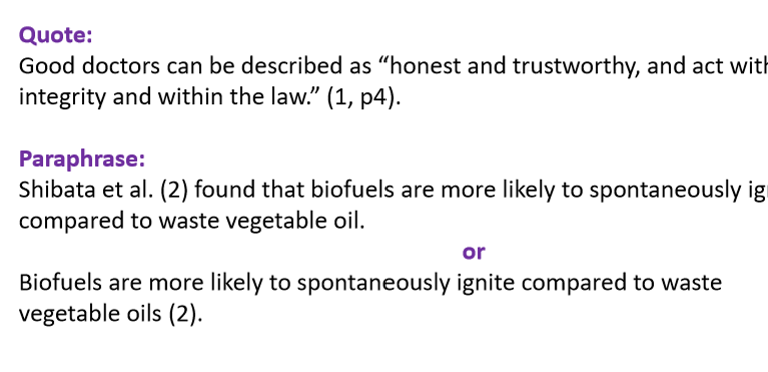
Quoting
Paraphrasing
Summarising
Synthesizing
In-text references (Citation)
Reference list at the end
What is quoting?
Using direct words found in the source, not common in scientific writing
What is paraphrasing?
Using your own words to express a relevant point from the source
What is summarising?
Condensing information you have read into a concise account of the main point
What is synthesising?
Bringing together information from multiple sources to make a point in a written assignment
Harvard referencing
Author-date style of referencing
date of publication
reference list at the end of the assignment

Vancouver referencing
Numeric referencing style
each piece of text cited should have a unique number in order of their citation
The number assigned to its source
Numbers generally written in brackets
Reference list in numerical order
Referencing software
EndNote
Mendeley
Zotero
What is a notched markscheme?
Marks are only given at set values, for example 62, 65,68 and 72
What is the status of the marks you receive during the year?
They are provisional until the exam board meets in May or June