Chapter 24- Quantitative Genetics
 Call Kai
 Learn
 Practice Test
 Spaced Repetition
 Match
 Flashcards
 Knowt Play
1/74

There's no tags or description
Looks like no tags are added yet.
75 Terms
What is true for discontinuous traits?
qualitative; only possess a few phenotypes
What is true for continuous characteristics?
quantitative; vary along a scale of measurement with many overlapping phenotypes
What are examples of the difficulty to determine continuous or discontinuous traits?
Height in humans, milk and meat production in cattle, and yield in various crops
What is quantitative inheritance?
the genetics of traits with continuous variation that can be measured in quantitative terms
What are polygenic traits?
the phenotype is affected by multiple genes; referred to as polygenes
What are multifactorial traits?
quantitative traits; phenotypes result from both gene action and environmental influences
What is an example of multifactorial traits?
stunted growth; genes and not receiving enough calories as a child
What is the multiple-gene hypothesis?
multi-factor; many genes, individually behaving in Mendelian fashion, contribute to phenotype in a cumulative or quantitative way
What do phenotypic traits show?
a continuous variation and can be quantified by measuring, weighing, etc
What determines polygenic inheritance?
two or more loci show an additive effect on the expression of a phenotype
What is an additive allele?
they contribute to a single quantitative trait to produce substantial phenotypic variation
How is an additive allele demonstrated?
with a plus sign (A+, B+, C+, etc.)
What is a non-additive allele?
they do not contribute to produce phenotypic variation
How are non-additive alleles demonstrated?
with a minus sign (A-, B-, C-, etc.)
What is the idea of additive and non-additive alleles?
having more additive alleles leads to more gene doase
What is an example of gene dosage?
more additive alleles leads to more dosage, making a plant taller
What is true for quantitative characteristics?
each phenotype may produce a range of possible phenotypes
What are threshold characteristics?
the trait is either present or absent; quantitative because the underlying susceptibility to the characteristic varies continuously
What is true for quantitative loci?
the more genes involved in a trait, the larger the number of phenotypic classes
What is the equation to calculate the ratio of F2 individuals expressing either extreme phenotype?
1/4^n; n= the number of polygenes
What can be done when there is a low number of polygenes?
the number of additive loci can also be estimated from the total number of possible phenotypes
What can determine the number of distinct categories observed when quantifying loci?
(2n+1)
What is required for analyzing quantitiative characteristics?
statistical methods
What are looked at when using statistical methods to analyze quantitative genetics?
Distribution, samples and populations
What is the frequency distribution?
a graph that displays the number or proportion of different phenotypes
What does "normal" distribution look like?
a symmetrical or bell-shaped curve
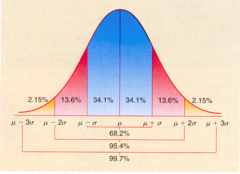
What is the population in stats?
the groups of interested individuals
What is the sample in stats?
a small collection of individuals from the population
What is true for a typical frequency distribution?
they are normally not bell-shaped and are typically skewed one way or the other; can also have two separate peeks
What is the mean?
the average of a set of measurements; provides information of where central point lies along the range of measurements for a quantitative trait
What is variance?
the average squared distance of all measurements from mean; provides information about spread of data around the mean
What is standard deviation?
the square root of variancel more than 95% of all values are found within two standard deviations to either side of the mean
What is the equation for standard deviation?

What is the standard error of the mean?
describes errors between means determines for multiple samples of the same group; values are always smaller than standard deviation
What does the standard error of the mean account for?
the sample size
What is the equation for standard error of the mean?

What is covariance?
COVxy; measures how much variation is common to two quantitative traits
What is the correlation coefficient?
r; standardizes covariance; indicates if two traits both increase or decrease together (r is positive) or if one increases as the other decreases (r is negative)
What is regression?
predicting the value of one variable, if the value of the other is given
What is the regression coefficient?
represents the slope of the regression line which is indicating how much one value changes on average per increase in the value of another variable
What does heritability describe?
the proportion of total phenotypic variation in population due to genetic factors
What is high heritability?
most variation attributed to genetic factors
What is low heritability?
most variation attributed to environmental factors
What does heritability not indicate?
how much of the trait is genetically determined or the extent to which an individual's phenotype is due to its genotype
How must heritability be measured?
at the population level (not individually)
What is the heritability estimate?
gives the proportion of phenotypic variation attributed to genetic variation within a certain population in a particular environment
What is an example of heritability?
the mean for human height is about 0.65; means 65% of overall variation in height is due to genotypic difference in individuals in 1 population
What is true for heritability estimates?
they can vary from population to population
How are heritability estimates determined?
both experimental and statistical techniques
How is phenotypic variance divided?
between two components; genotypic variance (VG) and environmental variance (VE)
What is genotype-by-environment interaction variance?
differences in yield between two wheat varieties at different soil fertility levels
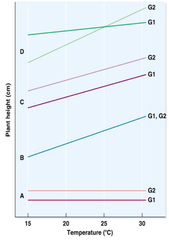
What is broad sense heritability?
H2; measures contribution of genotypic variance to total phenotypic variance
What is the equation for broad sense heritability?
H2=Vg/Vp
what does the genotypic variance component include?
all types of genetic variation in a population
What do broad sense heritability estimates assume?
that the genotype-by-environment variance component is negligible
What is narrow-sense heritability?
h2; proportion of phenotypic variance due to additive genotypic variance alone
What is the equation for narrow-sense heritability?
h2=Va/Vp
What are the subcomponents that genotypic variance can be divided into?
Additive variance, Dominance variance, and Interactive variance
What is additive variance?
genotypic variance due to the additive action of alleles at quantitative trait loci
What is dominance variance?
deviation from additive components that results when phenotypic expression in heterozygotes is not precise; incomplete dominance or codominance
What is interactive variance?
deviation from additive components that occurs when two or more loci behave epistatically (how one gene can affect another)
What are the limitations of heritability?
- does not indicate the degree to which a characteristic is genetically determined
- an individual does not have heritability
- there is no universal heritability for a characteristic
- even when heritability is high environmental factors may influence a characteristic
- indicates nothing about the nature of population difference in a characteristic
What is artificial selection?
humans choosing individuals with preferred phenotypes from initially heterogenous populations for future breeding
What is the purpose of artificial selection?
to develop a population with a high frequency of individuals with desired traits
What are artificial trait selections?
traits being selected for a monogenic (rapid) or polygenic/multifactorial (slower and more complex)
What are the traits of economic importance in crops and livestock?
- grain yield in plants
- weight gain or milk yield in cattle
- speed or stamina in horses
What is realized heritability?
selective breeding estimates potential success for artificial selection
What is an example of realized heritability?
artificial selection for increased oil content in corn; diminishing returns
What is true for quantitative traits?
they are of economic or medical relevance; plant or livestock
What do polygenically controlled complex traits make difficult?
-identify all genes involved
- determine the affect of each gene on phenotype
What are quantitative trait loci studies?
QTL; a locus that contains a gene or genes contributing to quantitative trait
- are mapped by finding associations between DNA markers and phenotypes
- not causative; located near things that are (linked)
What is the QTL study for the ORFX gene?
mapping and characterizing quantitative traits in tomato, including fruit shape and weight
- identified more than 28 QTLs
- specific gene (ORFX) responsible for about 30% of variation in fruit weight
- ORFX gene isolated, cloned, and transferred between plants to confirm its role in the phenotype
What is true for the ORFX gene?
can not account for all observed variations in tomato size
- two other QTLs; lc and fas
- indicates that artificial selection for size increased the number of seen compartments
What are Expression quantitative trait loci (eQTL)?
genetic loci that explain variation in expression levels of mRNAs
- important toot in identifying genes that cause complex diseases; Type 2 diabetes, Asthma, Coronary artery disease
What are genome-wide association studies?
GWAS; involve scanning markers across the genomes of many individuals to find genetic variations associated with a particular trait or disease
- two or more groups are contrasted; people with and without a disease