populations genetics and hardy-Weinberg equilibrium
 Call Kai
 Learn
Learn Practice Test
 Spaced Repetition
 Match
Match Flashcards
 Knowt Play
1/22

There's no tags or description
Looks like no tags are added yet.
Name | Mastery | Learn | Test | Matching | Spaced | Call with Kai | Chat |
|---|
No analytics yet
Send a link to your students to track their progress
23 Terms
populations
- a group of individuals of a particular species occupying a definite space in which the individuals interact, interbreed, and exchange genetic materials
- shares a common gene pool
- is the smallest unit that can evolve—in other words, an inidividual can't evolve.

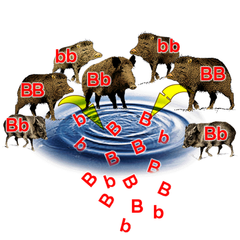
the gene pool
- species in a population have a shared?
- all of the alleles of all individuals in a population
mutation
genetic drift
selection
gene flow
non-random mating
(5) types/agents of evolutionary change
mutation
- creates variation
- changes DNA sequence, changes amino acid sequence, and changes proteins
- Small ____ creep into populations over time. Some are helpful, some harmful, and many are neutral but may be beneficial or harmful later.
- increase genetic variation in a population.

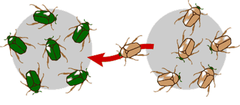
gene flow
- Some individuals from a population of brown beetles may have joined a population of green beetles. What would make the genes for brown beetles more frequent in the green beetle population?
bottleneck effect
- when a large population is drastically reduced by a disaster and lowers variation.
- also narrows the gene pool.

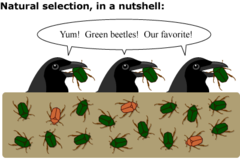
natural selection
- survival & reproduction due to changing environmental conditions.
Hardy-Weinberg equilibrium
- "A fundamental principle in population genetics stating that the genotype frequencies and gene frequencies of a large, randomly mating population remain constant provided immigration, mutation, and selection do not take place." American Heritage Dictionary
- usually results in evolution
- Godfrey Harold Hardy (1877-1947)
- Wilhelm Weinberg (1862-1937)

No Selection
No Mutation
No Migration
Large Population
Random Mating
(5) ASSUMPTIONS OF HARDY-WEINBERG EQUILIBRIUM
No natural selection
- if some individuals survive and reproduce at a higher rate than others, then their offspring will carry those genes and the frequency will change for the next generation.
No migration
- Immigrants can change the frequency of an allele by bringing in new alleles to a population.
No mutations
- if alleles change from one to another, this will change the frequency of those alleles
Large population size
- small populations have fluctuations in allele frequencies (e.g., fire, storm).
POPULATION GENETICS
The study of the rules governing the maintenance and transmission of genetic variation in natural populations.
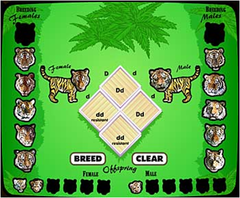
Random mating
- if certain traits are more desirable, then individuals with those traits will be selected and this will not allow for random mixing of alleles.

1.0 = p + q
Determining the Allele Frequency using Hardy-Weinberg:
p
= Frequency of “A” allele
q
frequency of “a” allele
p
is the frequency of the dominant allele.
q
is the frequency of the recessive allele.
p²
is the frequency of individuals with the homozygous dominant genotype.
2pq
is the frequency of individuals with the heterozygous genotype.
q²
is the frequency of individuals with the homozygous recessive genotype.