5.0 reliability
 Call Kai
 Learn
 Practice Test
 Spaced Repetition
 Match
 Flashcards
 Knowt Play
1/53

There's no tags or description
Looks like no tags are added yet.
54 Terms
Every measurement is confunded
by error
Error can be due to
Transitory effects
Specificity effects
Random effects
Transitory effects
caused by personal or situational effects that change from trail to trail (from measure to measure).
effects the performance of the whole session - makes u feel underperformed
Specificity effects
caused by the content of the ítems.
Random effects
other than transitory & specificity
They cannot be attributed to either to personal, situational (trial) or specificity factors
Error in measurement example
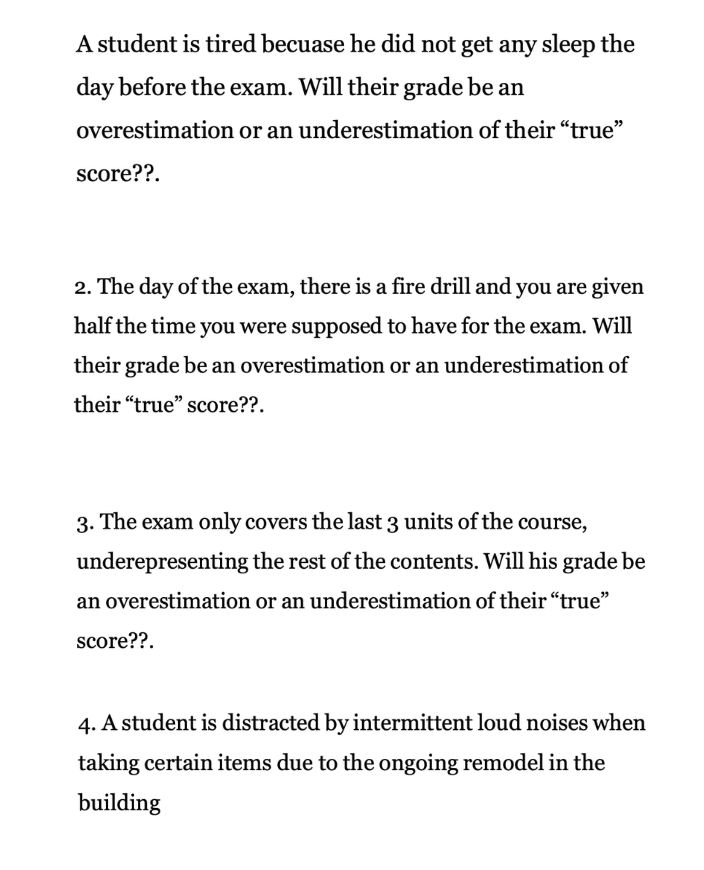
Because every measurement is subject to error
Observed score ≠ True score
Observed score ≠ True score
We believe every that person has a true score, that is: a ‘true value’ for a given the attribute.
We need to figure out how much observed scoresdeviate from those true scores.
Classical Test Theory (CTT) attempts to do this.
A mathematical assumption is a
proposition believed to be truth that will help us guide our actions
What follows are the main assumptions of the CTT.
Scores follow a linear model:


is the
observed score of person i on test j
Xi,j= observed score of subject i on test j → considering different tests with the same lenght & contents specifications
forms or parallel forms

true score of subject i

error measurement for subject i on test j

unknown
Note that Ti does not have a j subscript because
the true score of a person is independent from the test form they are taking
ei, j relates to the
person & not the test
Some examples of sources of error when administering tests:
the test-take
the test
the application
From the test-taker
lack of motivation
lack of concentration
tiredness, impulsiveness
participant reactivity
From the test
poorly worded items
reverse-worded items
test length
From the application
unclear instructions
time of the day
uncomfortable exam room
CTT does not differentiate between different sources of error:
X i , j = Ti + ei,j

Ti = E (X i,j )
The true score (Ti) equals the expected value of the observed score (Xi , j )

If we were to test person i
an infinite number of times to assess her true level on a trait
the sum of all her observed scores added together would be equal to the true score (= true value on that trait).
If we were to test person i an infinite amount of times to assess her true level on a trait, the sum of all her observed scores added together would be equal to the true score (= true value on that trait). → WHY??
Because we expect that random error will sometimes make a person’s score higher than it is, while other times it will make it lower than it is
We expect that all errors added together, in the long run, will cancel each other out.
The expected value of the errors is equal to zero

CTT formula
X = T + E

0
Given that the errors from a form are not systematic (so are random)
they are independent from the True score


0

the errors from a form are independent from the errors from a different form

those errors are independent from the true score of a different test (other construct).

validity vs reliability
poor validity
good reliability

validity vs reliability
poor reliability
poor validity

validity vs reliability
good reliability
good validity
Reliability definition
consistency of scores of a test
to the extent to which the measure yields the same value (or score) when we measure the same subject repeatedly.
is the ability to reproduce a measure consistently
If we could remove all sources of error
we would have perfect reliability
To calculate reliability
we need to choose a procedure to compare scores
Depending on which scores we choose to compare, we will talk about different types of reliability:
Parallel or alternate forms reliability
Test-retest reliability
Inter-rater reliability
Internal consistency
parallel or alternate forms → how it works
We build two parallel (or alternate) forms of the same test, we administer to a sample and then we calculate the correlation between the scores.
If correlation is high, we conclude that both tests are measuring the same thing
Parallel tests are
test that are similar in content
that cover the same range and level of difficulty in the items
We assume that both tests (parallel tests) are measuring
the trait that we intend to measure
In practice → parallel tests (we do)
We don’t create alternate forms of a test just to check for reliability.
We usually create them because we want several forms of the same test.
Example: Parallel or alternate forms

Test-retest reliability → how it works
We test the same group of people twice, allowing some time to go by between the first and the second application of the test
The correlation between the scores of both administrations indicate how stable the measure is in time
Test-retest reliability → The psychological trait (or ability) that we are measuring has to be
stable in time
Test-retest reliability → The interval of time between first & second application needs to be
long enough so subjects don’t remember what they answered in the first application
Test-retest reliability → it is important to control for
learning effects
practice
variance due to personal situation of the subject
Example: Test-retest

Inter-rater reliability → how it works
when using a measure that depends on the judgment of experts (for instance constructed response or neuropsychological scales with tasks)
we assess reliability by the degree of agreement amongst raters
Inter-rater reliability → differences in ratings are to be
expected
as there will be more strict or more lenient raters
we still need a certain degree of agreement to consider the measurement reliable
Inter-rater reliability → If we are dealing with nominal or ordinal data
we need to introduce a new coefficient to assess agreement → Cohen’s kappa.
Inter-rater reliability → For ratio or interval type data
we can still use Pearson’s correlation to calculate the strength of the relationship among raters.
Example: Inter-rater reliability
