Week 3 - RF Lecture Developmental - Brain Development during Adolescence
 Call Kai
 Learn
 Practice Test
 Spaced Repetition
 Match
 Flashcards
 Knowt Play
1/22

Earn XP
Description and Tags
23 Terms
What is Adolescence?
the transition between childhood + adulthood
begins with puberty, typically ages of 10-14
traditionally, was considered to end around 18-21
Sawyer et al (2018) = proposed extending it to 24
involves physical, psychological + social changes
HPG Axis (hypothalamic-pituitary-gondadal)
regulates hormonal changes that initiate puberty + reproductive maturation
Three Main Components:
hypothalamus = signals the pituitary gland
pituitary gland = releases hormones that stimulate the gonads
gonads (ovaries/testes) = produce sex hormones involved in puberty
Physical + Psychological Changes/Development
physical = increases in height, weight, muscle mass, organ development
psychological = identity development, new relationships, greater responsibility
Brain Development = Synaptogenesis
the formation of new synaptic connections between neurons

Brain Development = Synaptic Pruning
the elimination of less frequently used synaptic connections, while frequently used connections are strengthened
= early in development, the brain produces many connections - not all are needed
= during pruning, connections that are used regularly are maintained or strengthened. Less- used connections are removed
= helps refine brain networks during development

Myelination
Myelin = a protective, insulating sheath surrounding axons
myelination continues during adolescence
increases the speed of electrical signal conduction along axons
= axon is like an electrical wire - myelin is the insulation, allowing electrical signals to travel more quickly and efficiently
brain becomes more myelinated = communication between brain regions becomes faster

Grey Matter
contains neural cell bodies and many synapses
generally decreases in certain regions during adolescence
changes are linked to synaptic reorganisation and pruning
= grey matter reaches a peak around the onset of puberty in some regions, then decreases - linked to synaptogenesis followed by pruning

White Matter
contains mainly myelinated axons
generally increases during adolescence
increase are linked to myelination = axons becoming more myelinated
changes are particularly significant in the frontal and parietal regions

Giedd et al. (1999) - MRI Research
research focus = how brain structure changes during childhood + adolescence
method = longitudinal MRI
Key findings:
white matter increased with development
grey matter showed a non-linear developmental pattern, including a peak around puberty in certain regions
important structural changes occurred in frontal + parietal regions
= helped demonstrate that substantial brain maturation continues beyond early childhood
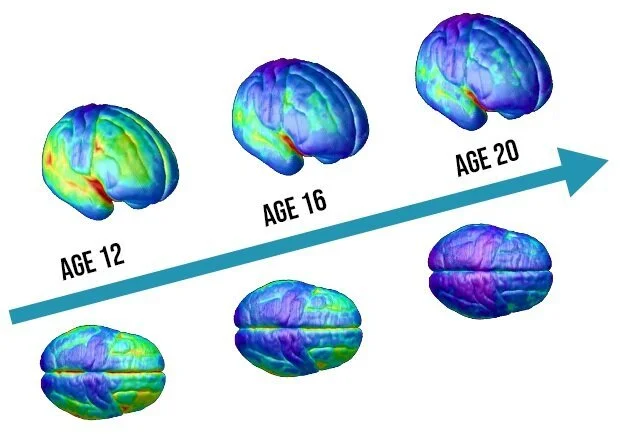
Gogtay et al. (2004) - Brain Maturation
Research Method = longitudinal study, 13 ppts aged 5-20, anatomical brain scans approx every 2 years
Key Findings:
different brain regions mature at different rates
regions involved in spatial perception mature relatively early
frontal regions associated with planning + critical thinking continue developing into the early 20s
temporal regions associated with learning + memory are among the later regions to mature
= brain doesn’t develop everywhere at the same time
= helps explain why adolescent cognitive abilities develop gradually
Cognitive & Social Development - Cognitive Control
= the ability to regulate thoughts + behaviour to achieve goals
Three Main Components:
inhibitory control = resisting impulses
working memory = holding + manipulating information temporarily
performance monitoring = detecting errors + evaluating behaviour
Risk-Taking in Adolescents
developing cognitive control and heightened sensitivity to immediate and social rewards
The Social Brain
= a network of brain regions involved in understanding social information
Theory of Mind (mentalising)
= the ability to understand + interpret our own and other’s mental states and intentions
eg - your friend is quieter than usual, so you think maybe they are sad, angry…= thinking about their possible mental state
Blakemore (2008)
research comparing adolescents + adults during theory-of-mind tasks
= adolescents showed greater activation in the dorsomedial prefrontal cortex than adults (dMPFC)
Brunett et al. (2009)
Examined emotional aspects of theory of mind, including fear and anger:
adolescents showed greater dMPFC activation than adults when processing social versus basic emotions
adults showed greater anterior temporal cortex activation than adolescents in the same comparison
= shows that both are capable of understanding social situations, but they can recruit brain regions differently

Van den Bos et al. (2010) - Trust and Reciprocity
Research Focus = how trust and reciprocity develop with age
trust = willingness to rely on another person
reciprocity = responding to another person’s actions (eg, returning cooperation)
Key findings:
trust + reciprocity generally increased with age when the ppt faced less risk
also increased when the other player would benefit more = only among 22 year olds
Puberty + Mental Health - Angold & Costello (2006)
before puberty = depression rates are relatively low and similar in girls and boys
after puberty = adolescent girls are approx twice as likely to experience depression
Puberty + Mental Health - Galvao et al. (2014)
earlier puberty compared with peers is associated with increased depressive symptoms + anxiety, particularly among girls
Puberty + Mental Health - Miranda-Mendizabal et al. (2019)
adolescent boys are more likely than girls to develop substance abuse use disorders and to die by suicide
Social Media + Adolescent Mental health
adolescents are particularly sensitive to peer feedback
some studies suggest associations between social media use, depressive symptoms + suicide-related outcomes
HOWEVER - research findings are mixed
many studies are correlational
correlational studies cannot prove social media causes depression = cannot establish causality, direction of effect or rule out third variables
Achterberg et al. (2022) - Social Media + Brain Development
RF = longitudinal associations between social media, mental well-being + structural brain development
Findings:
greater social media use was associated with small differences in brain regions involved in social cognition + self-control
lower mental well-being was associated with slightly smaller surface areas in regions involved in emotion + social understanding
there was no clear, consistent association between social media use + mental health
= challenges the oversimplified claim that social media is necessarily harmful to adolescent mental health
Protective Factors for Adolescent Mental Health
physical activity = Belcher et al - exercise may promote resilience + emotional regulation
sleep = Galvan - poor sleep is associated with poorer memory, processing speed + executive function
diet = O’Neil et al - better quality diets are associated with better mental health
social support = Van Harmelen et al - Family + friendships can buffer the relationship between childhood adversity + later depression