Level of organization of cells
 Call Kai
 Learn
Learn Practice Test
 Spaced Repetition
 Match
Match Flashcards
 Knowt Play
1/123

There's no tags or description
Looks like no tags are added yet.
Name | Mastery | Learn | Test | Matching | Spaced | Call with Kai | Chat |
|---|
No analytics yet
Send a link to your students to track their progress
124 Terms
Atoms
Building blocks of cells
Cells
Building block of tissue
cytology
Study of cells
Sex Cells
sperm cells in males, oocyte cells in females.
Somatic cells
all other cells in the body.
What is the Cell is surrounded by
“watery medium” (Extracellular fluid (ECF))
Cytoplasm is made up of
cytosol (liquid/ICF)
organelles (little organs) - intracellular structures
Cell Membrane functions
Physical isolation
Sensitivity
Regulates exchange with environment
Structural support
Phospholipid Bilayer
Two layers of phospholipids with two hydrophobic tails and a hydrophilic head. Tails bind together away from H2O.
Where can H2O and Solutes pass through?
gates or pores
Integral proteins
span the membrane (transmembrane) one or more times.
Peripheral proteins
proteins attached only on inside or outside surface. Not inserted into the membrane.
Anchoring Proteins (stabilizers)
anchors membrane to the cytoskeleton (inside), anchors cell to another cell (outside).
Recognition proteins (recognizers)
immune cells use proteins on outside of membrane to identify “normal” or “abnormal” cells.
Enzymes
these catalyze reactions in (ECF) outside or inside (cytosol).
Reception proteins
molecules called ligands, come into contract with these reception proteins which triggers changes in the cells.
insulin (ligand)
binds to a receptor which causes cell to increase absorption of glucose.
Carrier proteins
binds solutes (ions such as sodium, calcium) and carries them across the membrane. These motions require ATP (energy sources) to carry/transport ions.
Channels
some integral proteins (transmembrane) form a passage through the membrane which allows H2O and small ions to pass
Leak channels
allow H2O and ions to pass at all times (rate may vary) No gates.
Lubrication
lubricates and protects cell membrane from physical and chemical injury.
Anchoring and locomotion
anchors some cells to form tissue, allows others to move.
Specificity in binding
glycoproteins and glycolipids can act as receptors.
Recognition
Enables the immune system to recognize and attack foreign antigens. Allows immune system cells to determine “friend” from “foe”.
Determines compatability
for blood transfusions and organ transplants.
Blood types
A, B, AB, O
What is Blood Type is determined by
presence/absence of glycolipids on “red blood cells”
Impermeable Permeability
nothing passes through the membrane.
Freely permeable membrane
everything passes through the membrane.
Selectively permeable membrane
Cell determines what will pass through the membrane.
What is Membrane transport is classified by
Energy Utilization or Mechanism of action (Passive or Active Transport).
Passive Transport
No energy is used as molecule is transported across membrane.
Active Transport
Energy is required to transport molecule across membrane.
Diffusion
Passive, molecules/ions in solution tend to become evenly distributed by floating around bumping into each other with random movement, this causes molecules/ions to become evenly distributed in a container (body).
Osmosis
the “diffusion” of H2O through protein leak channels across a membrane.
Where will H2O always move?
toward the area with the greatest salt/carbohydrate/solute concentration.
Tonicity
various osmotic solutions have an affect on cells; used to describe the solute in the outside (ECF) solution.
hypotonic solution
If solution outside cell (ECF) has lower concentration as inside of cell, then H2O will go/move from outside to inside. cell expands, may burst “hemolysis”
Isotonic solution
If solution outside cell (ECF) has same “solute” concentration as inside of cell, then no movement of water. No change
hypertonic” “solution
If solution outside cell (ECF) has higher concentration as inside of cell, then H2O will move from inside to outside. cell shrivels, dehydrates “crenation”
cotransport
can carry two substances/molecules at same time into or out of cell
countertransport
carries one substance in while carrying another substance out of the cell
three specific types of CMT (Carrier Mediated Transport)
Facilitated Diffusion
Primary Active Transport
Secondary Active Transpor
Facilitated diffusion
passive (no energy) ion/compound binds to a receptor which moves it from higher concentration to lower

Active Transport (Primary Active Transport)
ATP is directly used to transport molecules across cell membrane, so this is NOT dependent on concentration.
Secondary Active Transport
Tno INITIAL direct coupling of ATP. One molecule(s) goes from high concentration to low concentration; however later in order to maintain homeostasis the cell may have to expend some ATP to remove excess molecules from inside.
Vesicular Transport
materials are moved in/out of cell by “vesicles”, which are small membranous sacs that “form” or fuse with cell membrane. Large volumes are carried out this way so also called “bulk transport”.
Endocytosis
molecules are transported into the cell, receptor mediated endocytosis,pinocytosis, phagocytosis
Exocytosis
waste/molecules are transported out of cell; opposite of endocytosis
receptor mediated endocytosis
ligands (molecules) bind to receptors on outside of the cell membrane sending a signal to the cell.

pinocytosis
“cell drinking”; a groove forms on the cell membrane allowing ECF to be trapped into a vesicle.

phagocytosis
“cell eating”; A solid object (bacteria, toxin) is encountered by the cell membrane.
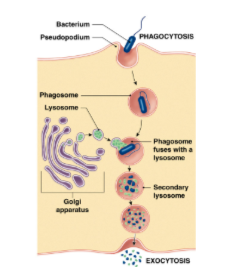
Non-membranous organelles
don’t have a membrane; thus they are always in touch with cytosol. Examples: cytoskeleton, microvilli, centrioles, cilia, ribosomes

Membranous organelles
organelles surrounded by lipid membrane.
Examples: ER, golgi, lysosomes, mitochondria.

Cytoplasm
comprised of:
Cytosol (fluid) and
Organelles that cytosol surrounds.
Cytoskeleton
internal protein framework; Comprised of:
1.Microfilaments
2. Intermediate fibers
3. Thick filaments
4. Microtubules
5. Centrioles
6. Cilia

Microfilaments
(less than 6 nm in diameter); most fragile of all filaments, primarily found in the peripheral parts of the cell; made up of actin which can interact with myosin to produce movement.
Microfilament Functions:
a. Anchors cytoskeleton to cell membrane
b. Provides strength
c. Alters cell shape
d. Ties cells together
e. Produces movement; actin interacts with myosin
f. Forms terminal web which is a layer of microfilaments just inside of
plasma membrane that forms a layer or lining
Intermediate filament
(7 nm to 11 nm in diameter); collagen is an example of this filament
Intermediate filament functions
a. Provides strength to maintain cell shape
b. Stabilizes the position of organelles
c. Stabilizes cell with respect to other cells.
d. Moves materials throughout cytoplasm
Microtubules
(25 nm in diameter); largest of the filaments that make up cytoskeleton; made up of protein tubulin
Microtubules functions
a. Primary component of cytoskeleton
b. Important in cell division
c. Provides strength
d. Moves organelles
e. Found in centrioles and cilia
Centrioles
made up of short microtubules, 9 + 0 array; means 9 groups, with 3 in each group (triplets) (total 27); no center group
Cilia
made up of microtubules; 9 + 2 array; means it has 9 groups, with 2 microtubules (doublets) in each group (total 18); the groups surround 2 in center;
Thick filaments
only appear in muscle (smooth, cardiac and skeletal); allow the muscle to contract
Microvilli
small finger like projections that increase surface area; allow for absorption and secretion to occur; provides approximately 600 times the amount of surface area over other cells.
Flagella
like cilia but larger; moves the cell around like a propeller on a boat; only found on the sperm in the human body.
Ribosomes
organelles that manufacture proteins;
-consists of large and small ribosomal subunit
-contains rRNA
-can be free floating or fixed in place

Proteasome
removes and breaks down damaged or abnormally folded proteins;
-proteins to be destroyed are marked/tagged with ubiquitin tag and are exposed to proteases which break peptide bonds.
Endoplasmic Reticulum
synthesizes protein, carbohydrates and lipids
- stores synthesized molecules
- transports molecules from place to place
- detoxification of drugs and toxins
- forms hollow chambers called cisternae
-folds proteins into their proper shape which are then transferred to the golgi for modifications

Smooth ER (SER)
Does NOT have ribosomes;
Makes cholesterol, steroid sex hormones
Rough ER (RER)
-HAS ribosomes
-this is where protein receives its secondary and tertiary structures then transports to the Golgi
-Moves proteins to golgi with transport vesicles
Golgi apparatus
has 5-6 flattened membranes that looks like stack of dinner plates called cisternae, lies close to nucleus, forms secretory vesicles
Transport vesicles
fuse with cell membrane of golgi’s forming face and release proteins into cisternae
Small vesicles
can move proteins from one cisternae to the next until it reaches the maturing face.
Lysosomes
contains digestive enzymes that will connect with membranes of vesicles and break down macromolecules of bacteria or own cell; responsible for autolysis of injured cells (breaks cells down)
Lipase
proteins which digests lipids
Carbohydrases
proteins which digests carbohydrates/sugars
Proteases
proteins which digests proteins
Nuclease
proteins which digests nucleic acids
Lysosome
may fuse with an organelle that’s old/damaged and enzymes break down organelle or with vesicle containing solid (bacteria) that needs to be destroyed.
Peroxisomes
smaller than lysosomescontain H2O2 hydrogen peroxide; carries enzymes that neutralize toxins by oxidation. Metabolizes fatty acids.
Mitochondria
power house of the cell; forms ATP (energy) contains matrix and cristae
Matrix
is fluid part of mitochondria

cristae
folds are in the inner membrane
TCA cycle - (tricarboxylic acid cycle)
Krebs or citric acid cycle. This cycle breaks down pyruvic acid in presence of oxygen (aerobic mechanism) to form ATP out of ADP.
Nucleus
largest most recognizable organelle inside the cell

nuclear envelope
a doubled layered membrane which separates the nucleus from cytoplasm.
perinuclear space
area between the doubled layered membrane
nuclear pores
are passageways in the envelope which allows communication w/ cytoplasm and allow ions to pass. Each nuclear pore has a regulatory protein that allow some proteins and RNA into or out of the nucleus.
Nucleoplasm
the fluid contents of nucleus.
Nuclear matrix
network of filaments that provides structural support.
Nucleoli
Organelle inside of nucleus which synthesizes mRNA; made of up:
RNA, proteins called histones and enzymes.
DNA
is coiled around small barrels called “histones”; DNA and the histones together are known as the nucleosome
chromatin
loosely coiled forming a tangle of fine filaments
kinetochore
is a protein structure where microtubules attach themselves to the chromosome
centromere
a region of DNA found in the middle of a chromosome where the two sister chromatids come in contact.
Nucleosomes
may be loosely coiled forming tangles called chromatin if cell is NOT ready to divied
chromosomes
Nucleosomes may be very tight or supercoiled if cell is ready to divide
gene
the portion/section of DNA needed to make one specific protein.