Intro to alcohol
 Call Kai
 Learn
 Practice Test
 Spaced Repetition
 Match
 Flashcards
 Knowt Play
1/40

There's no tags or description
Looks like no tags are added yet.
41 Terms
False

E
Its released before and after pleasurable experiences - the neurotransmitter itself does not create the pleasureable feeling.
Dopamine is the signal that says "that was rewarding, do it again.
What chemical group characterizes alcohol?
The hydroxyl (–OH) group. its called ethanol or ethyl alcohol
ABV (alcohol by volume)
The percentage of pure alcohol in a beverage. In Canada, any drink over 1.1% must list its % ABV.
Match each beverage to how it's made and its typical ABV
beer/ale, wine, liquor.
Beer/ale: brewed from grains, hops, yeast and water, 4–9%
Wine and fortified wine: fermented fruit, 12–15%
Liquor: fermentation and distillation of starch- or sugar-rich ingredients, 35–50%.
What extra step in making liquor explains its much higher ABV
Distillation. Beer and wine are only fermented.
Standard drink
A way to compare and standardize the alcohol content of different beverages. One standard drink is roughly 13.6 g of pure alcohol, or about 100–120 calories.
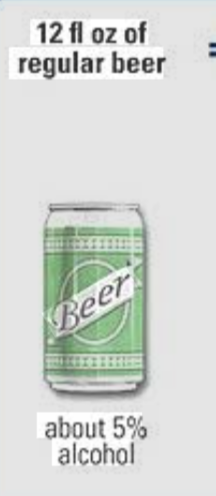
Standard beer
12 oz beer (~5%)
Standard Malt liquour

8 oz malt liquor (~7%)
stronger beer or lager
standard wine
5 oz wine (~12%),

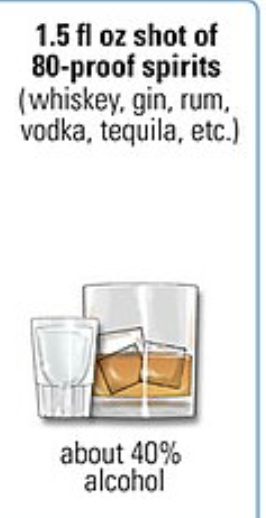
standrad distilled speriods.
1.5 oz distilled spirits (~40%).
Note: 1 oz ≈ 29.5 mL.
Why are beer, wine and liquor servings different sizes but all "one drink"?
They have different ABVs. Stronger drinks get a smaller volume so each contains the same ~13.6 g of alcohol.
Why is it hard to know how much alcohol and how many calories you're consuming?
(1) Drink sizes vary like some beers have longer spouts. (2) Alcohol has no Nutrition Facts label. (3) Cocktails mix several alcohols in one glass.
Absorption of alcohol
The rate at which alcohol enters the bloodstream. It's strongly linked to how "drunk" we feel.
BAC (blood alcohol concentration)
The ratio of alcohol in the blood by weight, measured as percent per decilitre (100 mL) of blood.
Example: BAC 0.08% = 80 mg of alcohol per 100 mL of blood.
What are the 3 categories of factors that affect alcohol absorption?
Drinking behaviour, what we drink, and our physiology.
Which drinking behaviours affect absorption?
How fast we drink, how much we drink, and what else we've eaten (especially carbohydrates) and when (before or during drinking).
How does eating carbs before or during drinking affect absorption?
It slows gastric (stomach) emptying, so alcohol is absorbed more slowly. All the alcohol is still absorbed eventually, just not as fast.
Why is a rum and Coke absorbed faster than straight rum?
Carbonation (and artificial sweeteners, as in Diet Coke) increase absorption.
Which physiological factors affect alcohol absorption?
Gastric emptying speed, body weight and composition, genetics, sex and race.
Oral mucosa
The lining of the mouth. A small amount of alcohol is absorbed here.
Where is alcohol absorbed, and what percentage at each site?
A small amount in the oral mucosa (mouth), 20% in the stomach, 75% in the small intestine, and the rest in the GI tract.
When is alcohol absorption the quickest?
On an empty stomach, when the alcohol concentration is 20–30%.
Why would straight liquor at 40%+ be absorbed slower than a 20–30% drink?
High concentrations irritate the stomach lining, which delays gastric emptying. Alcohol stays in the stomach longer instead of moving to the small intestine, where most absorption happens.
Two people drink the same amount, but one is much larger. Who has the lower BAC, and why?
The larger person. They have more tissue to spread the alcohol into, so it's less concentrated in the blood.
Two people weigh the same, but one has more body fat and the other more muscle. Who has the higher BAC, and why?
The person with more body fat. Muscle has more blood vessels (greater vasculature) and takes up alcohol, while fat is relatively insoluble to alcohol. With less tissue to distribute into, more alcohol stays in the blood.
Where does alcohol ultimately go once its in the bloodstream?
Its a toxin or poison so it eventually reaches the liver for breakdown. In the liver, 2 specialised enzymes break it down.
2 enyzmes in the liver breaking down alcohol and steps
Alcohol dehydrogenase (ADH) converts alcohol into acetaldehyde, a toxic and reactive compound.
ALDH (aldehyde dehydrogenase) then converts acetaldehyde into acetate
acetate travels out of the liver into other tissues, becoming carbon divide and water which are excreted.
How much alcohol can be metabolized at once?
Alcohol metabolism is FIXED. The body metabolizes a fixed rate of 0.15-0.20% BAC per hour, or one standard drink.
What's the difference between alcohol absorption and alcohol metabolism in terms of rate?
Absorption varies with food, carbonation, concentration and physiology, and has no limit, since all the alcohol you drink eventually gets absorbed. Metabolism is fixed at about 0.015–0.020% BAC/hour (roughly 1 standard drink per hour)
What are the 3 factors that affect alcohol metabolism?
chronic drinking
being female
being of a specific race
How does chronic drinking affect alcohol metabolism?
It boosts production of an enzyme that helps clear alcohol from the blood, so chronic drinkers need more alcohol to reach the same BAC.
What's the downside of chronic drinkers' boosted alcohol-clearing enzyme?
The process creates reactive oxygen species (ROS), which can damage liver cells.
Why do females often reach a higher BAC than males from the same amount of alcohol?
The stomach enzyme that helps break down alcohol is 4 times less active in females. Hormone fluctuations across the menstrual cycle can also increase absorption.
Being of a specifc race
30–50% of east asians have ineffective or absent ALDH and this limits the breakdown of acetaldehyde, which builds up and causes "Asian glow or flush" symptoms.
Myths about alcohol metabolism

Depressant
Alcohol is a depressant. It slows down brain and body functioning.
Until alcohol is metabolized, what does it do to the body?
It causes dysfunction in the parts of the body it's absorbed into.
DONT know this unless on other slides:
Brain: slower reactions, poor judgement, slurred speech, loss of coordination
Stomach: irritates the lining (like your note on the absorption slide)
Liver: has to work to break it down, and makes toxic acetaldehyde along the way
Describe the short-term effects of alcohol as BAC rises
Initially: light-headedness, relaxation, release of inhibitions.
Higher BAC: impaired motor coordination, judgement, alertness, emotional regulation, gait and speech.
Dangerous levels: unconsciousness, coma, respiratory arrest, death (acute alcohol poisoning).
At what BAC does accident and injury risk already increase
Even a BAC of 0.03%.
there is no safe level of alcohol
If alcohol metabolism is fixed, where does the danger of drinking come from?
The balance between consumption, absorption and metabolism. If you drink and absorb faster than your liver can clear (~1 drink/hour), BAC keeps rising.