Kines for exam 3 -Elbow and Forearm
 Call Kai
 Learn
 Practice Test
 Spaced Repetition
 Match
 Flashcards
 Knowt Play
1/77

Earn XP
Description and Tags
Elbow and Forearm
78 Terms
How many joints of the elbow? What are they?
2 joints; humeroradial and humeroulnar joints
How many joints of the forearm? What are they?
2; proximal and distal radio-ulnar joints (which do pronation and supination)
Tell me what joint of the elbow is? (i.e., ball&socket)
compound synovial joint (2 articulations)
humeroulnar- modified hinge
humeroradial- plane (gliding) joint
Axis of rotation of elbow
Oblique
Superior/lateral
medial to lateral: through trochlea → capitulum → lateral condyle
What is a capsular pattern of elbow joint?
Flexion > extension (more limited)
What muscles are important in the elbow joint capsule?
brachialis, triceps, anconeus (prevent pinching of capsule)
What are ligaments in elbow joint?
lateral (radial) collateral ligament
medial (ulnar) collateral ligament
Functions of elbow joint ligaments (3)
prevent valgus/varus movement
Restrain end ranges of flexion and extension
approximate articular surfaces
Anterior fiber’s functions of MCL
strongest and stiffest
resist valgus force
taught with extension (ant. components) & flexion (post. components)

Posterior fiber’s functions of MCL
resist valgus force
taut with extreme flexion

Transverse fibers’ function of MCL
limited articular stability

Which muscles are called dynamic stabilizers of MCL?
flexor carpi ulnaris (primary)
FDS and pronator teres
What position of MCL is happening maximal elbow extension?
closed-packed position
LCL’s primary fiber bundles(2)
radial collateral ligament
lateral collateral ligament
Function of radial collateral ligament (LCL)
taut with varus force
taut with extension
Function of lateral collateral ligament (LCL)
taut with varus force
taut with flexion
forms a sling to support radial head - prevents exessive ER of proximal forearm relative to humerus
How does cubital tunnel form?
humeroulnar joint and MCL
fibrous aponeurosis between two heads of FCU

What nerve does it contain in cubital tunnel?
ulnar nerve
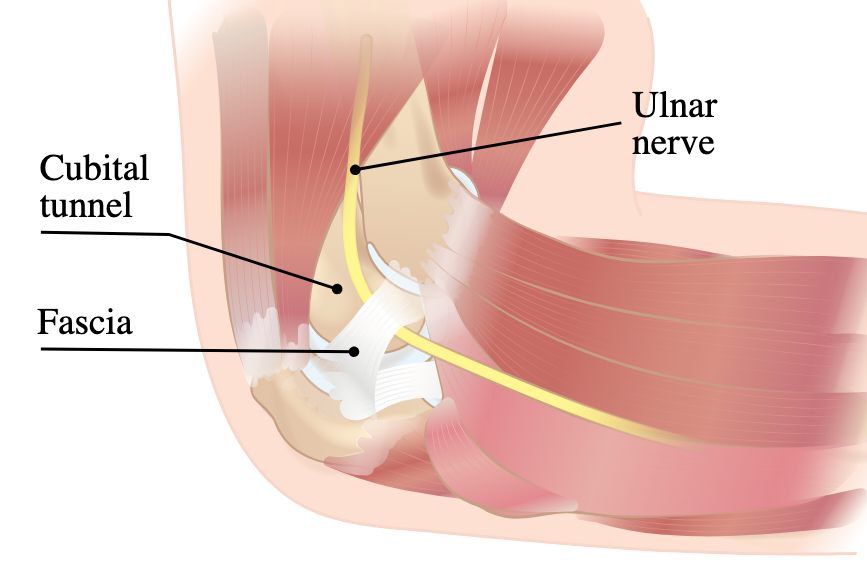
Why does cubital tunnel decrease in size with elbow flexion?
increase pressure on nerve, such as string musician
How to measure elbow joint?
cubital valgus (“carrying angle”)
in full extension -forearm valgus relative to humerus
What things cause by bony structure of the trochlea?
- trochlea is larger medially
- superior/ lateral axis
Normal cubital valgus
AMAB= 5 degrees, AFAB= 10-15 degrees
Excessive Valgus >20 degrees
Excessive Varus = varus position or >5 degree varus compared to other side

Elbow
Degrees of freedom:
Plane of motion:
Axis of motion:
Normal range of motion: (each motion)
Most functional activities:
Degrees of freedom: 1
Plane of motion: sagittal
Axis of motion: medial-lateral (oblique)
Normal range of motion: flexion 150 degrees; extension 0 degree
Most functional activities: between 30-130 flexion
Humeroulnar Joint Arthrokinematics
Concave trochlear notch of ulna; convex trochlea of humerus
Flexion of Humeroulnar Joint
anterior roll/ glide

Extension of Humeroulnar Joint
posterior roll/glide

Structures limiting extension of humeroulnar joint
anterior capsule, anterior MCL fibers, flexor muscles, bony approximation
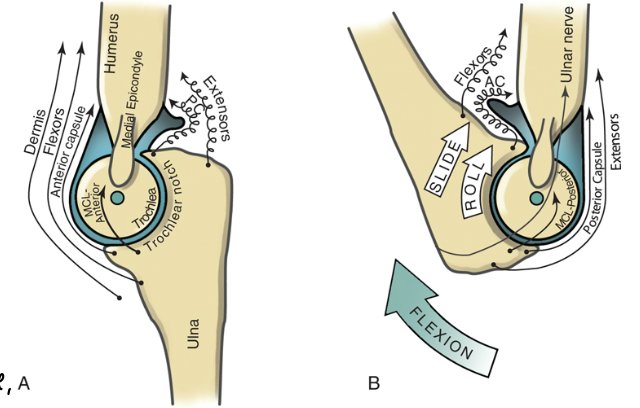
Structures limiting flexion of humeroulnar joint
posterior capsule, ulnar nerve, posterior MCL fibers, extensor muscles, soft tissue approximation

Arthrokinematics of Humeroradial Joint
Concave fovea of radius with convex capitulum of humerus
Flexion of humeroradial joint
anterior roll/glide
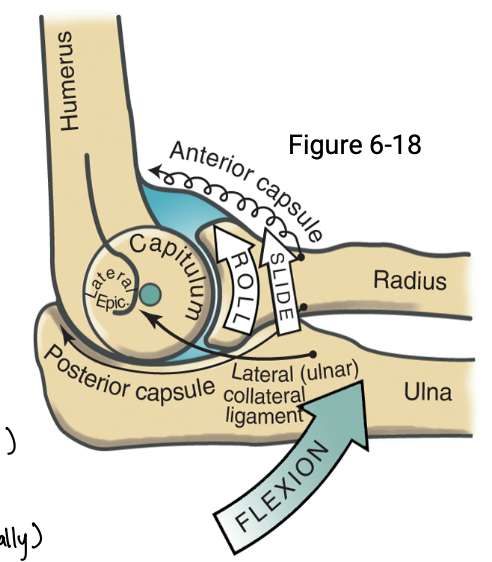
Extension of humeroradial joint
posterior roll/glide
Structures limiting extension of humeroradial joint
anterior capsule (minimally)
Structures limiting flexion of humeroradial joint
inferior LCL, posterior capsule (minimally)
Radioulnar Joint (forearm motion)
Degree of freedom:
Plane of motion:
Axis of rotation:
Normal range of motion:
Functional range of motion:
Degree of freedom: 1
Plane of motion: transverse
Axis of rotation: superior/inferior
Normal range of motion: supination and pronation =80 degrees
Functional range of motion: 50 degrees of pronation and supination
Arthrokinematics of Proximal Radioulnar Joint
Convex on concave (NWB) = spin
Function of Annular ligament (proximal radioulnar joint)
thick band of connective tissue
blends with capsule and LCL
holds radius against ulna
Function of Quarate ligament (proximal radioulnar joint)
below radial notch (ulna) to medial radial neck
stabilizes proximal radioulnar joint (extra help of radial head stability)
Function of Oblique cord (proximal radioulnar joint)
from radial notch to bicipital (radial) tuberosity
limits distal movement of radius
Arthrokinematics of distal radioulnar joint
Concave ulnar notch of radius and articular disc on convex head of ulna (NWB) - roll and slide
What ligament does distal radioulnar joint have?
dorsal and palmar radioulnar joint capsular ligaments
Function of distal radioulnar joint
Articular disc - part of the triangular fibrocartilage complex (TFCC)
Connects radius and ulna
provides dual articular surface:
proximally with ulnar head
distally with carpal bones
separates distal radioulnar joint from radiocarpal joint
For open chain supination, which bone is moving and which one stays still at least in the open chain?
radius
Arthrokinematics of Distal radioulnar joint for open chain supination?
concave radius on convex ulna
Arthrokinematics of Proximal radioulnar joint for open chain supination?
Spin of radial head in annular ligament
making Tight connection of radius to ulna = no roll/glide
For open chain pronation, which bone is moving and which one stays still at least in the open chain?
radius
Arthrokinematics of Distal radioulnar joint for open chain pronation?
concave radius on convex ulna
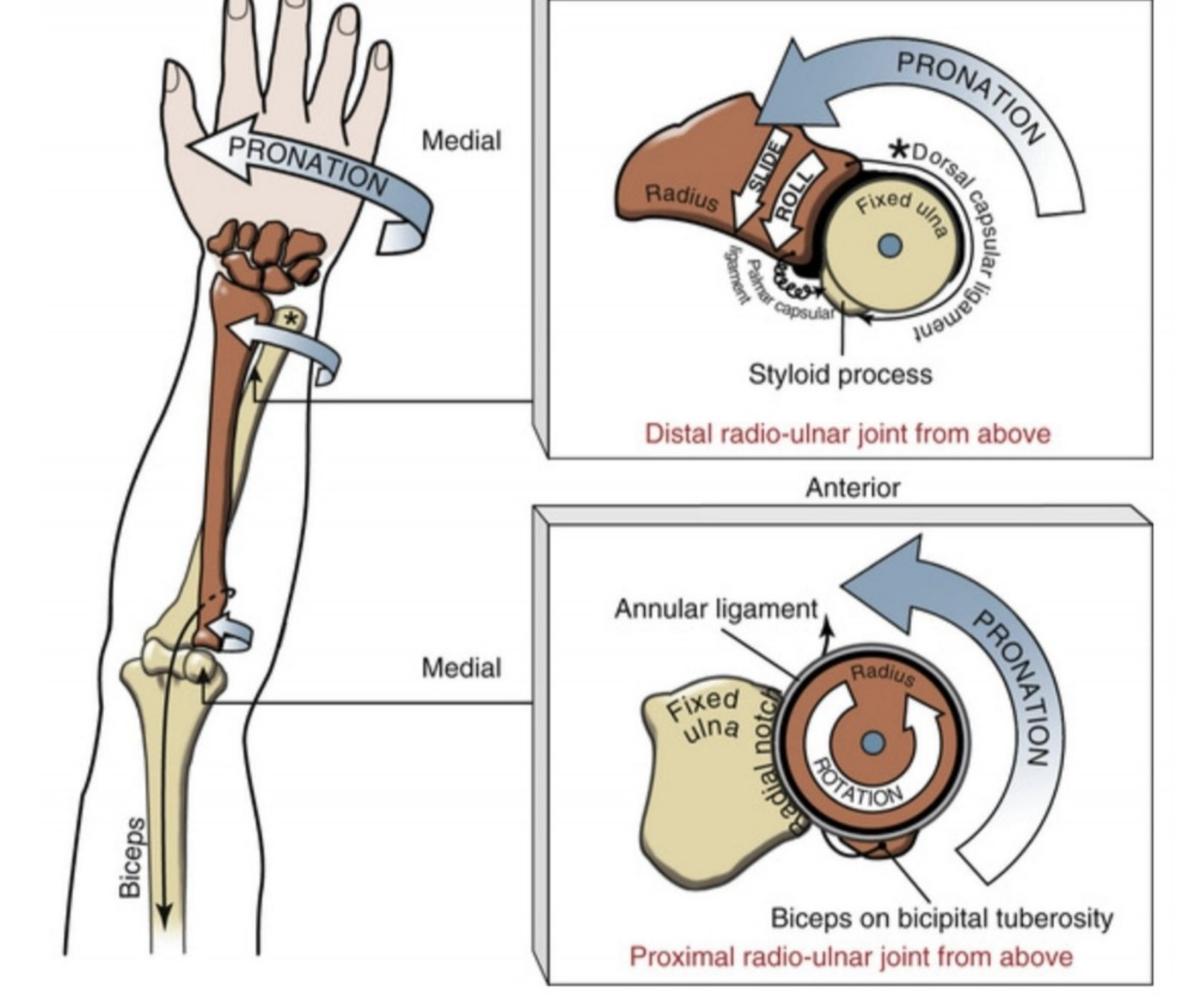
Arthrokinematics of Proximal radioulnar joint for open chain pronation?
spin of radial head in annular ligament
making Tight connection of radius to ulna = no roll/glide
For closed chain pronation, which bone is moving?
external rotation of humerus (shoulder) and ulna (is moving) in relation to radius
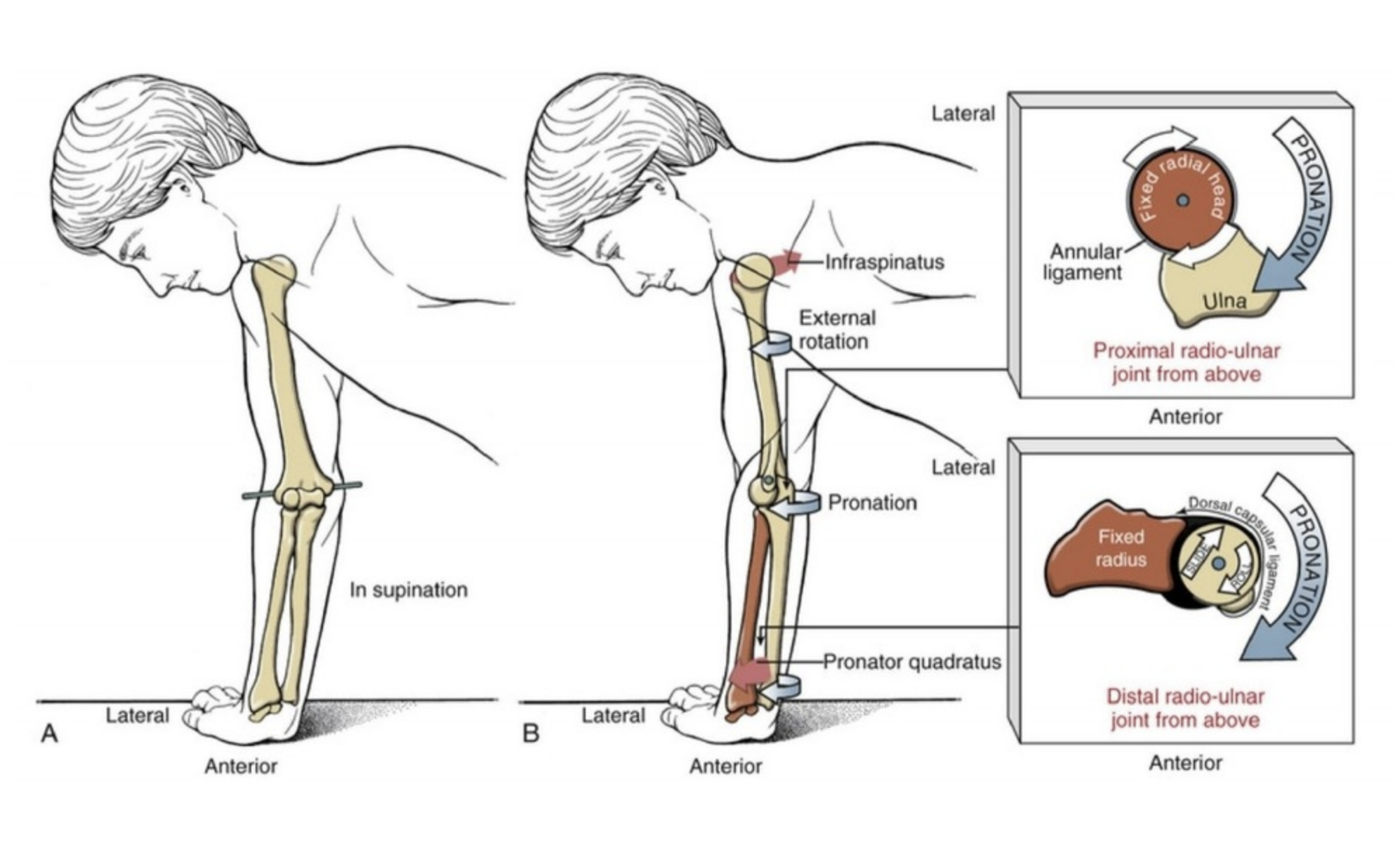
For closed chain supination, which bone is moving?
internal rotation of humerus (shoulder) and ulna (is moving) in relation to radius

For closed chain, proximal radioulnar joint would move what?
radial notch of ulna rotates around fixed radius
*For closed chain, distal radioulnar joint would move what?
convex head of ulna rolls and slides in opposite direction of the concave fixed ulnar notch of the radius

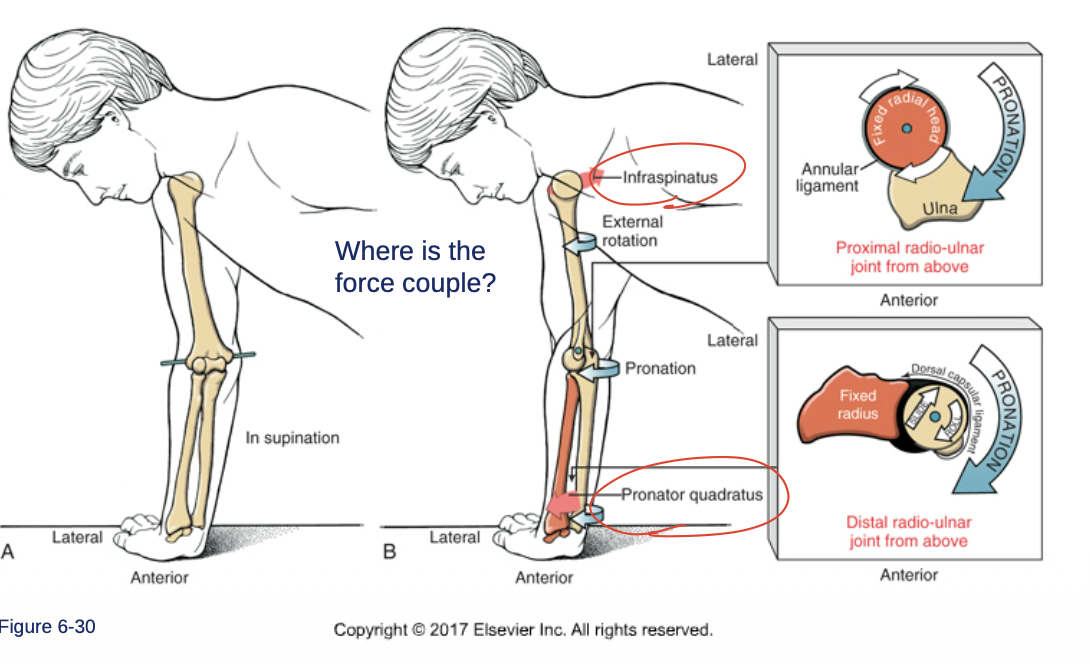
*For closed chain pronation, what muscles does work as a force-couple?
infraspinatus and pronator quadratus whether ER or pronation together to do
***What is Weight-Bearing compressive force?*** short-answer question
80% compressive force that crosses wrist is directed through the radiocarpal joint → radius
20% of force crosses medial side of wrist through the soft tissues in ulnocarpal space
Creates tension on interosseous membrane (runsvfrom radius to ulna in distal / medial direction) which transmits force from radius to ulna
Forces equalize at elbow between humeroulnar (HU) and humeroradial (HR) joints
Force transmitted to humerus -Allows sharing of joint compression forces between HR & HU joints.

***Non weight-bearing/ distraction*** short-answer question
distraction force through radius
slackens interosseous membrane
tension applied to: (not strong enough to resist distraction force)
oblique cord
annular ligament (radial head)
Brachioradialis must fire (dynamic stabilization)

Which nerve acts brachialis (flex) and biceps brachii (flexors and supinators)?
musculocutaneous (C5-C7)
Which nerve acts brachioradialis (elbow flexor), triceps and anconeus (elbow extensor), and supinator and EPL and EI (supinators)?
radial (C7-T1)
Which nerve acts pronator teres and pronator quadratus?
median (C6-T1)
What action of biceps brachii?
main elbow flexor + supinates and flex shoulder
Active insufficiency of biceps brachii
shoulder flexion, elbow flexion
action of brachialis
flex elbow with any forearm position
action of brachioradialis
flexes elbow with neutral forearm
supination and pronation to neutral
stabilizing muscle
What is the most important thing of Brachioradialis muscle?
increase activation with increase force requirements
What muscles mainly activates extension on elbow?
anconeus (initiates the motion) and triceps
Activation pattern of triceps
med → lat → long head
What is the Law of Parsimony?
1 joint muscles fire before 2 joint muscles
*Functional Task: Pushing Door Open*
Kinematics of the motion:
Activation of muscles:
Maintains length tension relationship of muscle:
Kinematics of the motion: shoulder flexion& elbow extension
Activation of muscles:
elbow extension
1st anconeus
2nd: triceps medial head → lateral head → long head (LH)
shoulder flexion
anterior deltoid: helps to flex shoulder and overcome extensor torque of LH
Maintains length tension relationship of muscle:
elbow extension: LH shortens
shoulder flexion: LH lengthens

Forearm supinators - bicep and supinator are primary muscles. What muscles are secondary of forearm supinator?
EPL, EL, Brachioradialis
What muscle of forearm supinator motion is the Law of Parsimony?
supinator
What is the position of maximal torque of forearm supinator?
90 degrees of ____
Functional Task - Turn a screw clockwise with the right hand
Kinematics: Forearm ___
Muscles Activation:
Kinematics: Forearm supination
Muscles Activation:
supinator (1st)
biceps (more power)
triceps and posterior deltoid (synergists)
fire to maintain shoulder and elbow position (resist flexion)

What muscles are the primary of forearm pronators?
pronator teres
activated during ALL pronation movements
stabilizes distal RU joint
pronator quadratus
activated during high-powered pronation
also elbow flexor
What muscles are the secondary of forearm pronator?
FCR
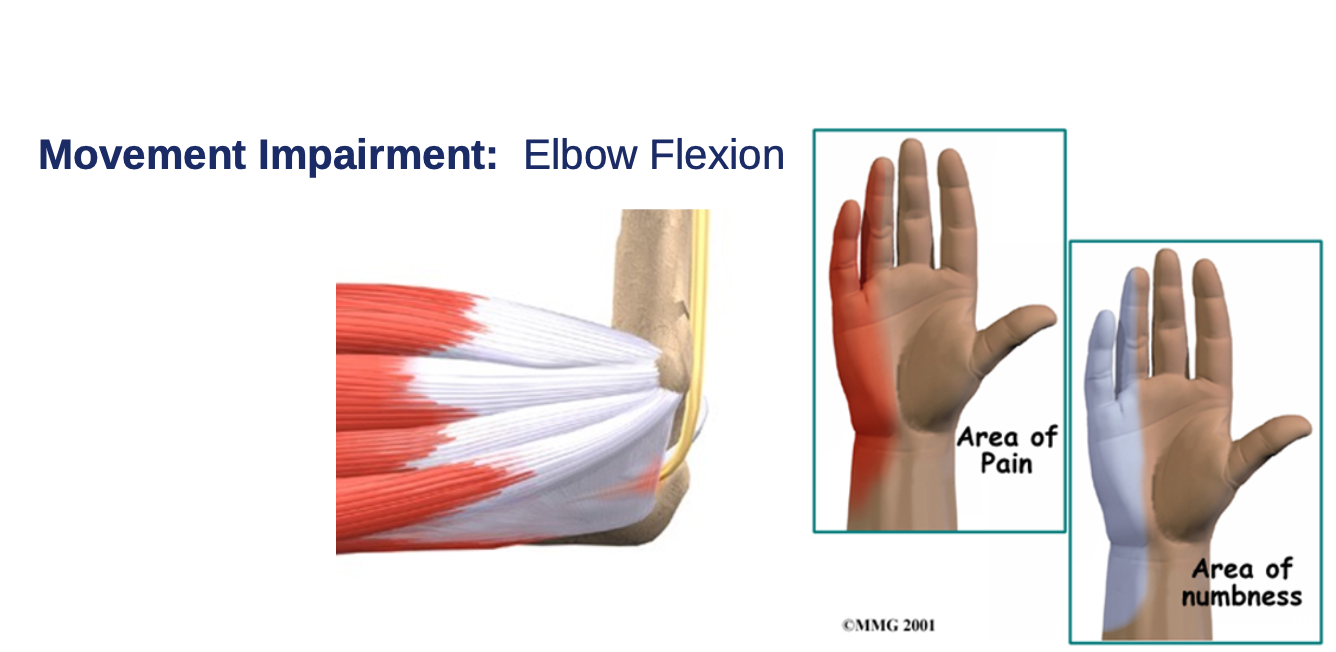
Case study: A 20 year old professional guitarist complains of medial elbow pain that radiates down her forearm and numbness and tingling in her 4th and 5th digits. She states that her pain increases when playing her guitar, resting her elbow on a table & sleeping (she sleeps in a fetal position). She notices that she isn’t able to grip well and has been dropping objects recently.
What does this cause? What movement is going to be impairment?
Cubital tunnel syndrome
movement impairment: elbow flexion
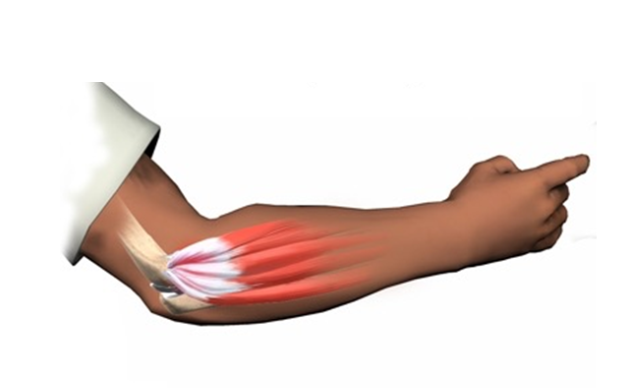
What injury causes wrist extension during repetitive tasks as an impairment?
Lateral epicondylitis (Tennis elbow)
movement impairment: wrist extension (forearm pronated) during repetitive tasks
● finger extension, forceful grasp, hammering, racquet sports
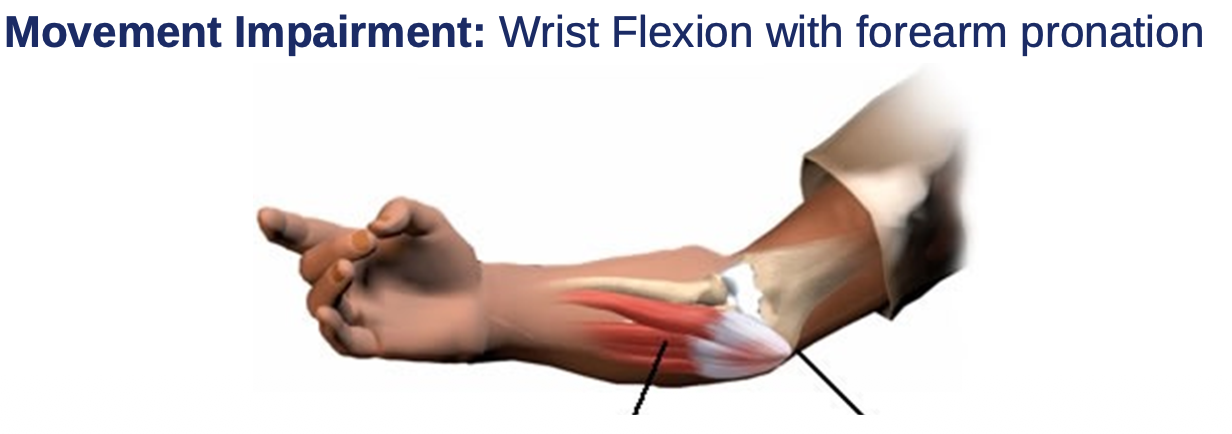
What injury causes wrist flexion with forearm pronation as an impairment?
Medial epicondylitis (Golfer’s elbow)
movement impairment: wrist flexion with forearm pronation
What injury causes elbow valgus as an impairment?
MCL injury
movement impairment: elbow valgus
1. WB- Fall onto outstretched/supinated upper extremity (valgus force)
○ Associated injuries: Compression fracture within humeroradial joint or along radius, ulnar nerve injury, injury to proximal attachments of pronator-wrist flexor muscles. If hyperextension, injury to anterior capsule.
2. NWB - Repetitive valgus – Ex: Throwing
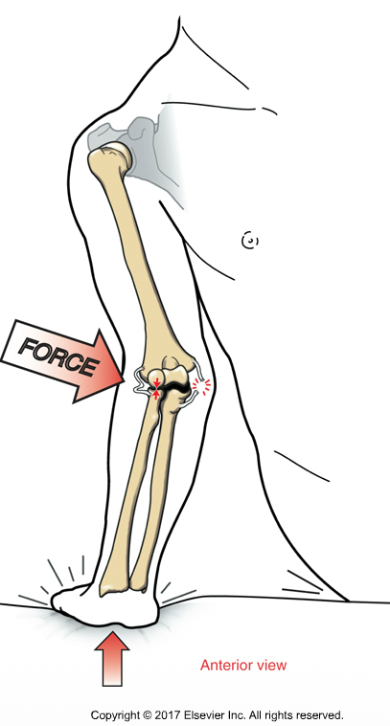
What injury causes elbow varus as an impairment?
LCL injury
movement impairment: elbow varus
Fall onto outstretched hand – football, soccer, rugby
● Can lead to instability at the elbow
What is called when dislocating of the proximal radioulnar joint?
Nursemaid’s elbow (especially for children)
Strenuous pull on the pronated hand can cause the radial head to slip through the distal end of the annular ligament.