ARCH 241 Exam 1
 Call Kai
 Learn
 Practice Test
 Spaced Repetition
 Match
 Flashcards
 Knowt Play
1/207

There's no tags or description
Looks like no tags are added yet.
208 Terms
30 years war
(1618-1648) This Bourbon vs. Habsburg War resulted from a conflict between the Protestant Union and the Catholic League in the Holy Roman Empire
Context: Everything was destroyed so cities needed to be rebuilt fast.
Baroque
An artistic style of the early 17th century to early 18th century characterized by complex forms, bold ornamentation, and contrasting elements
Plaster
Key material featured in baroque. Workable, durable, and moldable so it allowed for ornamentation featured in Baroque.
Baroque Characteristics
- Large, quickly built buildings
- Reliance on plaster molds for interior and exterior
- Exterior Cladding
- typically on flat Land
- Later, large gardens
- Illusions
Matthias Daniel Pöppelmann (1662-1736)
- Key architect of Saxon Baroque
- Built through Saxony and Poland
- Der Zwinger Palace (Dresden)
Saxony
Germany

Der Zwinger
- Architect: Matthias Daniel Pöppelmann
- Modeled after Hippodrome (from Turkey which they defeated)
- Symbol of power
- Features the onion form specific to Baroque
- Mythology in palace tells a story

Mansard Roofs
- This design maximizes usable attic space (often called a garret) without increasing the building's overall height, and it is frequently punctured with dormer windows to provide light and access
- Large, sloped roof encompassing 1 or more floors
- Design helps evade the tax per floor. Roof is not a floor, therefore no tax.
- Feature of domestic Baroque
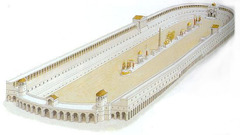
Hippodrome
An ancient Greek stadium used for horse and chariot racing
How is plaster connected in Baroque?
via skeleton with wire meshings
Andreas Schlüter (1659-1714)
- German Baroque architect
- Built for Prussia and Russia
- Shaped Berlin's early Baroque identity
- Berlin Palace
The Great Northern War (1700-1721)
War between the Russians and the Swedish. It was long and costly for both sides, but the Russians ended up gaining control of the Baltic Sea
- Ended Sweden's reign as a major European power

Winter Palace, St. Petersburg
Rebuilt by Bartolomeo Rastrelli as an enormous, aqua-colored royal residence, now the Hermitage Museum. There Elizabeth, Peter the Great's daughter, established a flashy, luxury-loving, and slightly crude court, which Catherine the Great in turn made truly imperial
- Modeled after Dresden Palace
Nine Years War (War of Palatinate Succession)
1688 - 1697 (War of the League of Augsburg) Result of Louis XIV trying to extend French territory to the Rhine river
- A consequence was the destruction of Heidelberg City (scorched Earth policy)
Johann Breunig (1660-1727)
- German Baroque Architect
- Focused on pubblic spaces
- Buildings:
- Alte Aula
- City Hall of Speyer, Germany
More Features of Baroque
- Continuous faces ~ walls with gates for privacy, courtyards
- Colors! Intention to raise spirits from previous warfare and destruction
- statues on top of buildings
- gold and orante

Volute (scroll)
a spiral, scroll-like ornament commonly found in classical column capitals, especially in the Ionic, Corinthian, and Composite orders.
Baroque Rococo (1715-1770)
- Late Baroque
- Lighter, playful successor of Baroque distinguished by pastel palettes, asymmetry, and intimate interiors.
- Shift toward private, aristocratic interiors.

Azulejo (azuela)
- Decorative tiles used in the Iberian peninsula
- painted, tin‑glazed ceramic tiles traditionally used in Spain and Portugal, with deep roots in Islamic art and a long history of combining practical and decorative functions in architecture
Blutenburg Castle
- Largest baroque castle
- Blutenburg means bloom

Ashler
- Cut and dressed stone
- Finest masonry stone
- Usually rectangular, finely worked
Architecture Teaching during Baroque
- Architects were often artillery officers and met/trained during the war
- Many went to Paris to train since France had not lost a war at this tie
- The international language was french
- Most baroque architects came from Italy (sent as mercenaries) ~ hotspot was Venice

Asamkirche, Munich
- Epitome of Baroque church
- Example of the resurgence of classical designs
- Very narrow and ornate

Solomonic Columns
A twisted column with a helical shaft and Classical capital and base; often used in Baroque architecture.

Pilaster
Partial column fitted into wall
Plaster, wire meshing, wooden core
Decorative columns inside Baroque Palaces consisted of
False
True or False: Baroque emphasized finely-hewn ashlars 9stone) or grey tones and straight lines.
English Baroque
- Began after Great Fire of London in 1966
- Some feature Greco Roman influence
- tends to be more sober than traditional baroque
Great Fire of London, 1966
Burned down all of London and left no remains of medieval architecture

Georgian Style
- Architecture after 1714
- Named after King George 1 of England
- It is characterized by symmetry, proportion, and classical ornamentation, drawing inspiration from the architecture of ancient Greece and Rome as interpreted through Renaissance principles

Neoclassicism (Classicism)
- A rediscovery or new appreciation for Ancient Greek and Roman architecture during the Enlightenment
- More sober than Baroque, less ornate, very versatile
- 1st 'industrialization' of architectural elements since elements can be built faster and 'better' than Baroque
- statues not really featured, reserved for corners if featured.
Palladianism
- Begun by Italian Architect, Andreas Palladio (1508-1580)
- Movement within the 16th century featuring classical influences
- Key Elements:
- Half moon/Crescent Shaped Streets
- Round open spaces
- Street designs during the Georgian period
Johann Joachim Vinckelmann (1717-1768)
**Clearly defined the differences between
Greek and Roman architecture of antiquity
- Considered to be the founder of modern archaeology and art history
- Chief librarian of the Vatican

The War of Austrian Succession (1740-1748)
War over the control of Austria due to the fact that Charles VI left Maria Theresa (a girl) as heir to the throne. Frederick II of Prussia invaded due to a want for Silesia and France helped him in order to humiliate their enemy (Austria.) Great Britain allied with Austria to prevent France from gaining more land. The colonies of F and GB began to fight also. Austria gave Silesia to Prussia and the Peace of Aix-la-Chapelle ended the war.
- Prussia won by gaining the wealthy region of Silesia

Seven Years' War (1756-1763) (French-Indian War)
- Conflict fought in Europe and its overseas colonies; in North America, known as the French and Indian War
- Britain became the dominant colonial power

American Revolution (1775-1783)
A period when 13 colonies gained independence from England. Based on disapproval by colonists of several taxes and other unpopular laws. Protests lead to fighting in 1775, and after two main British armies were captured in 1777 and 1781 and an alliance of the colonists with the French, the Treaty of Paris was signed.

French Revolution (1789-1799)
A radical revolution against the French monarchy and nobility. Its adherents argued for a new society based on the ideals of egalitarianism, brotherhood, and freedom.
- Constitutional monarchy v. abolish monarchy
The Enlightenment
A movement in the 18th century that advocated the use of reason in the reappraisal of accepted ideas and social institutions.

Royal Salt Works
- Arc-et-Senans, France, 1775-78, (Claude Nicolas) Ledoux, Visionary neoclassicism
- Example of industrialization
- hole for ventilation, salt factory
- Interesting columns to distinguish from churches and government buildings

Etienne-Louis Boullee (1728-1799)
- Wanted to make architecture expressive
- Designed the cenotaph for Sir Isaac Newton in 1784
Cenotaph
a monument erected to the memory of the dead, with the dead human body not present

Pediment
the triangular top of a temple that contains sculpture

Carl Gothard Langhans
- Prussian architect
- Designed both civic buildings and residences
- Designs: Brandenburg Gate (Berlin)
- Schloss Dyhernfurth: repeated windows and such = standardization
Reign of Terror
- (1793-94) during the French Revolution when thousands were executed for "disloyalty"
- Caused revolutionaries to push eastward
Napoleonic Wars
- A series of wars fought between France (led by Napoleon Bonaparte) and alliances involving England and Prussia and Russia and Austria at different times (1799-1812).
- 7 coalition wars
Napoleon's Empire
- By 1812 Napoleon had conquered all of Europe except England
- Renovated the infrastructure of cities
- Expanded eastward into Russia and dismantled every state along its way
- Dissolved the Holy Roman Empire in 1806
- Ended in 1815
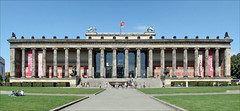
Karl Friedrich Schinkel (1781-1841)
- Prussian architect and civil administrator
- Designed many of the new buildings in the emerging city of Berlin
- Studied works of Winckelmann
- Did not enslave himself to the Greco-Roman style and sought out new materials to use
- 1st to render and add people to the scene
- Built the Altes Museum in Berlin, Neue Watch in Berlin
True
T or F: Neoclassicism borrowed from all classical societies, not just Greece and Rome

Cornice
a projecting ledge over a wall
When was Napoleon defeated?
1815, Waterloo
- Napoleon was exiled and his men were executed
True
T or F: After napoleon's defeat, the leftover empires decided who they were and what their identity was
British Museum, London
- Architect is Sir Robert Smirke
- 1823-1852
- At this time, we see the emergence of museums to store antiquities

Old St. Petersburg Stock Exchange
- Russia scorched their land to avoid Napoleon's invasion. They developed stock exchanges.
- Design resembles Greek temples to communicate money as a priority
- opened 1811 during the wars

Rotunda
Circular or oval area under a dome
True
During the time of the Napoleonic wars, there was a mix of Neoclassicism and Baroque
Neoclassical Features
- Square shapes
- Used gold in interior
- symmetry, geometric clarity, classical orders, and restrained ornamentation
Industrialization
- latter decades of the 18th century
- design and construction of buildings specifically for industrial purposes, emphasizing functionality, efficiency, and the use of modern materials like steel, concrete, and glass.
Sayner Hütte
- Ironworks famous for the Casting Hall (1st steel and iron structure)
- Fell to Prussians in 1815
- 1st industry hall with a weight carrying cast iron
Casting
melting metal into a form
Cast Iron
molten iron poured into a mould to make a product

Wrought Iron
- a tough, malleable form of iron suitable for forging or rolling rather than casting
- smithered iron shaped by a blacksmith
- typically curved
Isambard Kingdom Brunel (1806-1859)
- English engineer (father was french)
-Designed & built wide range of projects, including broad-gauge railways, suspension bridges, & steamboat
- Used logic & analysis to reshape the mechanical & structural engineering of his time

Clifton Suspension Bridge
- 1830-1863
- 1st suspension bridge
- Isambard Kingdom Brunel
- Interior is metal, outside is brick with clad iron

Paddington Station
- London, 1854
- Isambard Kingdom Brunel
- Neoclassical style: sober arches, busts of myths
- Trains came about in the 1800s mostly built by the British

The Crystal Palace
- London, 1851
**iron and glass
- Designed by Sir Joseph Paxton, construction overseen by Brunel
- Designed as an exhibition hall to bring great minds together, specifically to house the Great Exhibition of 1851
- Destroyed by fire in 1936
Prince Albert
- Married to Queen Victoria
- Pushed idea of the exhibition space in Crystal Palace

Great Exhibition of 1851
In 1851, the British organized the first industrial fair at London in the Crystal Palace. The fair had 100,000 exhibits that showed a wide variety of products made in the Industrial Revolution. It was a display of Britain's wealth to the world.
Table and Cloth Design
Combination of cast iron trusses draped with glass where the glass acts as the cloth.
Glass Palace
- significant because of the mechanical production of glass, 4'x10".
- Building type with table and cloth design
- Contains steel louvers

Louver
An assembly of sloping, overlapping slats, fixed or adjustable, which excludes rain but admits air and or light.

Rose Window
a circular stained-glass window

Barrel Vault
an elongated or continuous semicircular vault, shaped like a half cylinder

Pointed Arch
An arch with a pointed crown, characteristic of Gothic architecture.

Turbine Building of the Menier Factory
- Noisel-sur-Seine, France,1871-1872
- Jules Saunier
- Chocolate factory in an Arab-andalusian style entirely built of brick and iron on a steel frame, masonry piers
- powered by hydraulics
True
Baroque was most sober in England
Jean-Baptiste Rondelet
- Designed church modeled upon Roman Pantheon
- Paris Pantheon

Pantheon
- classical temple front with a large, domed rotunda
Where was Georgian architecture founded?
England
Napoleon was defeated at Waterloo in what year?
1815
Greco-roman temple
structure combining Greek architectural orders—Doric, Ionic, or Corinthian—with Roman innovations such as high podiums, frontal emphasis, and urban integration
What is the classical column order from bottom to top?
1. Doric 2. Ionic 3. Corinthian
False
Neoclassical architects were know to work in cultural isolation
Neoclassicism
A style used for various building and was an organic continuation of the Baroque approach to mass producing architecture
Romanticism
- Change in literature between the network of nobles urging each other to allow more freedom to citizenry and peasantry in face of the French Revolution
- Attempt to counter and prevent revolutions by giving people more rights

Semperoper
- Gottfried Semper, 1841
- Neoclassical and Baroque style: mass statue, columns, curved
- Resembles an inverse of the Zwinger Palace
- At this time, we see the emergence of the theatre to the public. Previously, theatre was reserved for nobles and the elite.
Hegelian Philosophy
- G. W. F. Hegel's philosophy which can be summed up by the dictum that "the rational alone is real," which means that all reality is capable of being expressed in rational categories. His goal was to reduce reality to a more synthetic unity within the system of transcendental idealism.
- Studied by Marx
Existentialism
- A philosophy based on the idea that people give meaning to their lives through their choices and actions
- Marx's work on class struggles gave rise to this philosophy
1848 Revolutions
series of republican (citizenry and peasantry) revolts against European monarchies, beginning in Sicily, and spreading to France, Germany, Italy, and the Austrian Empire. They all ended in failure and repression, and were followed by widespread disillusionment among liberals.
Louis Napoleon (Napoleon III)
- This was the first French president as a result of the election after the Revolution of 1848
- used class struggles to get to the top and launched multiple coups to obtain leadership
- responsible for remodeling of Paris
Reconstruction of Paris
- Whole districts were destroyed to create streets, which stemmed from leaving no areas for barricades and easy mobility of the troops. Parks and public buildings were created. The reconstruction created many jobs. The Metro was built in 1895. New railroads were created.
- Designed by Georges-Eugene Haussmann
- New boulevards and designs linked major places
- 2nd Empire Style Features:
- Mansard Roofs, roofs made of slate
- buildings of the same size
- chimneys in every apartment

Slate
thin stone stacked on each other, popular in Baroque
2nd Empire Style
- 19th‑century French‑inspired style defined by its mansard roofs, elaborate ornamentation, and eclectic blend of Baroque, Renaissance, and classical elements, originating under Napoleon III
- Style pushed boundaries
- Over the top design
- Stemmed from Beaux Art

Saint-Augustin, Paris
- Victor Baltard, 1860-1870
- Steel frame construction
- No buttresses ~ significant considering the height of Saint-Augustin (80 m)

Beaux-Arts
A style of architecture favored by the Ecole Des Beaux-arts, characterized by symmetrical plans and the eclectic use of architectural features combined to give a massive, elaborate, and often ostentatious effect.
Royal Palace of Brussels
- Neoclassical exterior with an experimental interior
- Example that architecture communicated political allegiance ~ King of Brussels (Prince Albert's uncle) did not use a French style since England funded Belgium to act as a buffer between France and the rest of Europe

Pylon
The wide entrance gateway of an Egyptian temple, characterized by its sloping walls
Neoclassical style was an allegiant style for which states?
German
What change occurred in England in the 1870s?
- Queen Victoria died. George V was crowned and kicked Germany out of the alliance, included France instead.
- Was done because George V did not like his cousin
The Scramble for Africa (1880-1900)
- prelude to rapid colonization. European powers sought to secure trade routes, resources, and strategic ports, and to end the slave trade jpellegrino.com. The Berlin Conference (1884-85) formalized rules for partition, leading to the division of most of Africa by the early 20th century.
- Brought materials like rubber useful for pulley systems and cars
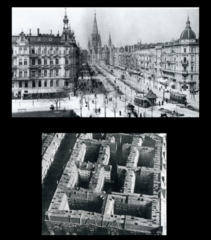
Mietskaserne (Rental Barracks)
- Older buildings around cities were replaced with multilevel rental apartments in city centers with improved conditions
- Designed for workers and their families in the midst of industrialization
- Important new features:
- courtyards within buildings featured stables for horses and carriages
- bathrooms in every apartment
- apartments had double sided window access allowing for cross draft ventilation