Cards Warm-up
 Call Kai
 Learn
 Practice Test
 Spaced Repetition
 Match
 Flashcards
 Knowt Play
1/37

There's no tags or description
Looks like no tags are added yet.
38 Terms
What medication should ideally be started in a stable patient with PMH of CHF (EF < 20%) that presents with new onset of AF w/ RVR?
Amiodarone
-Diltiazem is another agent that may be utilized but due to negative inotropy effects (especially with a weakened LV with poor EF), it may worsen the patient’s state.
When agents may be used in cardiogenic shock and with which preferences?
Dobutamine: best in patients with hypotension, also has short half life and easier titration, no renal impairment issues
Milrinone: preferred in severe RV dysfx, pulmonary HTN, or on chronic BB use (increases pulmonary dilation), but be aware of BP. Must be renal dose adjusted
-source: DOREMI trial

Describe the following EKG and its significance in a patient with angina
De-Winter T wave
-STEMI equivalent in clinical setting; indicates LAD occlusion

Describe the following EKG and its significance in a patient with angina
Posterior MI
-noted by horizontal ST depressions in V1-V4, R/S ratio > 1
-when performed with posterior leads (V7-9), this will aptly show the ST elevations
What structure develops from the fetal ductus arteriosum?
Ligamentum arteriosum
What nerve innverates sensation to the pericardium?
Phrenic nerve (C3-5)
What structure is the attachment site for the myocardium and serves to insulate electricity?
fibrous trigone
What vessel feeds the SA and AV node?
RCA (right coronary artery)
What determines a R or L sided heart?
What vessel feeds the posterior interventricular artery (RCA or LCA)
Describe the phases of action potential in cardiac cells
Phase 4 - Resting potential (four = floor)
Phase 0 - Na+ channels open to rapidly polarize the cell
Phase 1 - K+ channels open as a result of influx of Na, causing cell to depolarize
Phase 2 - Ca+ channels open as a result of K+ channels, causing a plateau
Phase 3 - In the battle between Ca+ and K+ channels opening, the latter prevails, causing return to resting membrane potential
Define EDV (end diastolic volume)
Ventricles have maximum blood volume (following atrial systole)
Define cardiac output and it’s normal range
CO = HR x SV
-normal range is 4-8, average 5L/min
Where is S2 best heard?
Erb’s point (3rd intercostal space)
Define what happens during the Q, R, and S segment of an EKG
Q wave = depolarization of (L) bundle branch (+ to - vector = - charge)
R wave = ventricular depolarization (+ to + vector = + charge)
S wave = basal segments of ventricle (+ to - vector = - charge)
Formula for SV?
SV = EDV (blood in ventricle AFTER diastole) - ESV (blood left after systole)
Write out changes in the heart happening with increases in preload, afterload, and inotropy

What agent is first line for a patient in AF with RVR with a PMHx of HFrEF?
Amiodarone
What agent is used ONLY to maintain NSR (once AF has been converted to NSR)?
Dronedarone
What antiarrythmic agent is used for cardioversion and NSR maintenance but has a significant AE of Torsades?
Dofetilide (Tikosyn) - QTc < 440 msWh
Remember the ‘T’ in Tikosyn can cause ‘T’orsades
When is warfarin preferred to DOACs?
Hx of mechanical heart valves or rheumatic MS
INR should be 2-3 (or 2.5-3.5) for efficacy
obtain PT/INR, CBC, renal and hepatic baseline labs
When does an Eliquis need to be halved?
If 2 or more of:
Age ≥ 80yo
Weight ≤ 60kg
SCr ≥ 1.5
What are examples of type 2 MIs?
Myocardial injury defined by mismatch between myocardial oxygen supply & demand
Coronary embolisms, vasospasms, significant arrhythmias, SCAD

A 60yo patient with PMHx of HTN presents with dyspnea and palpitations with VS including a BP of 120/84, HR of 150 with the following monitor strip. What’s the best treatment option?
AFL w/ 2:1 conduction
First line options include non-DHP CCBs (diltiazem, verapamil) or beta-blockers (metoprolol)
What trial established the precedent that early rhythm control led to reduced ACE outcomes?
EAST-AFNET trial in 2024
Describe the timeframe of when AC therapy should be started prior to cardioversion in someone with known vs unknown length of duration in AF in a patient.
If unknown or >48h in AF:
-should have 3 weeks of AC prior to getting a TEE.
-if thrombus seen, should have 4 weeks of AC, then repeat TEE to assess if CV is still possible

In a 25yo M presenting with exertional dizziness, what are the most significant findings and what diagnosis should be considered?
1) LVH, most noted in the S-wave of V4, V5
2) Deep Q-waves in I, V5, V6
Dx: HOCM (specifically interventricular septal thickening)
Explain why one may see TWI or STE in an EKG displaying WPW?
WPW features an abnormal depolarization of the atria, but also causes abnormal REpolarization of the ventricles, causing this phenomena
What EKG finding in WPW can distinguish a type A vs type B conduction?
V1 morphology
-type A has a prominent R wave
-type B has a prominent S wave


In a 30yo F presenting with palpitations, what are the most significant findings on ECG and what diagnosis should be considered?
1) RAD (aVF is positive facing, I is neutral)
2) TWI in pretty much every lead
3) Epsilon wave seen in V1, as well as II, III and aVF
[Arrhythmogenic RV Dysplasia]
-autosomal dominant genetic d/o, seen by fatty infiltrate on RV free wall, which predisposes pts to paroxysmal ventricular arrhythmia, SCD
-2nd MC cause of SCD in young pts, following HOCM
-MC presenting sx may be SCD, palpitations, or syncope. On diagnostics, may see frequent PVCs or sustained VT w/ LBBB morphology
-on echo, will see dilated hypokinetic RV outflow tract as well as hypokinetic RV; should follow with cardiac MRI to further assess

In a 30yo F presenting with SOB, what are the most significant findings on ECG and what diagnosis should be considered?
1) Severe bradycardia (~30 bpm)
2) Peaked T waves in V2-5
[Hyperkalemia]
-for other context, this was following missed dialysis with a K+ lab value of 7.9
-consider other causes of severe bradycardia like BB/CCB toxicity
*even despite a normal EKG, if a patient has a bradycardic → PEA arrest, assume hyperK until proven otherwise
What toxicity can produce the following EKG? What drugs can cause this?
Sodium channel blocker toxicity
Drugs that can cause this include 1A/1C antiarrhythmics, TCAs (+tachy), propanolol (+brady), carbamazepine
What is the reversal agent for BB toxicity?
Glucagon

What type of abnormality is seen on this EKG?
Apical HCM
-note the large ‘spade shaped’ diffuse TWI on leads II, avF, V2-5
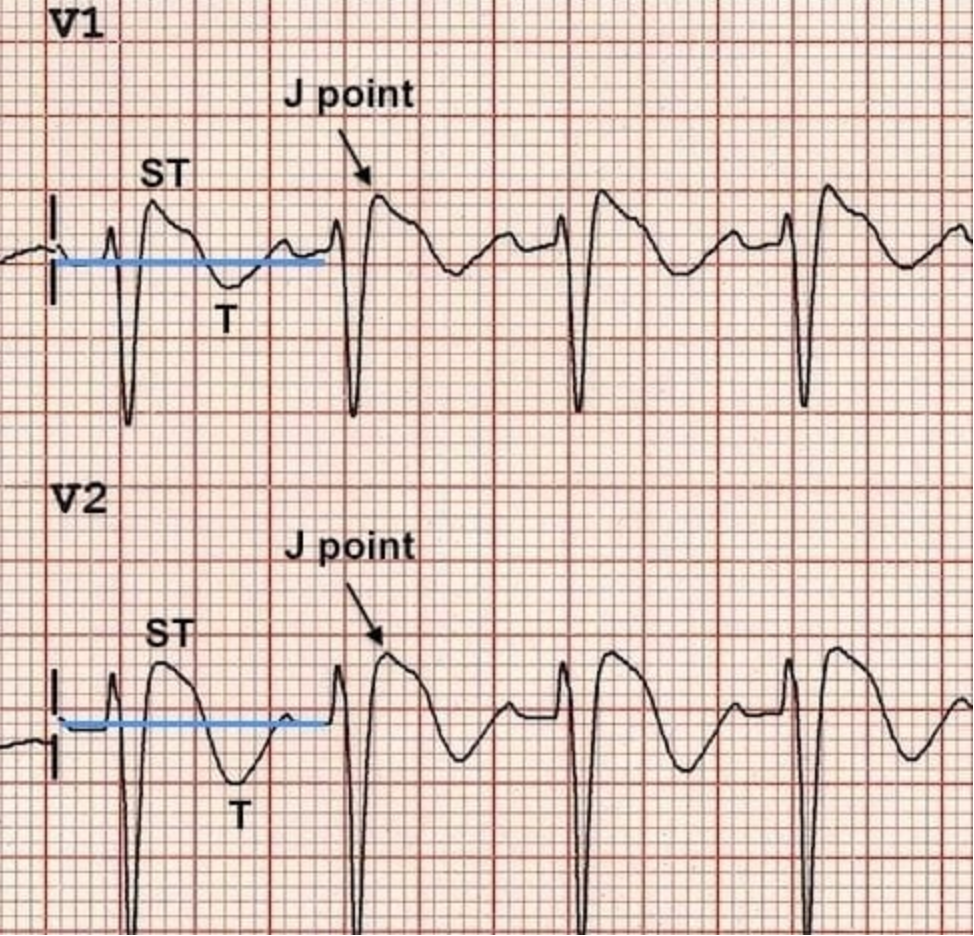
Explain the following as it relates to Brugada syndrome: pathophysiology, EKG findings, classic symptoms, and treatment
p/p: inherited or spontaneously occurring mutation of cardiac sodium gene, causing a proneness to arrhythmias
EKG: noted J point downsloping or ‘coved’ morphology and associated TWI
sx: SCD, symptomatic ventricular arrythmias (paroxysmal syncope, seizures, nocturnal agonal respirations)
tx: ICD installment
What four therapies of medical management are best for stable angina?
BBs (daily)
SL nitroglycerin as needed for sx relief
daily ASA, Statin
Revascularization via PCA or CABG is the definitive treatment
When would a CABG be preferred to a PCI?
L main stenosis > 70 %
3 vessel disease (or 2 vessel disease in diabetics
LV EF of < 40%
What artery is typically utilized for a CABG?
LIMA (left inferior mammary artery); has a 90% patency life at 10 years
long saphenous vein can be a secondary source; only a 60% patency life at 10 years
What agent can be used as a last line for stable angina and found to improve exertional angina to improve exercise capability?
Ranolazine
-late Na channel blocker that REDUCES O2 requirement of cardiac muscle