Genetic Processes: The Cell Cycle, Mitosis, and Heredity
 Call Kai
 Learn
 Practice Test
 Spaced Repetition
 Match
 Flashcards
 Knowt Play
 Podcast
1/61

Earn XP
Description and Tags
Comprehensive vocabulary flashcards covering the cell cycle, mitosis, cytokinesis, cancer cell biology, cloning, DNA structure, mutations, chromosomes, karyotypes, and reproductive strategies.
62 Terms
Gamete
A specialized sex cell (egg/ovum or sperm) containing a haploid number (n) of chromosomes that unites during fertilization to produce a zygote.
Somatic Cell
Any body cell in a multicellular organism excluding reproductive cells, containing a diploid number (2n) of chromosomes.
Haploid (n)
A cell condition containing half the usual complement of chromosomes; in humans, this number is 23 chromosomes.
Diploid (2n)
A cell condition containing two copies of each chromosome; in humans, this number is 46 chromosomes.

Cell Cycle
The repeating process of controlled growth and division in somatic cells, consisting of interphase and cell division (mitosis and cytokinesis).
Interphase
The growth stage and 'resting phase' where a cell takes a rest from dividing and spends approximately 90% of its time growing, producing organelles, and duplicating DNA.
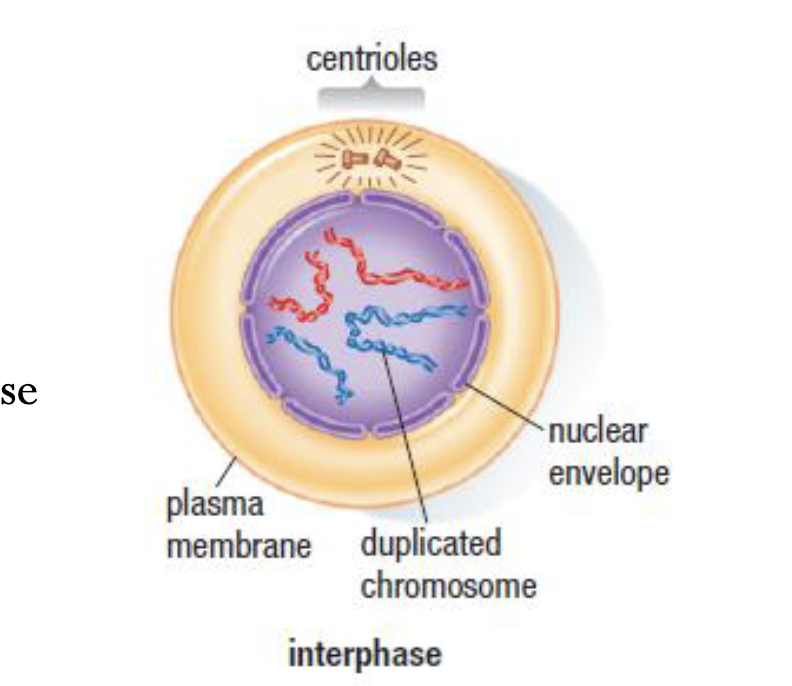
G1 Phase (GAP 1)
The major growth period of interphase during which molecules are synthesized to prepare the cell for DNA replication.
S Phase (Synthesis)
The subphase of interphase in which DNA is copied and chromosomes are duplicated into identical sister chromatids.
G2 Phase (GAP 2)
The final stage of interphase during which the cell grows and makes molecules to prepare for mitosis.
Mitosis
The division of a parent cell's nucleus into two genetically identical daughter nuclei, maintaining the diploid (2n) chromosome number.

Prophase
The first phase of mitosis where chromatin condenses into visible chromosomes, the nuclear membrane breaks down, the nucleolus disappears, and centrosomes migrate to opposite poles.

Metaphase
The longest phase of mitosis where chromosomes line up along the centre of the cell (equatorial plate) and spindle fibres attach to each centromere.
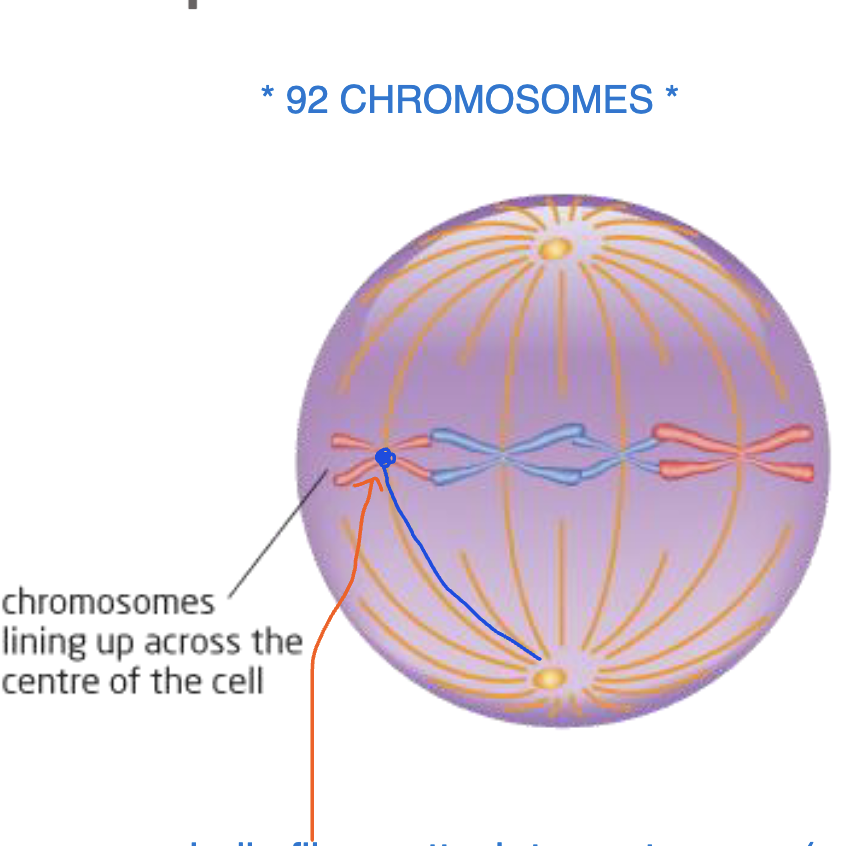
Anaphase
The shortest phase of mitosis where spindle fibres contract, separating sister chromatids at the centromere and pulling them toward opposite poles as individual chromosomes.
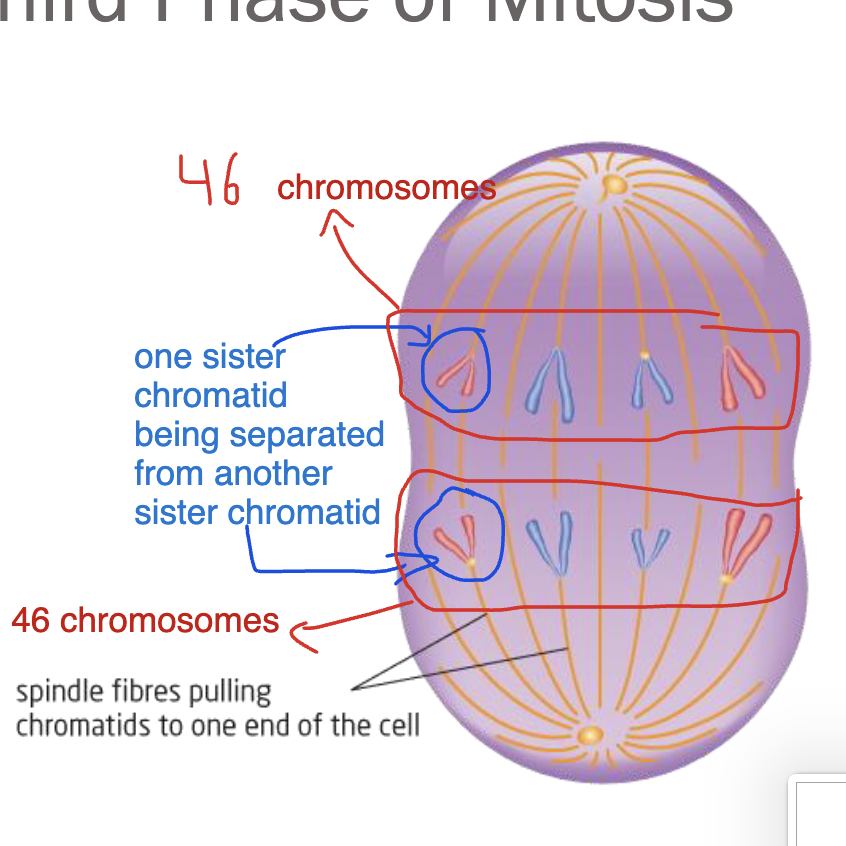
Telophase
The final phase of mitosis where spindle fibres disappear, nuclear membranes reform around two new nuclei, nucleoli reappear, and chromosomes uncoil back into chromatin.
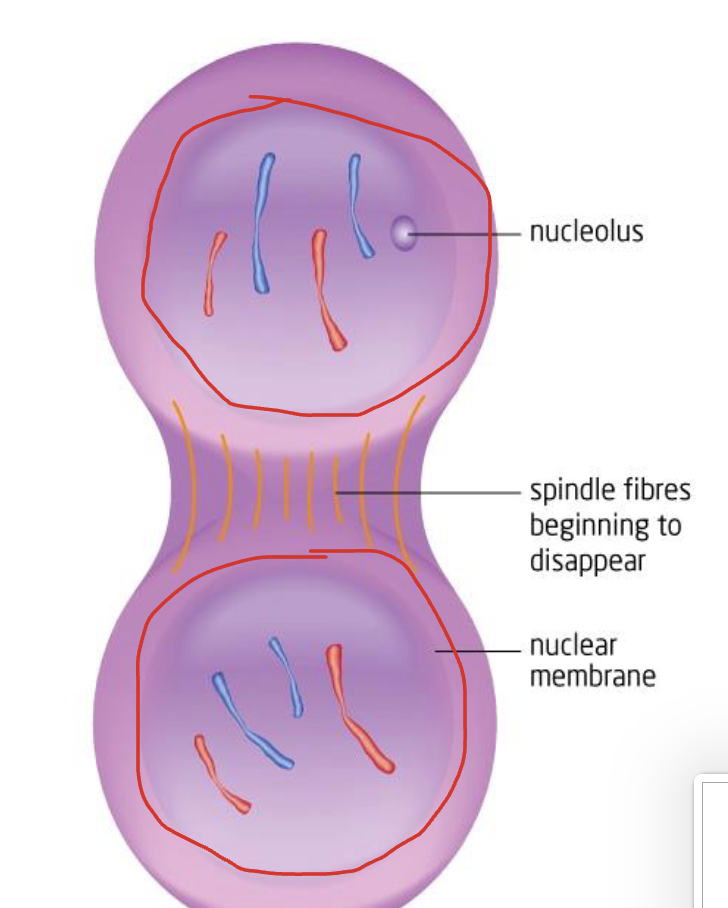
Cytokinesis
The stage of cell division following telophase that separates the parent cell's cytoplasm, cytosol, and organelles into two new daughter cells.

Centromere
A protein structure that holds two sister chromatids together and serves as the attachment point for spindle fibres before chromosome separation.
Sister Chromatids
Two identical copies of a chromosome produced during DNA replication in interphase that remain joined at the centromere.
Cytokinesis Cleavage Furrow
The shallow groove formed during cytokinesis in animal cells when a ring of contractile proteins pinches the cell membrane inward until it divides.

Cytokinesis Cell Plate
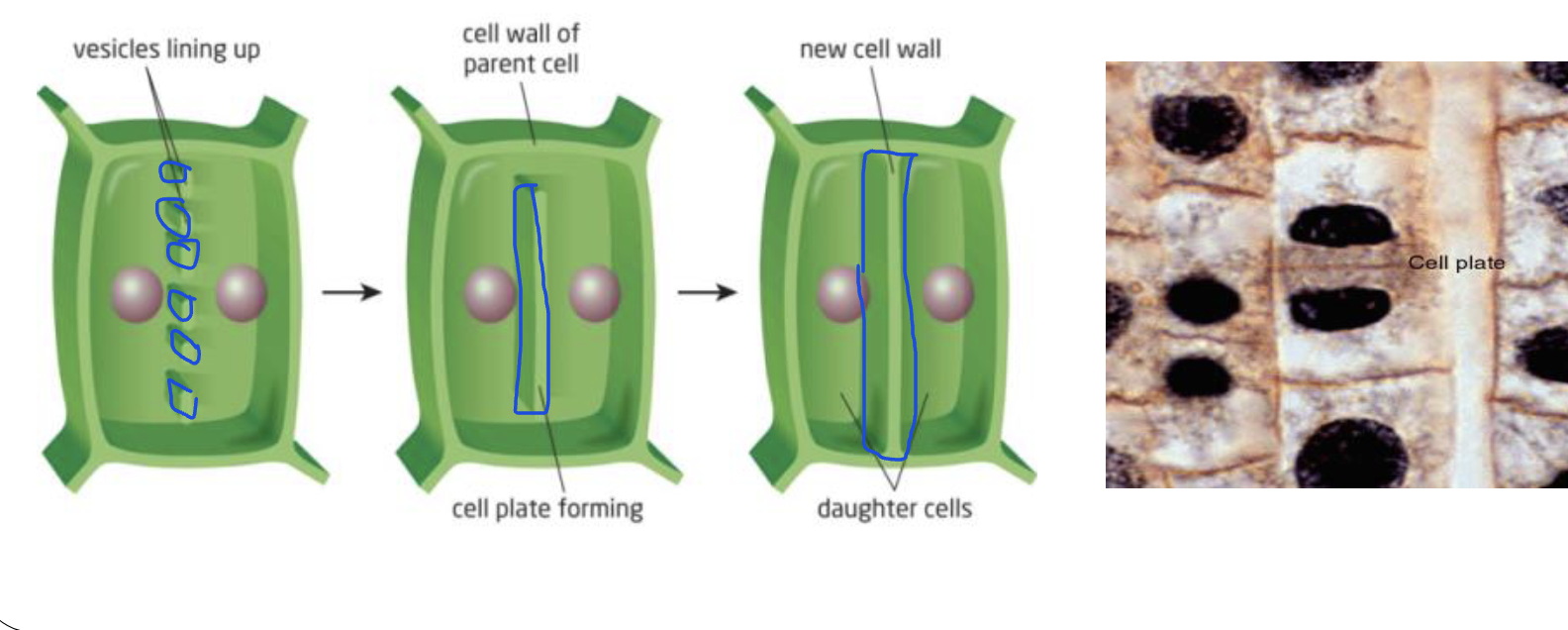
A structure formed in dividing plant cells by Golgi-derived vesicles lining up between two new nuclei, eventually developing into the new cell wall.
Cell Cycle Checkpoints
Regulatory stop and go-ahead points located in G1, G2, and M phases where protein signalling assesses whether cell division should proceed.
Apoptosis
Programmed cell death ('cell suicide') initiated by a death signal in DNA when a cell experiences irreparable damage from toxic chemicals or physical wear.

Tumour
An abnormal clump of cells that forms when cells acquire mutations that allow them to ignore normal cell cycle stop signals and divide continuously.
Benign Tumour
A non-cancerous abnormal mass of cells that remains restricted to its original site within the body.

Malignant Tumour
A cancerous mass of rapidly dividing abnormal cells capable of invading surrounding tissues and spreading throughout the body.
Metastasis
The spread of malignant cancer cells from their primary site to distant parts of the body via the bloodstream.
Telomerase
An enzyme present in cancer cells that prevents them from stopping division by signaling that they do not have to cease reproducing.
Radiation Therapy
A localized cancer treatment that damages dividing cells so they fail to align properly on the metaphase plate or separate correctly, causing daughter cells to die.
Chemotherapy
A systemic cancer treatment using drugs administered throughout the whole body to disrupt DNA replication in all actively dividing cells.
Immunotherapy
A targeted cancer treatment at the tumor site that utilizes the body's own immune system to recognize and kill cancer cells.
Cloning
The process of forming genetically identical offspring from a single somatic cell or tissue.
Callus
A ball of undifferentiated plant cells that forms during plant tissue culture before being transferred to a medium to grow into a cloned organism.
Dolly the Sheep
The first mammal successfully cloned from an adult body cell; a Finn Dorset lamb born on July 5, 1996, created by Dr. Ian Wilmut.
Cell Theory
A foundational biological concept developed in the mid-1800s stating that all living things are composed of cells, cells are the smallest functional units of life, and all cells arise from pre-existing cells through cell division.
Deoxyribonucleic Acid (DNA)
The double-stranded helical nucleic acid molecule that stores and transmits hereditary genetic information from parent to offspring.

Nucleotide
The repeating structural subunit of DNA, composed of a 5-carbon pentose sugar, a phosphate group, and a nitrogenous base.
Purines
A class of double-ring nitrogenous bases found in nucleic acids, consisting of adenine (A) and guanine (G).
Pyrimidines
A class of single-ring nitrogenous bases found in DNA, consisting of cytosine (C) and thymine (T).
Complementary Base Pairing
The specific chemical pairing across DNA strands where adenine (A) always pairs with thymine (T) and guanine (G) always pairs with cytosine (C) via hydrogen bonds.
Point Mutation
A genetic error consisting of a change in the nucleotide sequence of DNA, classified into base-pair substitutions, insertions, or deletions.
Base-Pair Substitution
A point mutation in which a single nucleotide in the DNA sequence is swapped or replaced by a different nucleotide.
Insertion
A frameshift point mutation in which one or more extra nucleotides are added into a DNA sequence.
Deletion
A frameshift point mutation in which one or more nucleotides are removed or missing from a DNA sequence.
Sickle Cell Anemia
A genetic disorder caused by a point mutation in hemoglobin that alters red blood cells into a rigid crescent shape, impairing oxygen transport.
Chromatin
The long, uncoiled, and diffuse form of DNA present during interphase that is not distinct or visible under a light microscope.
Chromosome
A condensed, compact, thread-like structure of DNA and protein that becomes distinctly visible under a microscope during mitosis.
Gene
A distinct segment of DNA located on a chromosome that contains the nucleotide sequence coding for a specific functional trait or protein.
Locus
The specific physical position or site occupied by a given gene along the length of a chromosome.
Homologous Chromosomes
A pair of matching chromosomes possessing the same length, centromere location, and dye banding pattern, carrying genes for the same traits at the same loci.

Allele
A distinct variant or alternate form of a gene located at a specific locus on homologous chromosomes.
Genome
The complete sequence of DNA and genetic instructions present within each somatic cell of an organism.
Coding DNA
The approximate 2% portion of the human genome composed of sequences that directly code for proteins and functional genes.
Non-Coding DNA
The approximate 98% portion of the human genome composed of base sequences that do not encode genes.

Karyotype
An organized visual representation of an individual's complete set of chromosomes arranged and numbered in homologous pairs according to size, shape, and banding pattern.
Autosomes
The non-sex chromosomes, consisting of chromosome pairs 1 through 22 in human somatic cells.
Sex Chromosomes
The 23rd pair of chromosomes (XX in females and XY in males) that determines the genetic sex of an individual.
Asexual Reproduction
The generation of offspring from a single parent that results in progeny with genetic material identical to the parent.
Sexual Reproduction
The creation of offspring by the fusion of two haploid gametes from different parents, yielding genetically diverse offspring.
Vegetative Propagation
A form of asexual reproduction in plants where a new, genetically identical plant grows directly from a specialized structure of the parent plant.
Budding
A mode of asexual reproduction where a new individual arises as an outgrowth or bud on the parent organism's body before separating (e.g., Hydra, yeast).
Fragmentation
A mode of asexual reproduction wherein a severed body piece of an organism regenerates and develops into a complete, mature clone (e.g., flatworms).
Binary Fission
An asexual reproductive process common in unicellular prokaryotes and protists where the cell duplicates its genetic material and divides into two equal parts.
Spore Formation
A method of asexual reproduction where an organism produces specialized cells (spores) that disperse and develop into clones under favorable conditions (e.g., fungi).