IDT Exam 3
 Call Kai
 Learn
 Practice Test
 Spaced Repetition
 Match
 Flashcards
 Knowt Play
1/28

There's no tags or description
Looks like no tags are added yet.
29 Terms
Anxiolytic / Sedative / Hypnotic MOA/USE
Anxiolytics: reduce anxiety
Sedatives: induce “sedation”, decrease activity, with this they have a calming effect/reduce anxiety
Hypnotics: induce drowsiness, cognitive performance decreases, allows onset and maintenance of sleep (from which one can be aroused)
Ascending arousal system receptors in brain
Locus Ceruleus (NE)
Raphe (5-HT)
yPAG (DA)
LH (Orexin)
TMH (His)
BF (ACh, GABA)
Orexin
older name: Hypocretin
from hypothealamus
Sleep neurochemistry transxmitters
GLU, NE, ACh, 5-HT, DA, GABA, Orexin, His
Biological Clock components
•Pineal gland releases melatonin (derived from serotonin in pineal gland)
•Suprachiasmatic Nucleus (SCN) – the master clock in the hypothalamus
•Retina – light** (LIGAND) synchronizes the endogenous clock
Pineal gland
synthesizes + releases melatonin (derived from serotonin in pineal gland)
•Suprachiasmatic Nucleus (SCN)
– the master clock in the hypothalamus
Cycle of sleep

Anxiety Subjective + Physiological Features
Apprehension Hypervigilance (‘jumpiness’)
Worry Restlessness
Anticipation Impaired concentration
Fear Depression
Neuromuscular (e.g. tension, fatigue, tremor)
Gastrointestinal (e.g. dry mouth, difficulty in swallowing)
Respiratory (e.g. hyperventilation)
Cardiovascular (e.g. palpitations)
Generalized anxiety disorder (GAD)
excessive anxiety and worry most of the time about life
Phobic anxiety disorders
an irrational fear that interferes with normal behavior
Panic Disorder
discrete periods of intense fear
Social Anxiety Disorder (SAD)
Situational – specific circumstances
Obsessive-compulsive disorder (OCD)
Obsessions: persistent thoughts, ideas, or images that intrude into conscious awareness
Compulsions are urges or impulses for repetitive intentional behaviors
Post-traumatic stress disorder
recurrent anxiety precipitated by exposure to an exceptionally stressful/horrific or life-threatening event (really a normal reaction to an abnormal event)
Acute stress disorder
a reaction to a recent identifiable stress; lasts less than six months
Comorbid depression and anxiety
depression and anxiety occurring together at the same time in the same patient (SSRI, SNRIs)
Anxiolytics and sedative/hypnotics act on
ascending arousal system provides rationale for:
(1)Targeting of GABAA receptors (BDZs)
(2)other mechanisms of action / drug-receptor targets
(3)general clinical uses of "CNS depressants"
Goal would be to separate responses: a non sedating anxiolytic
Benzodiazepenes
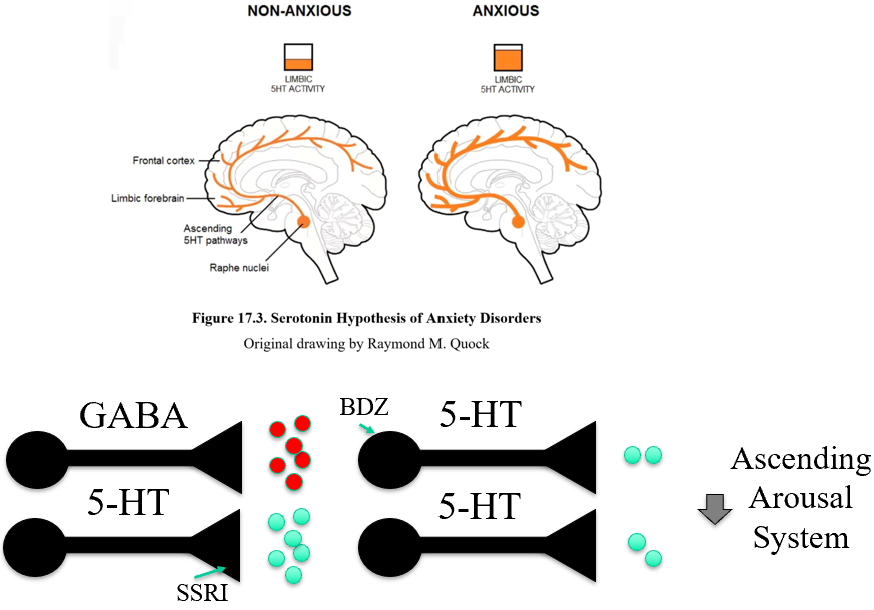
Mechanism: Anxiolytic effect is likely in the limbic system high density of GABAA a2d of HVCC to reduce excitation ; Benzodiazepenes potentiate GABA binding enhance the affinity + Increase frequency of channel opening; NOT EFFICACY
Advantages: Rapid onset of action
Relatively High therapeutic index
Very effective for acute anxiety and effective for other forms of anxiety
Benzodiazepine use should be “short term”
Disadvantages: Tolerance
CNS depressants/sedative
Impair cognition/memory
Additive danger with opioids, alcohol etc.
DEA Schedule IV habituation/dependence/abuse
Classification of Benzodiazepenes based on elimination
Midazolam (Versed) - v. short! <<*; Chlordiazepoxide * (Librium), Chlorazepate * (Tranxene)
Oxazepam */** (Serax), Alpralozam** (Xanax); ; ; Lorazepam** (Ativan); Temazepam**(Restoril)
Diazepam ***(Valium); Clonazepam*** (Klonapin)
* Short-acting (3-8 hours)
** Intermediate (6-24 hours)
*** Long-acting (1-3 days)
First line Anxiolytics
SSRIs
SNRIs
(slow onset)
Drugs WITH Anxiolytic Properties
ØSelective Serotonin Reuptake Inhibitors (SSRIs)
ØSerotonin-Norepinephrine Reuptake Inhibitors (SNRIs)
ØTricyclic Antidepressants
Disadvantage (all) - relatively slow onset of action
ØGABApentinoids: Pregabalin and Gabapentin (for GAD)
inhibit neurotransmitter release through binding to
a2d (alpha 2 delta) subunit of presynaptic calcium channel. “Atypical calcium channel blocker”
Disadvantage safety – FDA warning of severe/ fatal breathing problems especially in combination with opioids and in patients at risk for decreased lung function; abuse liability
Acute and Novel Anxiolytic Drugs
Acute:
ØBeta-blockers e.g. Propranolol; Atenolol
Used for performance and social anxiety
Only treats physiological symptoms (palpitations, tremor and gastrointestinal upset, etc.); Acute action (Like benzodiazpenes)
Novel:
ØBuspirone (Buspar) - 5-HT1A agonist
Efficacy comparable to diazepam but a relatively selective anxiolytic no sedative, hypnotic, anticonvulsant, muscle relaxant properties, minimal abuse liability, unsuitable for acute anxiety – slow onset of action
Comparable Anxiolytic action/efficacy of:
Bendoziazepenes, Buspirone, and Antidepressants

SSRIs / SNRIs
INDIRECT Action on Anxiety: Acts on 5-HT to decrease 5-HT at ascending arousal system
General uses of sedative-hypnotic drugs
•Relief of anxiety
•Insomnia
•Sedation and amnesia (e.g. pre-anesthesia allows less “hypnotic”; suitable for short uncomfortable procedures)
•As a component of balanced anesthesia
•Treatment of epilepsy, seizures, status epilepticus
•Muscle relaxants for neuromuscular disorders (including back pain)
•Treatment/control of ethanol or other sedative-hypnotic withdrawal states
Sedative/hypnotic drugs
Benzodiazepines (bold, good for insomnia)
Clonazepam ***(Klonopin); Diazepam ***(Valium); Lorazepam **(Ativan); Oxazepam (Serax); Triazolam (Halcion); Estazolam *(ProSom); Temazepam (Restoril); Flurazepam *(Dalmane); Quazepam ***(Doral); Midazolam <*(Versed)
Non-benzodiazepine agonists: Z drugs
Zaleplon (Sonata); Zolpidem (Ambien); Zopiclone (both isomers) marketed as Eszopiclone (Lunesta)
Barbiturates
Amobarbital **(Amytal); Aprobarbital (Alurate); Butabarbital (Butisol); Mephobarbital (Mebaral); Methohexital (Brevital); Pentobarbital* (Nembutal); Phenobarbital ***(Luminal); Secobarbital **(Seconal); Thiopental* (Pentothal)
Barbiturates
Amobarbital **(Amytal); Aprobarbital (Alurate); Butabarbital (Butisol); Mephobarbital (Mebaral); Methohexital (Brevital); Pentobarbital* (Nembutal); Phenobarbital ***(Luminal); Secobarbital **(Seconal); Thiopental* (Pentothal)
*Ultrashort (5-15 min)/induction of anesthesia
**Short acting (3-8 hrs)/insomnia/preoperative sedation
***Long acting (days) treatment of seizures
Newer GABA receptor activators are also used for anesthesia
-LOWER TI THAN BENZOS