3.4.2 DNA and protein synthesis

0.0(0)
Studied by 0 people
call kaiCall Kai
learnLearn
examPractice Test
spaced repetitionSpaced Repetition
heart puzzleMatch
flashcardsFlashcards
GameKnowt Play
Card Sorting

1/5

encourage image

There's no tags or description

Looks like no tags are added yet.

6 Terms

1
New cards

the structure of mRNA

-Messenger RNA (mRNA) is a type of RNA synthesised during the process of transcription.

-It carries the genetic code from the DNA to the ribosomes, where it’s used to make a protein during translation.

-Therefore, mRNA acts as a template for protein synthesis.

-Features:

  • Single-stranded, linear molecule.

  • Contains a base sequence complementary to a DNA sequence.

  • Contains codons, which are sets of three bases that code for an amino acid.

  • Small enough to leave the nucleus.


2
New cards

the structure of tRNA:

tRNA:

-Transfer RNA (tRNA) is a type of RNA used in the process of translation.

-Its role is to transport amino acids to ribosomes to build up a polypeptide chain.

-Features:

  • Single-stranded molecule folded into a clover-leaf shape.

  • Uses hydrogen bonds between complementary base pairs to hold it in shape.

  • Contains a specific sequence of three bases at one end, known as the anticodon.

  • Contains an amino acid binding site at the opposite end.


3
New cards

Comparing the function of mRNA and tRNA

knowt flashcard image
4
New cards

The process of Transcription:

-Transcription is the initial step in the synthesis of proteins. It involves creating an mRNA copy of a gene from the DNA template

-In eukaryotic cells, transcription takes place within the nucleus. This mRNA then exits the nucleus and enters the cytoplasm, where translation occurs.


Transcription begins with the RNA polymerase enzyme binding to DNA.

  1. The hydrogen bonds between the DNA bases break via the action of DNA helicase, and the two strands of the double helix separate.

  2. One strand acts as the template for mRNA synthesis.

  3. Free RNA nucleotides align with the DNA template through complementary base pairing.

  4. In the RNA molecule, uracil pairs with adenine, while adenine pairs with thymine, and cytosine pairs with guanine.

  5. RNA polymerase catalyses the formation of phosphodiester bonds between adjacent RNA nucleotides.

  6. A complementary mRNA strand is formed, which is removed from the template strand, forming pre-MRNA

  7. mRNA is released, detaches from DNA, and DNA rewinds into its double helix structure.

  8. DNA polymerase joints template strands back together to form phosphodiester bonds


Splicing:

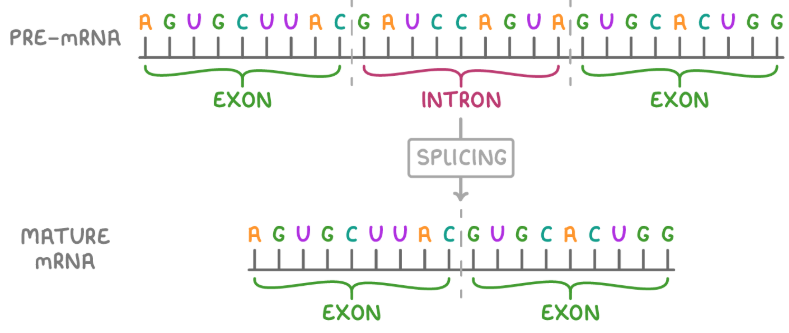
  1. In eukaryotic cells, both introns (non-coding regions) and exons (coding regions) of DNA are transcribed into the initial mRNA transcript (pre-mRNA).

  2. This pre-mRNA undergoes RNA splicing, a process where introns are removed, and exons are joined together.

  3. This produces mature mRNA consisting of only exon sequences.

  4. This mature mRNA then travels out of the nucleus for translation.


<p><span style="background-color: transparent;">-Transcription is the initial step in the synthesis of proteins. It involves creating an mRNA copy of a gene from the DNA template</span></p><p><span style="background-color: transparent;">-In eukaryotic cells, transcription takes place within the nucleus. This mRNA then exits the nucleus and enters the cytoplasm, where translation occurs.</span></p><p><br><span style="background-color: transparent;">Transcription begins with the RNA polymerase enzyme binding to DNA.</span></p><ol><li><p><span style="background-color: transparent;">The <strong>hydrogen bonds </strong>between the DNA bases break via the action of <strong>DNA helicase</strong>, and the two strands of the double helix separate.</span></p></li><li><p><span style="background-color: transparent;"><strong>One strand</strong> acts as the template for mRNA synthesis.</span></p></li><li><p><span style="background-color: transparent;">Free RNA nucleotides align with the DNA template through complementary base pairing.</span></p></li><li><p><span style="background-color: transparent;">In the RNA molecule, uracil pairs with adenine, while adenine pairs with thymine, and cytosine pairs with guanine.</span></p></li><li><p><span style="background-color: transparent;"><strong>RNA polymerase</strong> catalyses the formation of <strong>phosphodiester bonds</strong> between <strong>adjacent RNA nucleotides.</strong></span></p></li><li><p><span style="background-color: transparent;">A complementary mRNA strand is formed, which is removed from the template strand, forming pre-MRNA </span></p></li><li><p><span style="background-color: transparent;">mRNA is released, detaches from DNA, and DNA rewinds into its double helix structure.</span></p></li><li><p><strong>DNA polymerase</strong> joints template strands back together to form phosphodiester bonds </p></li></ol><p></p><p><span style="background-color: transparent;"><strong>Splicing:</strong></span></p><ol><li><p><span style="background-color: transparent;">In eukaryotic cells, both introns (non-coding regions) and exons (coding regions) of DNA are transcribed into the initial mRNA transcript (pre-mRNA).</span></p></li><li><p><span style="background-color: transparent;">This pre-mRNA undergoes RNA splicing, a process where introns are removed, and exons are joined together.</span></p></li><li><p><span style="background-color: transparent;">This produces mature mRNA consisting of only exon sequences.</span></p></li><li><p><span style="background-color: transparent;">This mature mRNA then travels out of the nucleus for translation.</span></p></li></ol><p></p>
5
New cards

Difference between transcription in prokaryotes and eukaryotes:

-Differences between transcription in prokaryotes and eukaryotes:

  • In prokaryotes, mRNA is directly produced from transcription without any splicing.

  • In eukaryotes, pre-mRNA is spliced after transcription to remove introns before it is transported to the cytoplasm.

<p><span style="background-color: transparent;"><strong>-</strong>Differences between transcription in prokaryotes and eukaryotes:</span></p><ul><li><p><span style="background-color: transparent;">In prokaryotes, mRNA is directly produced from transcription without any splicing.</span></p></li><li><p><span style="background-color: transparent;">In eukaryotes, pre-mRNA is spliced after transcription to remove introns before it is transported to the cytoplasm.</span></p></li></ul><p></p>
6
New cards

Translation:

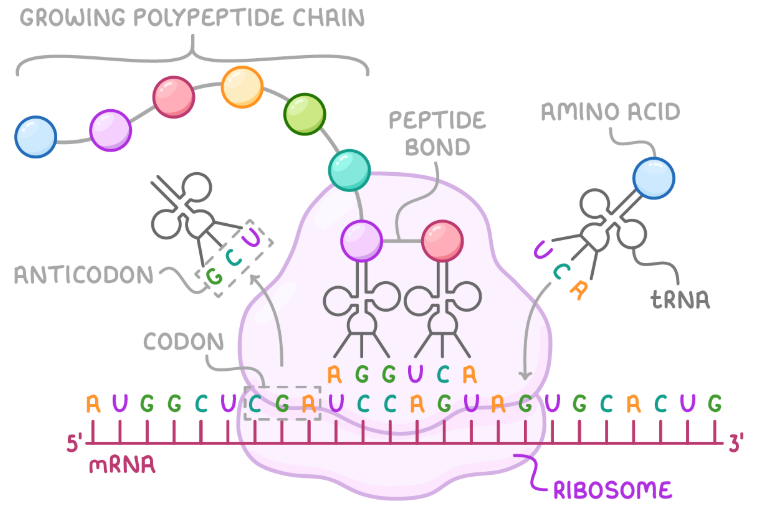
-Translation occurs in the cytoplasm, specifically on the ribosome in both eukaryotic and prokaryotic cells.

-Translation is the process of decoding the information in messenger RNA (mRNA) to synthesise a polypeptide chain, with the help of transfer RNA (tRNA). This chain then folds into a functional protein.


Translation involves several key steps:

1)The ribosome attaches to the mRNA strand at a start codon (AUG).

2)A tRNA molecule, carrying a specific amino acid and with an anticodon (UAC) that is complementary to the start codon, binds to the mRNA.

3)A second tRNA molecule with an anticodon complementary to the next mRNA codon, and also carrying a specific amino acid, attaches to mRNA.

4)The amino acids carried by the first two tRNA molecules are linked together via a peptide bond using ATP.

5)The first tRNA molecule detaches from mRNA and is free to collect another amino acid for future use.

6)The ribosome moves along mRNA, allowing another tRNA molecule, which carries the next amino acid, to bind to the next codon on mRNA.

7)The process from step 4 to 6 is repeated, which elongates the polypeptide chain.

8)At any point during this process, two tRNA molecules can be attached to the ribosome.

9)The sequence continues until the ribosome reaches a stop codon on mRNA.

10)The completed polypeptide chain detaches from the ribosome.
<p><span style="background-color: transparent;">-Translation occurs in the cytoplasm, specifically on the ribosome in both eukaryotic and prokaryotic cells.</span></p><p><span style="background-color: transparent;">-Translation is the process of decoding the information in messenger RNA (mRNA) to synthesise a polypeptide chain, with the help of transfer RNA (tRNA). This chain then folds into a functional protein.</span></p><p></p><p><span style="background-color: transparent;">Translation involves several key steps:</span><br></p><p><span style="background-color: transparent;">1)The ribosome attaches to the mRNA strand at a start codon (AUG).</span></p><p><span style="background-color: transparent;">2)A tRNA molecule, carrying a specific amino acid and with an anticodon (UAC) that is complementary to the start codon, binds to the mRNA.</span></p><p><span style="background-color: transparent;">3)A second tRNA molecule with an anticodon complementary to the next mRNA codon, and also carrying a specific amino acid, attaches to mRNA.</span></p><p><span style="background-color: transparent;">4)The amino acids carried by the first two tRNA molecules are linked together via a peptide bond using ATP.</span></p><p><span style="background-color: transparent;">5)The first tRNA molecule detaches from mRNA and is free to collect another amino acid for future use.</span></p><p><span style="background-color: transparent;">6)The ribosome moves along mRNA, allowing another tRNA molecule, which carries the next amino acid, to bind to the next codon on mRNA.</span></p><p><span style="background-color: transparent;">7)The process from step 4 to 6 is repeated, which elongates the polypeptide chain.</span></p><p><span style="background-color: transparent;">8)At any point during this process, two tRNA molecules can be attached to the ribosome.</span></p><p><span style="background-color: transparent;">9)The sequence continues until the ribosome reaches a stop codon on mRNA.</span></p><p><span style="background-color: transparent;">10)The completed polypeptide chain detaches from the ribosome.</span></p>



