Goodwin Renal
 Call Kai
 Learn
Learn Practice Test
 Spaced Repetition
 Match
Match Flashcards
 Knowt Play
1/11

There's no tags or description
Looks like no tags are added yet.
Name | Mastery | Learn | Test | Matching | Spaced | Call with Kai | Chat |
|---|
No analytics yet
Send a link to your students to track their progress
12 Terms
What happens to GFR if there is significant loss of blood volume?
A large loss of blood volume decreases GFR significantly because:
Decreases in blood volume or pressure can shut down renal filtration:
§ Blood volume decreases and renal perfusion pressure decreases
§ Glomerular hydrostatic pressure decreases
§ These both cause GFR to decrease
What portion of the nephron has the highest osmolarity?
The deep medullar region (bottom of loop of Henle and collecting duct)
o Countercurrent multiplier creates hyperosmotic medulla
o Osmolarity can reach ~1200 mOsM
- High osmolarity allows water to be reabsorbed later
What portion of the nephron has the lowest osmolarity?
The thick ascending limb/ early distal tubule
o AKA diluting segment
o Mechanism:
§ Na+, K+, Cl- are actively pumped out
§ Not permeable to water
o Results in very dilute filtrate
Urine osmolarities can vary between 50-1200mOsM. Why?
The kidney can adjust water reabsorption based on body needs
o Controlled mainly by ADH (vasopressin)
o Two extremes:
§ Low ADH – dilute urine
§ High ADH – concentrated urine
o Kidney tunes this balance to maintain osmolarity and homeostasis
What hormone regulates the rate of water reabsorption in the distal tubule and collecting ducts?
ADH – vasopressin
o Inserts Aquaporin-2 channels into cells
o Water moves:
§ From tubule into blood
o No ADH = no water reabsorption causing diluted urine
How are cells of the distal nephron able to respond so quickly to hormonal stimulation?
They use pre-made proteins (Aquaporins).
o ADH causes rapid insertion of AQP2 channels
o No need for new protein synthesis
o Leads to FAST response
What hormone plays a critical role in sodium reabsorption and how is it regulated?
Aldosterone:
o Increases Na+ reabsorption and K+ secretion
Regulation
o Controlled by RAAS (Renin-Angiotensin-Aldosterone System)
§ Triggered by:
· Low bp
· Low blood volume
· High potassium
- Helps restore volume and BP
What are the side effects of Angiotensin II on blood pressure?
Angiotensin II raises blood pressure through multiple mechanisms:
a. Vasoconstriction
b. Increased aldosterone causing increased sodium and water retention/absorption
c. Increased Vasopressin causing increased water retention/absorption
d. Increased thirst
e. Increased sympathetic activity
- Strong increase in BP and volume
What are the effects of ANP on the renal system?
ANP (Atrial Natriuretic Peptide) does the opposite of RAAS:
a. Increases GFR (more filtration)
b. Decreases Na+ reabsorption
c. Decreases water reabsorption
d. Inhibits renin, aldosterone, and ADH
Net effect: Decreased blood volume and bp
What hormone helps to regulate potassium concentration in plasma?
Aldosterone
o Increases K+ secretion into urine
o Can excrete up to 150% of filtered load
Keeps plasma K+ in a tight range
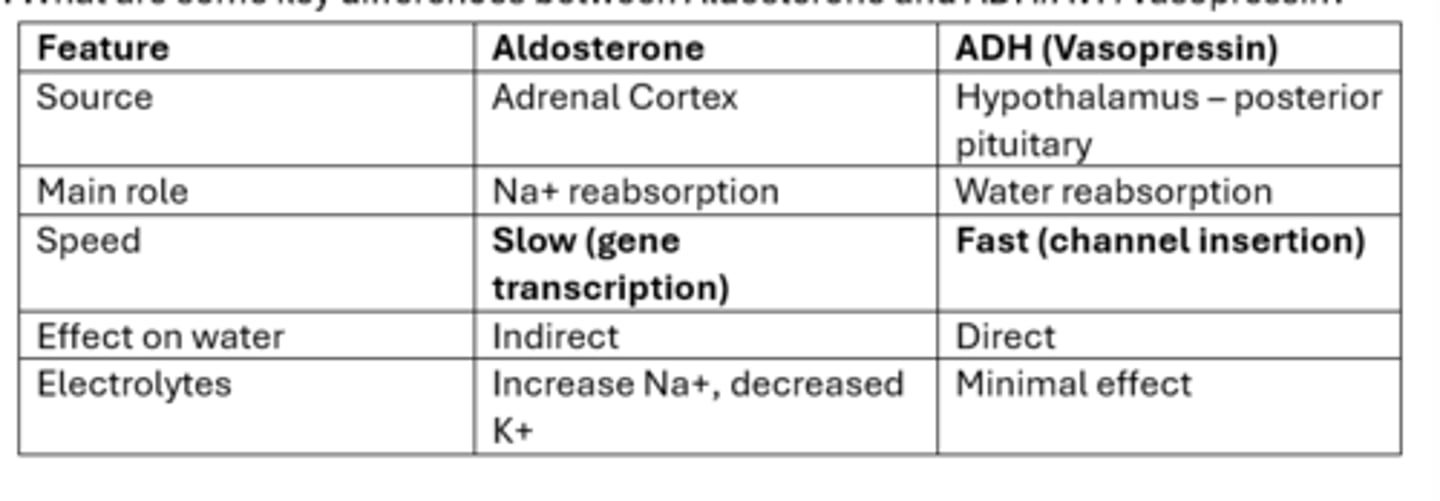
What are some key differences between Aldosterone and ADH/AVP/Vasopressin?
Aldosterone = salt
ADH = Water
Can you die from drinking too much water?
Yes
o Excess water causes decreased plasma osmolarity
o Leads to:
§ Hyponatremia
§ Cell swelling (especially in the brain)