D4 Continuity and change of ECOSYSTEMS (SL)
 Call Kai
 Learn
Learn Practice Test
 Spaced Repetition
 Match
Match Flashcards
 Knowt Play
1/99

There's no tags or description
Looks like no tags are added yet.
Name | Mastery | Learn | Test | Matching | Spaced | Call with Kai | Chat |
|---|
No analytics yet
Send a link to your students to track their progress
100 Terms
Selective Pressure
A selective pressure is an environmental factor that can influence the success of a population. It is usually a factor that favours one variation over another in that environment so plays a crucial role in natural selection.
Fitness in Evolutionary Terms
An organism's biological fitness relates to their ability to pass on their genes. This is generally linked to survival as living long enough to reproduce is crucial for genetic contribution.
Sexual Selection
Sexual selection is a process similar to natural selection in that some organisms are more successful at producing offspring, leading to the increase in their genetic attributes in their population over time.
Antibiotic Resistance
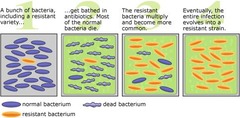
Not being killed by antibiotics is a genetic trait in some bacteria. When the colony is exposed to antibiotics, the non-resistant bacteria die and the resistant bacteria have a selective advantage and survive to reproduce.
Paradigm Shift in Darwin's Theory
The word 'paradigm' refers to a framework to interpret information in Science. Darwin's theory highlighted that evolution is driven only by heritable traits and changed the paradigm through which evolutionary change is still viewed.
Causes of Genetic Variation - Mutation
Many mutations have a negative or deleterious impact on the phenotype of an individual since most proteins are structured precisely for their function. However, some mutations give rise to a new phenotype and add variation.

Causes of Genetic Variation - Meiosis
Gametes produced by individuals are all unique from one another due to two processes during Meiosis: Independent Assortment and crossing over, which cause new combinations of alleles.

Causes of Genetic Variation - Sexual Reproduction
Once unique gametes have been created, it is totally random as to which one is fertilised during reproduction, ensuring even siblings are always unique.
Carrying Capacity
The maximum population size of a species that an environment can sustain indefinitely without being degraded.
Natural Selection
The process where organisms better adapted to their environment tend to survive and produce more offspring.

Overproduction of Offspring
A reproductive strategy where more offspring are produced than can survive, leading to competition for resources.
Abiotic Factors
Non-living chemical and physical parts of the environment that affect living organisms and the functioning of ecosystems.
Acquired Trait
A characteristic that an individual develops during its lifetime, often due to environmental influences or behavior.
Heritable Trait
A trait that is encoded in an organism's DNA and can be passed on to offspring.
Birds of Paradise
A group of birds known for their elaborate plumage and mating displays, influenced by sexual selection.

John Endler's Guppy Experiment
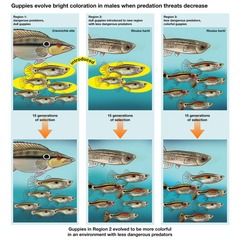
A study investigating the effect of predation on the color variation of guppies, showing that brighter colors attract mates but may be less advantageous in the presence of predators.
Sustainability
The ability of an ecosystem to maintain ecological processes, biodiversity, and productivity over time.
Ecological Tipping Point
The threshold at which an ecosystem can no longer sustain itself due to significant disruption.
Amazon Rainforest
The largest rainforest in the world, known for its complex water cycle that supports its sustainability.

Camouflage
The ability of an organism to blend in with its environment to avoid detection by predators.
Genetic Variation
The diversity in gene frequencies among individuals within a population.
Evolution
The change in the heritable characteristics of biological populations over successive generations.
Depletion of Amazon Rainforest
Currently 17% of the original Amazon rainforest has been depleted, mainly around the edges.

Temperature and Rainfall Shifts
Already there have been temperature and rainfall shifts, suggesting tipping point could be close.
Sufficient Supply of Energy
A sustainable ecosystem needs sufficient energy to meet the needs of all the organisms.
Photosynthesis
Key process where plant life creates glucose/carbon compounds to meet the needs of every trophic level in the ecosystem.
Nutrient Recycling
Processes that cycle nutrients from dead organisms back into the ecosystem.
Decomposers
Play a crucial role in cycling carbon, nitrogen, phosphorus, and other trace elements.
Genetic Diversity
Crucial for ensuring a species can adapt to changes in their environment.
Species Biodiversity
Genetic diversity is necessary for species diversity which is necessary for ecosystem diversity.
Response to Climate Change
A healthy sustainable ecosystem would have enough genetic diversity for its species to maintain a wide range of tolerance.
Environmental Disruptions to Sustainability
Include overharvesting, erosion, eutrophication, and selective removal of important species.
Overharvesting
Removal of crops or trees that disrupt nutrient recycling.
Erosion
Causing the loss of nutrients.
Eutrophication
Too many nutrients in water leading to plant overgrowth.
Keystone Species
Some species that are especially important, and their removal has a significant impact.
Mesocosm
A small experimental area set up as an ecological experiment, functioning as a self-contained sustainable mini ecosystem.
Sealed Glass Mesocosm
A model of a sustainable ecosystem where matter must be recycled.
Open Tank Mesocosm
Not a true model of sustainable ecosystems as matter can enter or exit.
Carbon Dioxide and Oxygen Cycling
Cycled by plant and animal life in a mesocosm.
Transparent Sides of Mesocosm
Allow sunlight (the energy source) to enter the system.
Terrestrial Mesocosm
A type of mesocosm that mimics a terrestrial ecosystem, often called terrariums, requiring more components to build effective soil.
Aquatic Mesocosm
A type of mesocosm that mimics an aquatic ecosystem.
Winogradsky Column
A microbial mesocosm that creates layers differing in abiotic environments, allowing different bacteria to thrive.
Facultative Anaerobes
Bacteria that can survive with or without oxygen.
Obligate Anaerobes
Bacteria that can only survive in environments without oxygen.
Trophic Cascade
The impact on other trophic levels when a keystone species is removed, destabilizing the ecosystem.
Top Down Control
A concept referring to the influence of top predators on the population sizes of lower trophic levels.
Soil Erosion
The loss of the upper soil layer, called topsoil, which is nutrient-rich and critical for ecosystem health.
Leaching
The process where rain or irrigation water dissolves nutrients in the soil and carries them away from plant roots.
Agrochemicals
Chemicals used in agriculture, including fertilizers and pesticides, which can lead to environmental problems.
Carbon Footprint
The total amount of greenhouse gases generated by an activity, with agriculture contributing around 9-12%.
Tillage
The agricultural practice of preparing soil for crops, involving loosening the soil, often requiring fossil fuel combustion.
Biodiversity
The variety of life in a particular ecosystem, including the number of species and their interactions.
Nutrient Runoff
The process where excess nutrients from soil are washed away into water bodies, often causing pollution.
Topsoil
The uppermost layer of soil, which is the most nutrient-rich and vital for plant growth.
Clover and Rye
Simple crops that farmers plant to cover soil and limit erosion.
Abiotic Environments
Non-living chemical and physical parts of the environment that affect living organisms.
Agrochemical Use
Looking for biological alternatives to reduce chemical inputs.
Monocultures
Looking for alternative plantation concepts with multiple species.
Biochemical Oxygen Demand (BOD)
The amount of oxygen required by bacteria to complete their own cellular respiration, which increases with decaying algae.
Biomagnification
The process where higher trophic levels accumulate higher concentrations of toxins due to consuming multiple lower trophic level organisms.
Biodegradable
Something that can be broken down completely and dissolve into soil without leaving remaining chemicals or plastics.
Compostable
A term used for materials that are completely plastic-free and able to dissolve without leaving plastic.
Macroplastics
Plastics larger than 5mm, including single-use plastic bottles and bags.
Microplastics
Plastic debris that is less than 5mm, which can be ingested unknowingly by fish and other organisms.
Rewilding
Any activities that are conservation efforts aimed at restoring and protecting natural processes and wilderness areas.
Fertilisers
One of the main causes of surplus nutrients leading to eutrophication, usually full of usable nitrogen.
Biomagnification of Mercury
The process where mercury is converted by microorganisms into methyl mercury, absorbed by small fish, and transferred up the food web.
Biomagnification of DDT
A synthetic insecticide developed in the 1940s that was absorbed by phytoplankton and resulted in high levels in top predators.
Ecological Succession
A predictable series of change over time in the species that live in an area.
Primary Succession
Occurs when new land is created and organisms arrive to prepare the land for other living organisms, with no pre-existing soil.
Secondary Succession
The process of change in species composition that occurs after a disturbance in an area that has existing soil.
Methyl Mercury
A form of mercury that is absorbed by small fish and transferred up the food web.
DDT
Dichloro-diphenyl-trichloroethane, a synthetic insecticide that caused environmental harm and was banned in the USA in 1972.
Invasive Species
Non-native species that adversely affect the habitats they invade.
Apex Predators
Top predators in an ecosystem that have few or no natural enemies.
Gene Flow
The transfer of genetic variation from one population to another.
Biotic Factors
Living components of an ecosystem that affect the survival of organisms.
Human Management
Active intervention by humans in natural processes.
Natural Processes
Processes that occur in nature without human intervention.
Environmental Pollution
The introduction of harmful substances or products into the environment.
Pioneer Species
Pioneer species are the first species to live in a newly establishing ecosystem. When there is bare rock during primary succession, the pioneer species are lichens and moss which are photosynthetic and do not use roots so can grow in harsh environments. They are responsible for breaking down the rock into soil. For secondary succession, the pioneer species to return first would be small grasses and flowers.
Climax Community
The pinnacle of succession is the most diverse and populated ecosystem called the Climax Community. The climax community is stable and will remain until a dramatic change in biotic and abiotic factors or natural disaster.
Cyclical Succession
Some ecosystems are marked by a changing cycle of communities. An example is a wood pasture that cycles through being a grassland, woodland and scrub. There is a predictable cycle whereby thicket allows protection for shade trees to grow which prevent thicket until they die and the cycle repeats.
Greenhouse Effect
Short-wave radiation from sunlight such as UV radiation penetrates the atmosphere and is re-emitted back as high-wave radiation. Greenhouse gases trap some of that re-emitted radiation and it is transmitted back and heats up the Earth. The addition of extra greenhouse gases through human activities enhances the effect and causes excess warming.
Infrared Radiation
When sunlight (shorter wavelengths including ultraviolet rays and visible light) hits an object, some of it is absorbed and then readmitted in the form of infrared radiation which is a longer wavelength form. This is the form of heat that gets trapped by greenhouse gases and sent back down to Earth, warming it.
Climate
Climate specifically refers to the long term patterns of both temperature and precipitation. Unlike weather which frequently changes, climate of a region should be a consistent feature. It is also important to recognise that it includes rainfall patterns and not just temperature.
Permafrost
Permafrost is a term for the soil that exists in very cold climates that is frozen solid. Permafrost is often below the surface which does contain thawed soil. But the permafrost means that most plants cannot survive because of the inability to form roots in the permafrost.
Albedo
The ability of a surface to reflect light.
Montane Species
Species that live on mountains, often with an altitude preference.
Upslope Migration
The shift of montane species towards higher altitudes due to climate change.
Greenhouse Gases
Gases that contribute to the greenhouse effect, primarily carbon dioxide and methane.
Positive Feedback Loop of Climate Change
A cycle where impacts of climate change cause further changes, such as melting ice decreasing albedo.
Tipping Point
The point where an ecosystem shifts from being a carbon sink to a carbon source.
Boreal Forest
A biome just below the tundra characterized by very cold average temperatures.
Impact of Climate Change on Migratory Birds
The trend of montane birds moving to higher latitudes over a period of 50 years.
Carbon Sink
An ecosystem that absorbs more CO2 than it releases.
Carbon Source
An ecosystem that releases more CO2 than it absorbs.
Poleward Migration
The movement of species towards the north and south poles due to climate change.