Microbiology Module 3 Quiz
 Call Kai
 Learn
 Practice Test
 Spaced Repetition
 Match
 Flashcards
 Knowt Play
1/177

There's no tags or description
Looks like no tags are added yet.
178 Terms
What is Lag Phase
cells adapt to the environment and synthesize new components- cell is essentially adjusting
What is Exponential Phase
growth rate is constant and maximal during this phase, and cell population is most uniform in chemical and physical properties
What effects Exponential Phase/Growth Rate
nutrient availability and growth conditions
What is Stationary Phase
when the total number of viable cells remains constant (growth rate and death rate are balanced)
What is Death Phase
when the number of viable cells declines exponentially due to increase in death rate, occurs due to resource depletion and waste accumulation
What is Long-Term Stationary Phase
some microbes can enter into this phase marked by successive waves of genetically distinct variants as bacteria continue to evolve, the death rate and growth rate are relatively constant here
Graph: Lag Phase

Graph: Exponential Phase

Graph: Stationary Phase
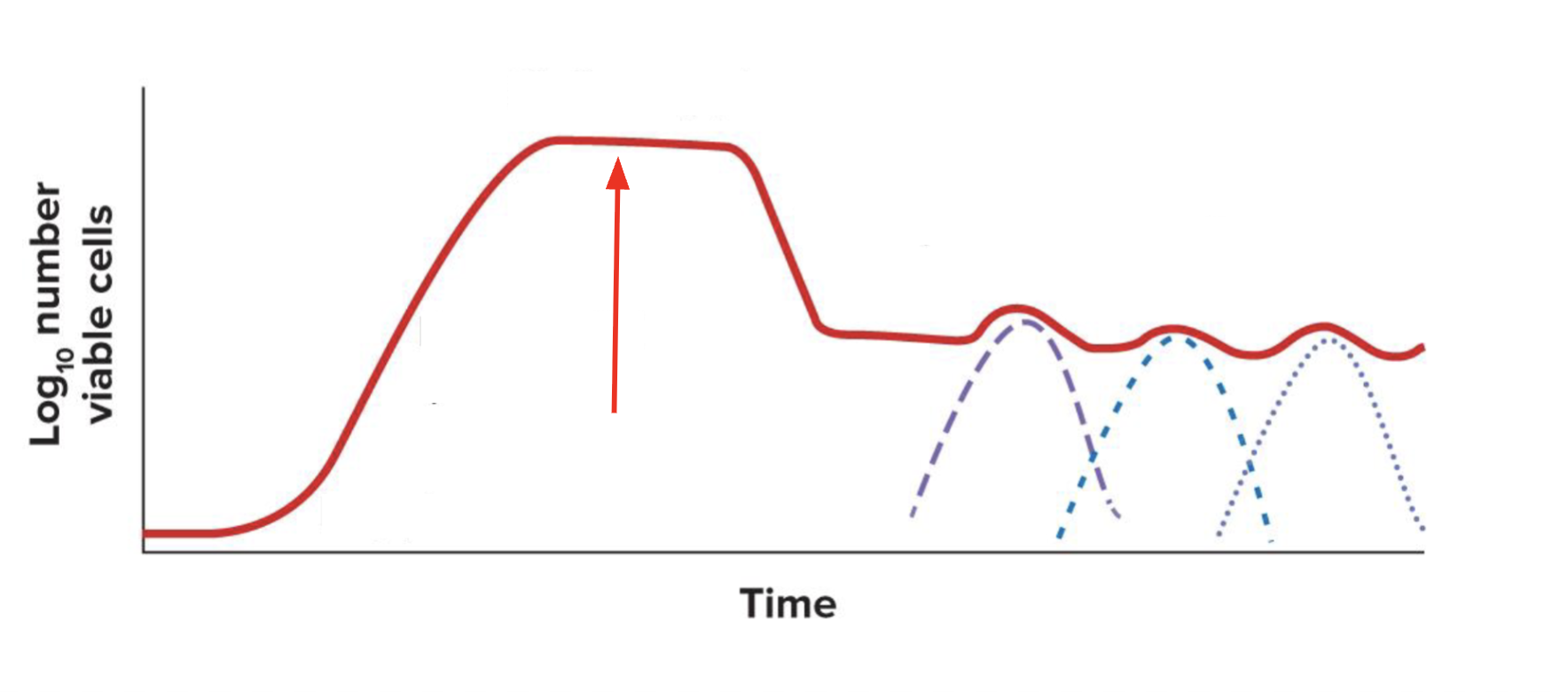
Graph: Death Phase

Graph: Long-Term Stationary Phase
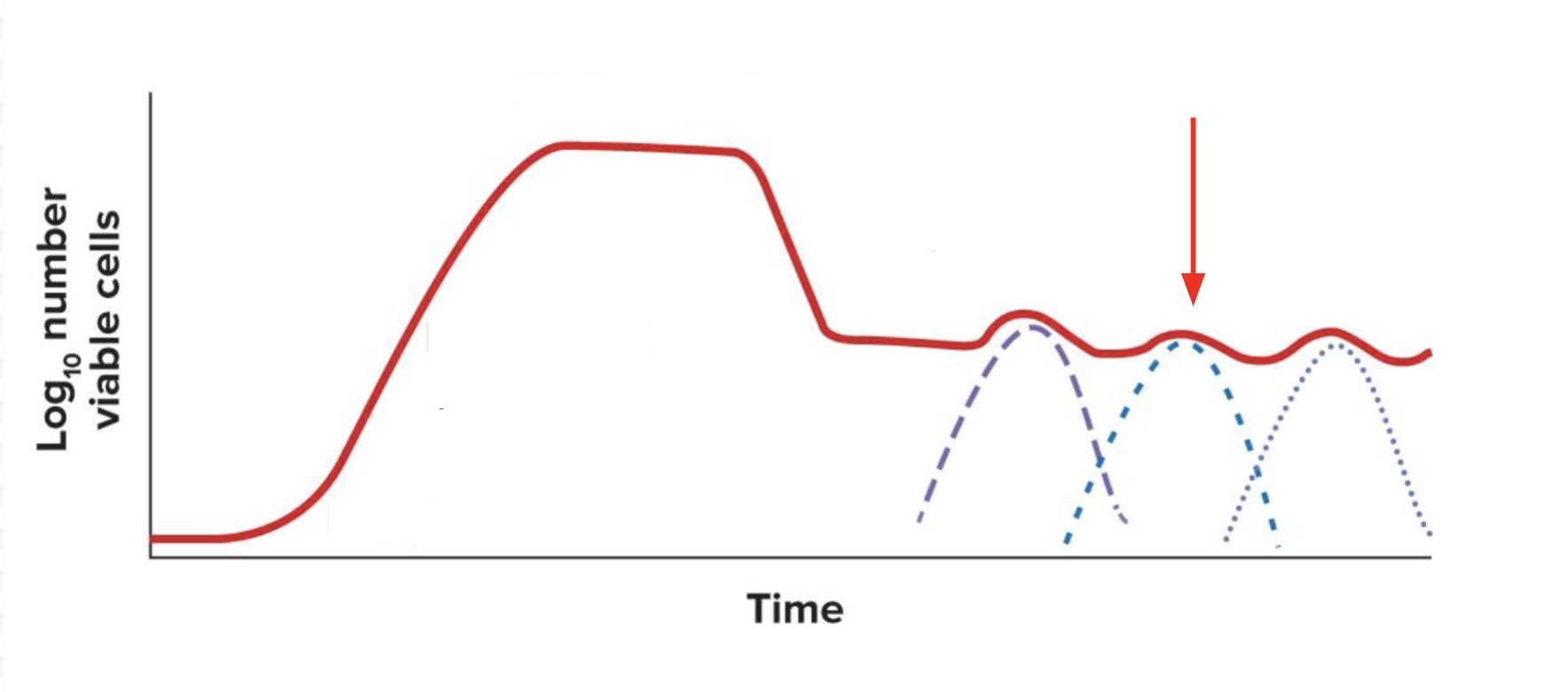
What is number of doublings
the amount of times the cells have doubled when getting from value Xo to Xf
= [log(Xf) - log(Xo)]/ log(2)
What is growth rate
the amount of time it takes for a population to double in size
= (# doublings)/ time; doublings per hour
What is doubling time
the amount of time it takes to double
= 1/ (growth rate); hours per generation/doubling
What is a psychrophile
A cell with a optimum growth temperature that is very cold/low
Psychrophile temperature range
0oC to 20oC
What is a psychrotroph
A cell with a more tolerant optimum growth temperature that is very cold/low
Psychrotroph temperature range
0oC to 35oC
What is a mesophile
A cell with an optimum growth temperature that is moderate
Mesophile temperature range
20oC to 45oC
What is a thermophile
A cell with an optimum growth temperature that is warm
Thermophile temperature range
45oC to 85oC
What is a hyperthermophile
A cell with an optimum growth temperature that is extremely warm
Hyperthermophile temperature range
85oC to 100oC
What is one of the main reasons cells have optimum temperatures
Enzymes work differently under different temperatures:
Too low = not catalytic/activity slows down
Too high = denaturation
What adaptations do microbes have to the heat
extra nucleic acid, protein, and membrane stability
How do microbes stabilize their proteins to the heat
Extra structural features: hydrogen bonds, noncovalent bonds, hydrophobic interiors, abundance of prolines, chaperone proteins
How do microbes stabilize their DNA to the heat
Nucleoid-associated proteins to stabilize
What adaptations do microbes have to the cold
extra flexibility in their structures
How do microbes prevent cytosolic freezing
Compatible solutes in the cytosol lower the freezing point
Antifreeze and ice-structuring proteins prevent ice crystals from growing
How do microbes adapt their proteins to the cold
Adjusting to flexibility: More glycine, Less hydrogen bonds and salt bridges, Reduced overall hydrophobicity
What is an obligate aerobe
a microbe that requires oxygen to grow
What is a microaerophile
a microbe that requires oxygen to grow but at concentrations lower than found in the atmosphere
What is a facultative anaerobe
a microbe that can grow with or without oxygen but grows fastest with oxygen
What is an aerotolerant anaerobe
a microbe that tolerates oxygen but does not use oxygen to grow
What is a strict anaerobe
a microbe that does not use oxygen to grow and will die when exposed to oxygen
Diagram: Obligate Aerobe

Diagram: Microaerophile

Diagram: Facultative Anaerobe
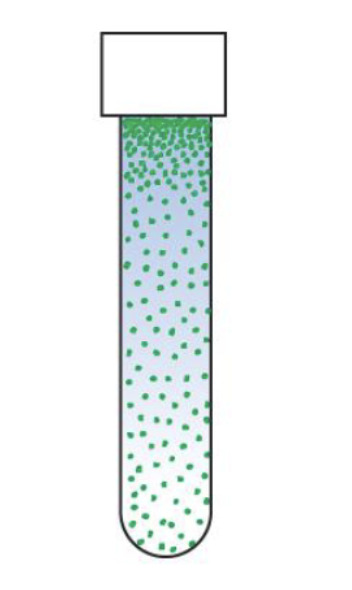
Diagram: Aerotolerant Anaerobe

Diagram: Strict Anaerobe

What oxygen related enzymes do obligate aerobes have
SOD, Catalase, Peroxidase
What oxygen related enzymes do microaerophile have
SOD, reduced Catalase, Peroxidase
What oxygen related enzymes do facultative anaerobe have
SOD, Catalase, Peroxidase
What oxygen related enzymes do aerotolerant anaerobe have
SOD, Peroxidase
What oxygen related enzymes do strict anaerobes have
none of the 3
What is SOD and how does it work
Superoxide dismutase enzyme
Breaks down Superoxide radical (O2- )
How does Catalase work
Breaks down hydrogen peroxide (H2O2)
How does Peroxidase work
Breaks down hydrogen peroxide (H2O2) with the help of NADH
What is the product of SOD
H2O2 and O2
What is the product of Catalase
2 H2O2 and O2
What is the product of Peroxidase
2 H2O and NAD+
What order are the oxygen enzymes used in
SOD with break down the enzymes → Catalase/Peroxidase will break down the H2O2 that SOD produces as a byproduct
What is osmolarity
the total concentration of all dissolved solutes in a liter of solution
What 3 types of solutions environments are there
hypertonic, hypotonic, isotonic solutions
What is a hypertonic solution
when the environmental solution has more solute than the inside of the cell
What is a hypotonic solution
when the environmental solution has less solute than the inside of the cell
What is an isotonic solution
when the osmolarity of the environmental solution and inside of the cell is equivalent
How do microbes react in hypertonic solutions
the cell expels water, shrinks, and wrinkles
How do microbes react in hypotonic solutions
the cell lets in water, swells, and bursts
How do microbes react in isotonic solutions
the cell is in stasis, letting in equal amounts of water and solute, remaining healthy size
How do microbes adapt to hypotonic solutions
Mechanosensitive channels detect stretching in the plasma membrane and allow solutes to exit cytoplasm, preventing membrane rupture
How do microbes adapt to hypertonic solutions
produce compatible solutes → keeps high intracellular concentrations without disrupting metabolism and growth
“salt-in” strategy to accumulate K and Cl in cytoplasm → keeps high intracellular concentration but alters metabolism and growth
What is a nonhalophile
microbes that prefer low concentrations of NaCl
What is the optimal NaCl concentration for a nonhalophile
0 M - 1 M (approx)
What is a halotolerant
microbes that tolerate lower and higher concentrations of NaCl
What is the optimal NaCl concentration for a halotolerant
0 M - 3 M
What is a moderate halophile
microbes that prefer a range of moderate concentrations of NaCl
What is the optimal NaCl concentration for a moderate halophile
0.5 M - 3.5 M
What is an extreme halophile
microbes that prefer extremely high concentrations of NaCl
What is the optimal NaCl concentration for an extreme halophile
2 M - 4 M
What does the suffix -tolerant mean
able to grow in an extreme condition
What does the suffix -phile mean
typically requires extreme condition for growth
What is an acidophile
a microbe that thrives and grows best in acidic environments
What is the pH range for an acidophile
5 - 0 pH
What is a neutralophile
a microbe that thrives and grows best in neutral environments
What is the pH range for a neutralophiles
5.5 - 8 pH
What is an alkaliphile
a microbe that thrives and grows best in basic environments
What is the pH range for an alkaliphile
8.5 - 11 pH
Why is the pH of the environment impactful to a microbe
radical changes in environmental pH can disrupt the proton motive force- damaging membrane proteins and lipids, alter protein folding patterns and active sites, and kill the microbe if the pH of the cytoplasm gets too low
At what pH will a microbe die if the cytoplasmic pH gets past this value
under 5 - 5.5 pH
How do alkaliphiles adapt to a high pH
they have surface proteins with different isoelectric points that allow for optimal functioning at a higher pH
How do neutralophiles adapt to a high pH
adapts by altering membrane lipid composition and pumping protons out of the cell
How do neutralophiles adapt to a low pH
adapts by pumping protons into the cell
What does irradiation damage in a microbe?
DNA, membrane, proteins, and metabolites
How do microbes mitigate radiation damage to ROS (reactive oxygen species)
with SOD, catalase, and peroxidase
How do microbes mitigate radiation damage to DNA
with double-strand break (DSB) repair system
How do microbes mitigate radiation damage to membrane
by modifing fatty acids and murein (structure modification)
How do microbes mitigate radiation damage to protein
by hydrolyzing/breaking down the damaged protein
How do microbes mitigate radiation damage to metabolites
by protecting the proteome (the “extra” genes meant for specific environmental conditions)
What are the 3 ways growth media are classified?
chemical composition, physical nature, function
What are the 2 types of chemical composition
complex or chemically defined (synthetic)
What are the 3 physical forms of media
Liquid, semisolid, solid
What are the 4 functions of media
Supportive, enriched, selective, differential
What is a chemically defined media
a media where all components and concentrations are known
What is a chemically complex media
a media where some ingredients are of nonspecific chemical composition and/or concentration
What are some common ingredients found in complex media
peptones and extracts (like beef or yeast)
What is peptone
partially digested protein
What are beef/yeast extracts
Sources of amino acids, peptides, nucleotides, vitamins, and minerals
What is a liquid media and why is it used
completely liquid solution that allows microbes to grow freely, works best for faster growth