BIOCHEMISTRY EXAM 2
 Call Kai
 Learn
Learn Practice Test
 Spaced Repetition
 Match
Match Flashcards
 Knowt Play
1/257

There's no tags or description
Looks like no tags are added yet.
Name | Mastery | Learn | Test | Matching | Spaced | Call with Kai | Chat |
|---|
No analytics yet
Send a link to your students to track their progress
258 Terms
Monosaccharides
single unit sugars
General Formula for a carb
(CH2O)n
Aldehyde groups make molecules…
More Reactive

Ketose
a sugar with a ketone group
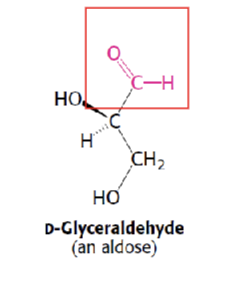
Aldose
a sugar with an aldehyde group
L almost always maps to…
S
D almost always maps to…
R

Can these sigma bonds rotate to interconvert these two molecules?
NO: because vertical sigma bonds are leaning AWAY from you in 3D space, and horizontal sigma bonds are leaning TOWARDS you
Possible stereoisomers =
2n where n is the number of chiral carbons
Ex. A 6-C aldose w/ 4 chiral carbons = 16 possible molecules
L or D is specified by…
the furthest chiral carbon from the aldehyde or keto group
Enantiomer vs Diastereomer
Enantiomer: differ on ALL chiral carbons
Diastereomer: only differ on one or more chiral carbons
What is an anomer?
a monosaccharide that readily cyclizes into a ring

If these reactions occur in an intramolecular fashion,…
the product is a ring
Glucopyranose
glucose in ring form
Pyranose vs Furanose
Pyranose: any 6 membered ring sugar
Furanose: any 5 membered ring sugar
These anomer reactions are in..
equilibrium (the ring reopens)
What is the equilibrium aqueous mixture of glucose at standard conditions?
33% alpha anomer
66% beta anomer
<1% linear
Is L or D the most common biological stereisomer?
D-stereoisomers

Be able to IDENTIFY all sugars

DRAW and desrcibe the structure of Glucose
good
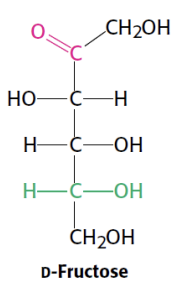
DRAW and desrcibe the structure of Fructose
good
Glucose and most monosaccharides are…
Reducing Sugars
Tissue Accumulation of Advanced Glycation End-products (AGEs)
may promote disease and aging
What can speed up the advanced glycation end product production?
reactive oxygen species from ETC can speed up process
What reaction causes food browning?
Maillard reaction
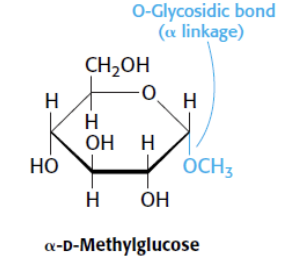
What type of glycosidic bond is it when attached to an alcohol?
O-glycosidic

What type of glycosidic bond is it when attached to nitrogen?
N-glycosidic
Linkage to anomeric carbon can happen in…
alpha or beta orientation

Other monosaccharide modifications..
DO NOT happen at the anomeric carbon
important for prokaryotes and eukaryotes

What modified monosaccharide is part of the peptidoglycan mesh?
Beta-D-Acetylglucosamine (GlcNAC)

What modified monosaccharide is important for neurodevelopment, cognition, and immune system function?
Sialic acid (Sia)
Modified sugars are used in…
Bacterial peptidoglycan cell wall
Complex Carbohydrates: Disaccharides are..
complex carbohydrates
2 glucoses joined by an 1,4 alpha bond (1 being the anomeric carbon)
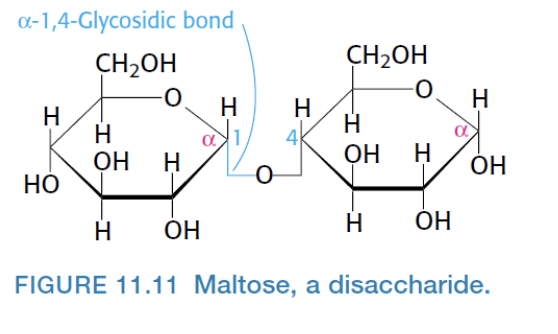
Reducing disaccharides can keep forming…
additional glycosidic bonds (formation of a glycosidic bond requires an enzyme)
If there is an H-C-OH on carbon 1 of the sugar to the right..
then the sugar is reducing
Lactose Intolerance
Digestive system needs to break the glycosidic bond between lactose (disacch.); Lactase helps break it down into galactose and glucose
Complex Carbohydrates: Polysaccharides
Glycogen
the most metabolically important homopolymer of glucose
Where is glycogen stored and what is the function?
in the liver and muscle; can be broken down to rapidly release glucose when repeated muscular activity is necessary
What does branching do?
makes it easier for enzymes to rapidly break into monosaccharide glucose units
What type of linkage does glycogen?
alpha-linkage
Why is it easier to chew bread than wood, even though they are both made up of glucose?
breaking the beta linkage (of cellulose- wood) enzymatically is difficult
Convergent evolution of ruminants and termites
both have bacterial symbionts that secrete cellulases that can break the beta linkage
Your body starts burning more fat after…
stored glycogen starts getting depleted
How do artificial sweeteners work?
transmembrane protein expressed on gustatory cells of the tongue, responsible for intial detection of sugary mono and di-saccharides
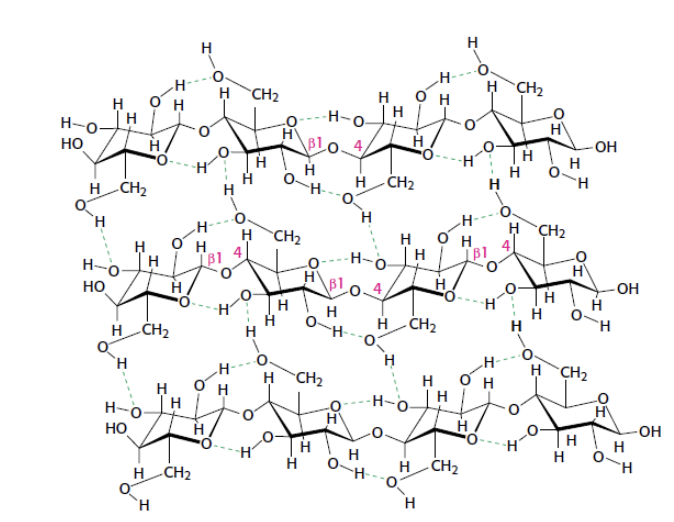
Complex Carbohydrates: Polysaccharides
Cellulose
Beta-1,4 linkages (plants); Beta is optimal for structure

Complex Carbohydrates: Polysaccharides
Starch
Alpha-1,4 linkages (plants); Alpha is optimal for storage

Complex Carbohydrates: Polysaccharides
Glycogen
Alpha-1,4 linkages (animals); Alpha is optimal for storage

Complex Carbohydrates: Chitin
Homopolymer of N-acetylglucoseamine (GlcNAc)
Like glucose but has acetylamine group at C2
exoskeleton of invertebrate arthropods

What kind of linkage is this?
β-1,4 glycosidic linkage

Complex Carbohydrates: Glycosaminoglycans (GAGs)
repeating chains of disaccharides
almost always components of the extracellular matrix
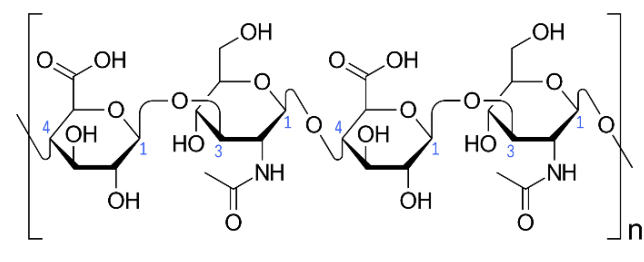
Complex Carbohydrates : Glycosaminoglycans (Hyaluronan)
Huge number of repeats
Highly hydroscopic; very viscous and elastic
Extremely important component of synovial fluid which lubricates joints that are highly impacted (knees, ankles)
Hydroscopic
binds a lot water

Which complex carbohydrate is an extremely important component of synovial fluid which lubricates joints that are highly impacted (knees, ankles)?
Glycosaminoglycans (Hyaluronan)
Complex Carbohydrates: Glycoproteins
“Generic” glycoproteins
Proteoglycans
Mucins
Glycoproteins: “Generic” glycoproteins
mostly protein w/ some sugars covalently attached
In which, organelle are sugars added to glycoproteins
Golgi Apparatus
Glycoproteins: Proteogylcans
glycoproteins covered densely w/ gylcosaminoglycans, mostly carbohydrate
Glycoproteins: Mucins
glycoprotein components of mucus, mostly carbohydrate
Complex Carbohydrates: Generic Glycoproteins
How are sugars added to proteins?
via a glycosidic bond (at the anomeric carbon)
N-linked glycosylation
to an Asparagine (Asn)
O-linked glycosylation
to a Serine (Ser) or Threonine (Thr)
What are the 2 flavors of glycoproteins, and which branching flavor has it?
Mannose branching
Complex branching
N-linked
Erythropoietin
secreted by kidneys and stimulates production of red blood cells
How does glycosylation affect the kidneys?
helps prevent kidneys from filtering out erythropoietin from the blood
How does glycosylation affect proteins?
helps proteins fold correctly and may be necessary for enzymatic function
can extend the conformation of extracellular proteins

Why is the LDL receptor stalk heavily glycosylated?
O-linked sugars keep the long stalk extended/unfolded, positioning the receptor’s working end far from the cell surface so it can interact with LDL
What kind of cell might have an LDL receptor?
Hepatocytes
What is the pathogenesis of Hurler’s Disease?
glycosaminoglycans cannot be degraded; their excess is stored in soft tissue of the face

What complex carbohydrate and Glycoprotein connects hyaluronan scaffold to other GAGs?
Proteoglycans
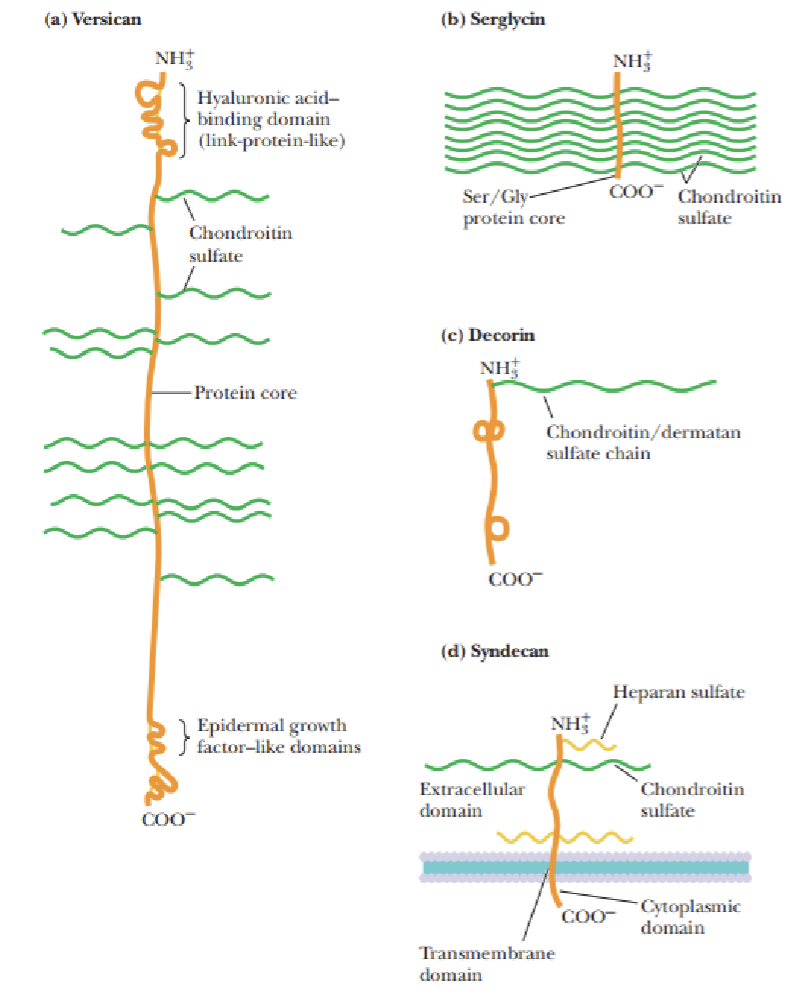
What are 5 functions of proteoglycans?
Protects cells from damage
Interacts w/ growth factors
Interacts w/ immune system
Crucial for function of cartilaginous joints
Altered expression in cancer (remodels the tumor microenvironment)

Mucins are components of..
mucus
What are the functions of mucins?
protection
lubrication
immune functions
Complex Carbohydrates: Blood Groups
Different people…
express different glycosyltransferases
Specific glycosylation patterns on erythrocytes are…
recognized by the immune system

Which blood group is a universal donor and which is an universal receiver?
O (Rh-) or O-negative: universal donor
AB (Rh+) or AB-positive: universal reciever
Lectins
proteins that can “read” carbohydrates
Mannan binding lectin
part of the innate immune sensing of fungi snd bcterial glycoproteins
What kind of domain do selectins have and what is their function?
lectin-domain
help leukocytes (neutrophils) of the inate immune systen ‘roll’ along endothelial (inner blood vessel) cell membrane
What are the 6 key properties of proteins?
are linear polymers of amino acids
have a variety of functional groups
interact w/ one another and other macromolecs.
undergo signif. conformational changes
some are enzymes
can be localized (nuclear, membrane, secreted, etc)
What is the primary determinant of the final FORM and FUNCTION of the protein?
the amino acid sequence
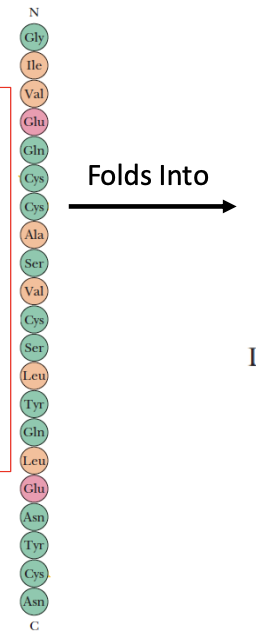
Primary Structure
linear structure of amino acids
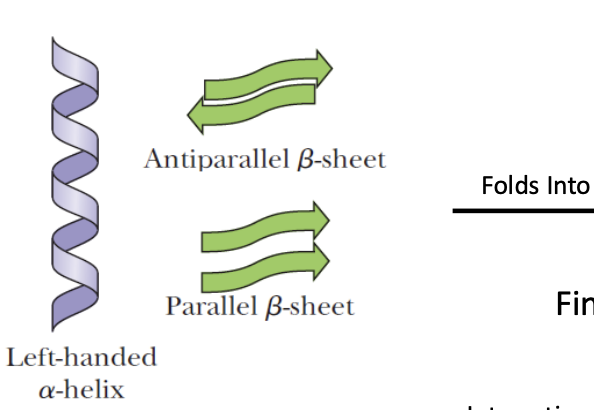
Secondary Structure
helices and sheets

Tertiary Structure
final (often globular) form of single polypeptide chain

Quaternary Structure
dimers, tetramers, etc.
prosthetic groups, cofactors

The basic structure of an Amino Acid
side chain, carboxylic acid group, amino group, R-group

Proteins only contain the…
L Isomer of Amino Acids
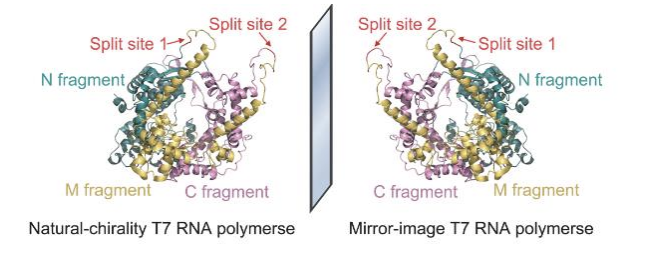
The authors of the Mirror image T7 transcription of chirally inverted ribosomal and functional RNAs generated a D-amino acid based RNA polymerase which makes L-RNA. Which elements have been completed?
Split site 1, Split site 2

Amino acids exist as Dipolar Ions in solution at…
Neutral pH
Sanger Sequencing
method for sequencing DNA
Edman degradation
different method for peptide sequencing

What amino acid do almost all proteins begin with?
Methionine (Met), because translation typically begins at the AUG/ATG start codon

How many amino acids are non-polar (hydrophobic), and what are they? (MINUS CYSTEINE)
9
Glycine (Gly)
Alanine (Ala)
Valine (Val)
Leucine (Leu)
Isoleucine (Ile)
Methionine (Met)
Proline (Pro)
Tryptophan (Trp)
Phenylalanine (Phe)
Aliphatic
open-chain carbon atoms
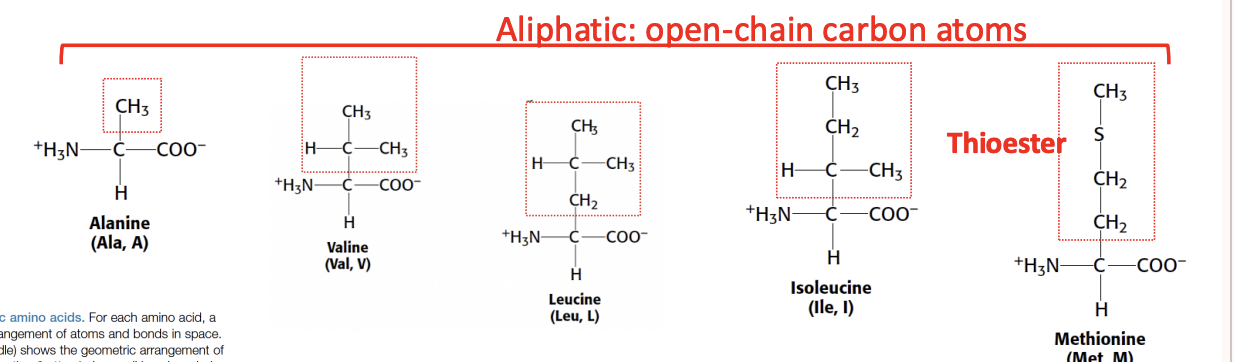
How amino acids are non-polar (hydrophobic) and aliphatic, and what are they?
5
Alanine (Ala)
Valine (Val)
Leucine (Leu)
Isoleucine (Ile)
Methionine (Met)

How many amino acids are polar (hydrophilic), and what are they?
6
(Hydroxyl Group)
Serine (Ser)
Threonine (Thr)
Tyrosine (Tyr)
(Carboxamide Group)
Asparagine (Asn)
Glutamine (Gln)
(Thiol Group)
Cysteine (Cys)
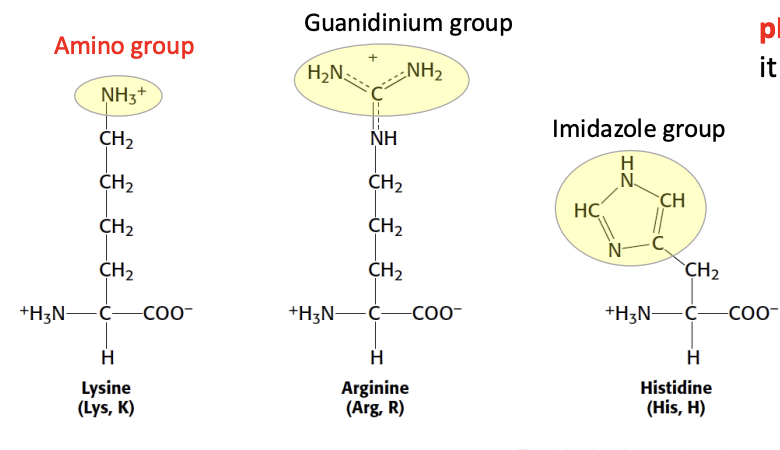
How many amino acids are positively charged (hydrophilic), and what are they?
Lysine (Lys)
Arginine (Arg)
Histidine (His)

How many amino acids are negatively charged (hydrophilic), and what are they?
Aspartate (Asp)
Glutamate (Glu)

Glycine (Gly)
only one H; only non-chiral AA; non-polar (hydrophobic)
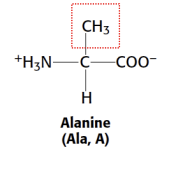
Alanine (Ala)
aliphatic; non-polar (hydrophobic); methyl R-group

Valine (Val)
aliphatic; non-polar (hydrophobic)