Cell Organelles, Cytoskeleton, and Cell Junctions
 Call Kai
 Learn
 Practice Test
 Spaced Repetition
 Match
 Flashcards
 Knowt Play
1/50

There's no tags or description
Looks like no tags are added yet.
51 Terms
What is a peroxisome?
A metabolic compartment bound by a single membrane.

What enzymes are found in peroxisomes?
Enzymes that remove H atoms from substrates and transfer them to O2.
What is produced as a byproduct of the reactions in peroxisomes?
Hydrogen peroxide (H2O2), which is then converted to water (H2O).
What is one of the primary functions of peroxisomes?
To use oxygen to break down fatty acids.
How do peroxisomes contribute to detoxification?
They detoxify alcohol and other harmful compounds.
What are glyoxysomes?
Specialized peroxisomes in fat-storing tissues of plant seeds that initiate conversions of fatty acids to sugar.
What is the primary function of mitochondria?
Site of cellular respiration
What type of membrane structure do mitochondria have?
Double membrane with an outer smooth membrane and an inner convoluted membrane with cristae

What is found in the mitochondrial matrix?
DNA, ribosomes, and enzymes
What is a characteristic feature of the inner membrane of mitochondria?
It has infoldings called cristae
What are mitochondrial diseases caused by?
Defects in proteins for cellular respiration that decrease ATP production
What is the main site of photosynthesis in plant cells?
Chloroplasts
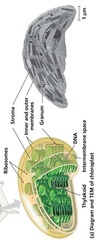
What are thylakoids?
Membranous systems of flat interconnected sacs in chloroplasts
What is a granum?
A stack of thylakoids
What is the stroma in chloroplasts?
The fluid inside the inner membrane containing DNA, ribosomes, and enzymes
What does the Endosymbiont Theory propose?
Eukaryotic cells originated from engulfing prokaryotic cells

What evidence supports the Endosymbiont Theory?
Organelles have two membranes, contain ribosomes, have circular DNA, and can grow and reproduce independently
What is the function of the cytoskeleton?
To organize structures and activities in the cell, providing mechanical support and enabling cell motility
What are the three types of structures in the cytoskeleton?
Microtubules, microfilaments, and intermediate filaments
What are microtubules made of?
Hollow rods constructed from tubulin dimers

What is the role of centrosomes in the cell?
Regions where microtubules grow from, providing compression resistance

What is a centriole?
A structure made of nine sets of triplet microtubules arranged in a ring, located in the centrosome
What is the difference between flagella and cilia?
Flagella are longer and fewer per cell, while cilia are shorter and more numerous
How do cilia function in the body?
They work like oars to move fluid over the surface of tissues and can also act as signal-receiving antennas
What is the primary cilium?
A non-motile cilium that transmits molecular signals from the environment to the cell's interior
What is the diameter of microtubules?
Approximately 25 nm
How do microtubules contribute to cell division?
They guide the separation of chromosomes during cell division
What is the role of the plasma membrane in cilia?
It surrounds the cilia and is involved in their movement and function
What is the structure of a motile cilium?
A motile cilium has a cross-section with nine doublets of microtubules arranged in a ring around a central pair of microtubules.
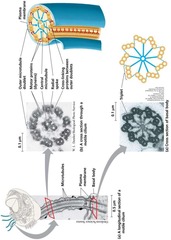
What motor proteins are used for the movement of flagella and cilia?
Dyneins are the motor proteins that facilitate the movement of flagella and cilia.

What energy source do dyneins use for movement?
Dyneins use ATP for energy.
What are microfilaments made of?
Microfilaments are made of actin subunits twisted in a double chain.

What role do cortical microfilaments play in the cell?
Cortical microfilaments support cell shape and give the outer cytoplasmic layer a gel-like consistency.
How do actin/myosin interactions contribute to cell movement?
Actin/myosin interactions cause muscle cell contractions and amoeboid crawling motility.
What are intermediate filaments primarily composed of?
Intermediate filaments are primarily composed of keratin proteins coiled together.

What is the function of intermediate filaments in cells?
Intermediate filaments bear tension to prevent the cell from tearing and provide a permanent framework.
What is the primary function of plant cell walls?
Plant cell walls provide protection, maintain cell shape, prevent excessive water uptake, and add rigidity.
What is the composition of the primary cell wall in plants?
The primary cell wall is composed of microfibrils of cellulose embedded in a matrix of polysaccharides and proteins.
What is the middle lamella in plant cells?
The middle lamella is a thin layer of pectin that glues the primary cell walls of adjacent plant cells together.

What are plasmodesmata?
Plasmodesmata are channels that connect plant cells, allowing cytosol to pass between them.

What is the extracellular matrix (ECM) in animal cells made of?
The ECM is made of glycoproteins, proteoglycans, and collagen.

What is the role of fibronectin in the ECM?
Fibronectin helps attach cells to the extracellular matrix.
What are integrins?
Integrins are cell-surface receptor proteins that bind to ECM proteins and regulate cell behavior.

What is the function of tight junctions in animal cells?
Tight junctions prevent fluid leakage between adjacent cells.

What do desmosomes do in tissues?
Desmosomes fasten cells together into strong sheets, providing resistance to stretching and mechanical stress.
What is the function of gap junctions?
Gap junctions allow the flow of small molecules between adjacent cells.
What is the significance of the central vacuole in plant cells?
The central vacuole helps maintain cell turgor pressure and stores nutrients and waste products.
What is the role of microvilli in cells?
Microvilli increase the surface area of cells, aiding in absorption and secretion.
How do motor proteins like dyneins facilitate movement?
Motor proteins like dyneins detach and reattach along microtubules, causing coordinated movement.
What is the primary component of the nuclear lamina?
Intermediate filaments are a major component of the nuclear lamina, providing structural support to the nucleus.
What is cytoplasmic streaming?
Cytoplasmic streaming is the circular flow of cytoplasm within cells that speeds up the distribution of materials.