Art History Quiz
 Call Kai
 Learn
 Practice Test
 Spaced Repetition
 Match
 Flashcards
 Knowt Play
1/41

There's no tags or description
Looks like no tags are added yet.
42 Terms

Cezanne, Still-Life with Fruit Dish, 1879-80
Style: Post-Impressionist. He called his goal making Impressionism "solid and durable like the art of the museums."
Iconography: Apples and a fruit dish on a table; ordinary objects with no story or symbolism. The subject is a pretext for looking.
Form: The table edge, dish and fruit are seen from several viewpoints at once; the table tilts toward us. Parallel, ordered brushstrokes build volume instead of dabs of light. Color modulates form (warm and cool shifts) rather than chasing a passing moment.
Context: Cézanne left Paris and exhibited with the Impressionists only briefly (1874, 1877). He rejected instantaneity, the opposite of Monet's "moment." Gauguin later owned this painting, which is why it appears in Denis's Homage to Cézanne (1900).
Say on the exam: Structure and construction over sensation; the bridge from Impressionism to modern art.

Cassatt, The Tea, 1880
Style: Impressionist (shown at the fifth Impressionist exhibition, 1880).
Iconography: Women at a tea table in an interior. Tea-drinking and the raised finger signal class and refined sociability. One woman raises a cup to her face while looking toward us, which suggests she is unposed.
Form: Close, cropped interior, loose brushwork, absorbed figures.
Context: An example of the spaces of femininity (Pollock): the domestic interior, a lowered viewpoint, and the "space of production" (where women actually paint and write). Cassatt came from a wealthy Pennsylvania banking family, settled in Paris in 1874, and declared herself independent. Women could not move freely in public, so the interior (not plein air) was her domain. Virginia Woolf's "a room of her own": freedom requires money and space. Compare Degas's all-male A Cotton Office in New Orleans.
Say on the exam: A woman's modern-life subject, with Fried's absorption (the cup before the mouth is a marker of the unposed) and the new woman type.

Cassatt, Lydia Crocheting in the Garden at Marly, 1880
Style: Impressionist.
Iconography: Her sister Lydia crocheting outdoors in a garden. Needlework is a conventional feminine activity; the garden is a "semi-interior" acceptable for a woman.
Form: Bright, open brushwork, a high or tilted viewpoint, loose greens and whites.
Context: Painted at the Marly house the family rented, so outdoor light but a family-controlled, chaperoned setting. Lydia modeled for Cassatt frequently.
Say on the exam: How Cassatt adapts Impressionist outdoor light to the limits on a woman's public life; absorption again (Lydia attends to her work, not us).

Gill, Signboard for the Lapin Agile Cabaret, 1880
Style: Popular/commercial art and caricature, not a gallery painting.
Iconography: A rabbit leaping out of a saucepan, holding a wine bottle. A pun: lapin à Gill ("Gill's rabbit") became Lapin Agile ("nimble rabbit"). It was a cabaret sign for a Montmartre bar frequented by artists and writers.
Context: André Gill was a famous political caricaturist. The picture belongs with café-concert and cabaret culture: art made for a paying, mixed audience, outside the Salon. Montmartre was the hill of bars, dance halls and bohemian life (the same neighborhood as Van Gogh's Moulin de la Galette views and the Moulin Rouge).
Say on the exam: Art in commercial public space; humor and wordplay; the Salon is no longer the only place art is seen.

Billhaud, Combat de negres pendant la nuit, 1882
Style: Arts Incohérents; a joke. The painting is an entirely black rectangle.
Iconography: None. The title (a racist 19th-century phrase meaning roughly "Fight of Black men at night") is the whole joke: a visual gag where you cannot see anything. Be ready to discuss the title's racism as part of the period's culture, not as a joke to repeat.
Context: Shown at the first Arts Incohérents exhibition (Paris, 1882), organized by Jules Lévy as a spoof, anti-establishment show for anyone, with no jury. It is an early monochrome, a forerunner of Alphonse Allais's white and red monochromes (1883 to 1897) and later modern art.
Form: Zero image; text and idea carry everything.
Say on the exam: Parody of the Salon and its seriousness; the idea that the title and context make the work; early conceptual humor.

Manet, A Bar at the Foiles-Bergere, 1882
Style: Late Manet: Impressionist-influenced, but with a finished tableau feel. Exhibited at the Salon of 1882, his last major Salon work; he died in 1883.
Iconography: A barmaid at the Folies-Bergère music hall, standing before a huge mirror. Bottles on the counter include Bass ale with its red triangle (the first registered trademark in Britain, which your notes call the first commercial trademark). Oranges, flowers, champagne. In the mirror: the crowd, a balcony acrobat's feet, and a man in a top hat apparently talking to her.
Form and the puzzle: The reflection does not line up with her. In the mirror she leans forward and engages a customer; in the front view she stands back, blasé and lost in thought. Critics thought Manet had forgotten to add the man in front. A sketch shows the face and reflection corresponding; he removed that consistency in the final version.
Context: The café-concert/music hall was "democratized theatre" for a mixed audience; mass culture (Bass Ale branding, mass-produced pleasure). The barmaid represents a new type of worker: not poor, not bourgeois, a new middle class. Her blasé attitude embodies modern life. Table service is new.
Two readings (from your notes): T. J. Clark: understand it through historical context. Michael Fried: it is about conviction and the beholder; the picture demands we stand in front of her, but the reflection needs a different position.
Say on the exam: Gaze and the beholder; modernity and class blurring; mass culture; the inside/outside of the barmaid (outward performance vs. inward feeling).

Seurat, Bathers at Asnieres, 1884
Style: A large, finished tableau (about 2 by 3 meters) that is a bridge between Impressionism and Seurat's dots. Smooth, matte color with some dotted touches added later.
Iconography: Working- and lower-middle-class men resting by the Seine; a boy in an orange hat calls across the river; factory chimneys of Clichy in the background. Your notes: this shows the "other side of the river" from La Grande Jatte, with a clear class difference.
Context: Rejected by the Salon jury, it was shown at the first Salon des Indépendants (1884). Seurat wanted a public, Salon-scale painting, not a small sketch.
Form: Still, quiet, frontal and profile figures; simplified volumes; horizontal bands of river and bank; almost no movement.
Say on the exam: Modernity and class, a frozen moment, Seurat's ambition to make an Impressionist subject into a monumental tableau.

Seurat, A Sunday on La Grande Jatte, 1884, 1884-86
Style: Neo-Impressionism / Pointillism (a term from critic Félix Fénéon). Started as an ébauche (sketch), finished as a very large painting. Shown at the eighth and final Impressionist exhibition, 1886; the largest painting there (54 artists exhibited).
Iconography: Sunday leisure on an island in the Seine, in fashionable Neuilly. Details from your notes:
A bourgeois man in a top hat who must stay upright to keep it on, next to a lounging man in shirtsleeves smoking a pipe (middle or lower class, or an upper-class man rowing).
A woman in a bustle and narrow waist with a monkey on a leash, suggesting a courtesan; the man "holds her" like the monkey.
Women fishing: French pêche (fishing) sounds like péché (sin).
A woman in a nurse's headdress (a wet nurse).
Sunday is the day workers are off, so classes mix. Compare the working-class side of the river (Clichy factories) and the middle-class suburb of Asnières.
Form: Pointillism: small dots of pure color that blend in the eye at the right viewing distance (optical mixing). Geometric, vertical and horizontal lines; flat, stiff, Egyptian-like profiles and frontal figures (critics in 1886 said so). Little tonal modulation. Uses simultaneous contrast and complementary colors.
Context: Based on color science (Chevreul, Rood). Not Impressionism's loose, instant sketch and not the finish of a tableau: something new. Impressionism lets us enter the artist's world; Neo-Impressionism makes a different, scientific world (your notes).
Say on the exam: Arbitrary vs. scientific; the frozen moment; ambiguous social types; the difference between Seurat and Monet.

Anquetin, Avenue de Clichy, 5’ O’Clock in the Evening, 1887
Style: An early example of what becomes Cloisonnism (the term was coined around 1888 by the critic Édouard Dujardin for Anquetin and Bernard). Flat, bright color zones outlined in dark contours, influenced by Japanese prints (Japonisme).
Iconography: A modern street scene in Montmartre at dusk: workers and passersby, gas light, blue and orange evening light. The avenue was a hangout for the same circle as Van Gogh, Toulouse-Lautrec and Signac (your notes call Boulevard de Clichy where all the artists hung out).
Form: No atmospheric perspective; shapes made of flat patches; strong outlines.
Context: Part of the move from Impressionism's "optic" sensation toward stylization and the decorative, which leads to Synthetism the next year.
Say on the exam: The link between Neo-Impressionist color theory and the flattened Cloisonnist/Synthetist style.
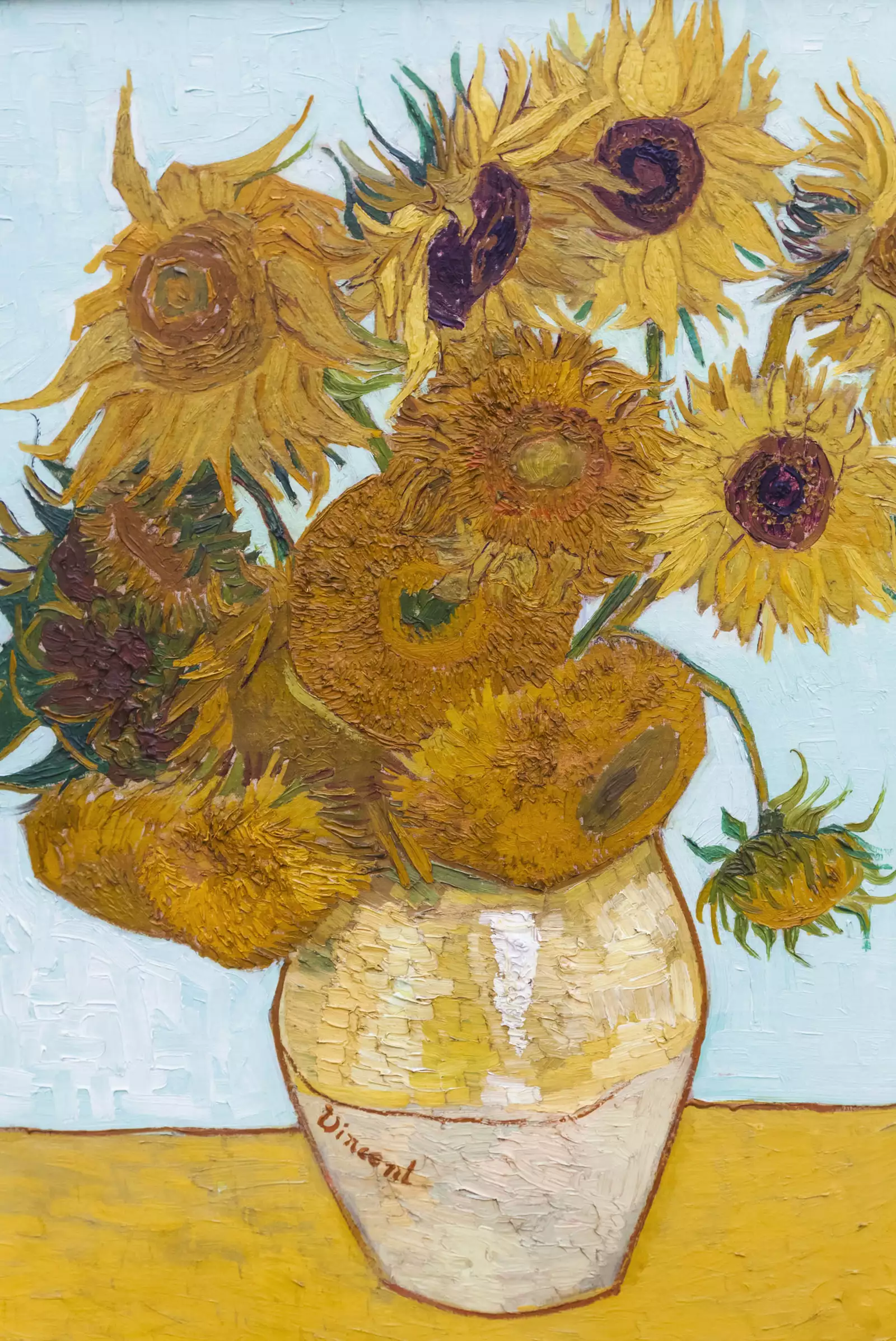
Van Gogh, Sunflowers, 1888
Style: Post-Impressionist/early Expressionist; heavy impasto; unmixed colors.
Iconography: Sunflowers in a vase, painted in yellows on yellow. Sunflowers were a cheerful, humble motif, associated with gratitude, loyalty and the sun. Van Gogh also saw them as a personal emblem.
Context: Painted in Arles as part of an ensemble of decorations for the Yellow House, especially the room for Paul Gauguin, who arrived in October 1888. Your notes: the sunflower paintings are the first breakthroughs of his independent style, meant to hang together as decoration.
Form: Thick paint, a flattened, nearly tabletop space, bold outlines, no deep perspective. Yellow dominates, with orange and blue-green for contrast.
Say on the exam: His independence from Seurat; decorative ensemble; color as emotion; link to Japonisme and the decorative theory of the Nabis.

Van Gogh, Starry Night, 1888
Starry Night (1889): Swirling sky with a crescent moon, glowing stars, a tall dark cypress, a church steeple and a village. Every brushstroke is a separate colored mark; swirls create a rhythm. Foreground, middle and background exist but the tree and sky flatten against each other. Painted from memory and imagination from the asylum window view. Your notes call it Expressionism: not objective reality but the subjective emotions things arouse.
Context: The night, stars and religious feeling come from Van Gogh's Christian background; he wrote that looking at stars made him think of death and transport. His breakdown (the ear incident in December 1888) followed Gauguin's stay.
Say on the exam: Expressive color and brushwork, subjective emotion, Post-Impressionism that follows Impressionist method but breaks from naturalism; how biography matters here.
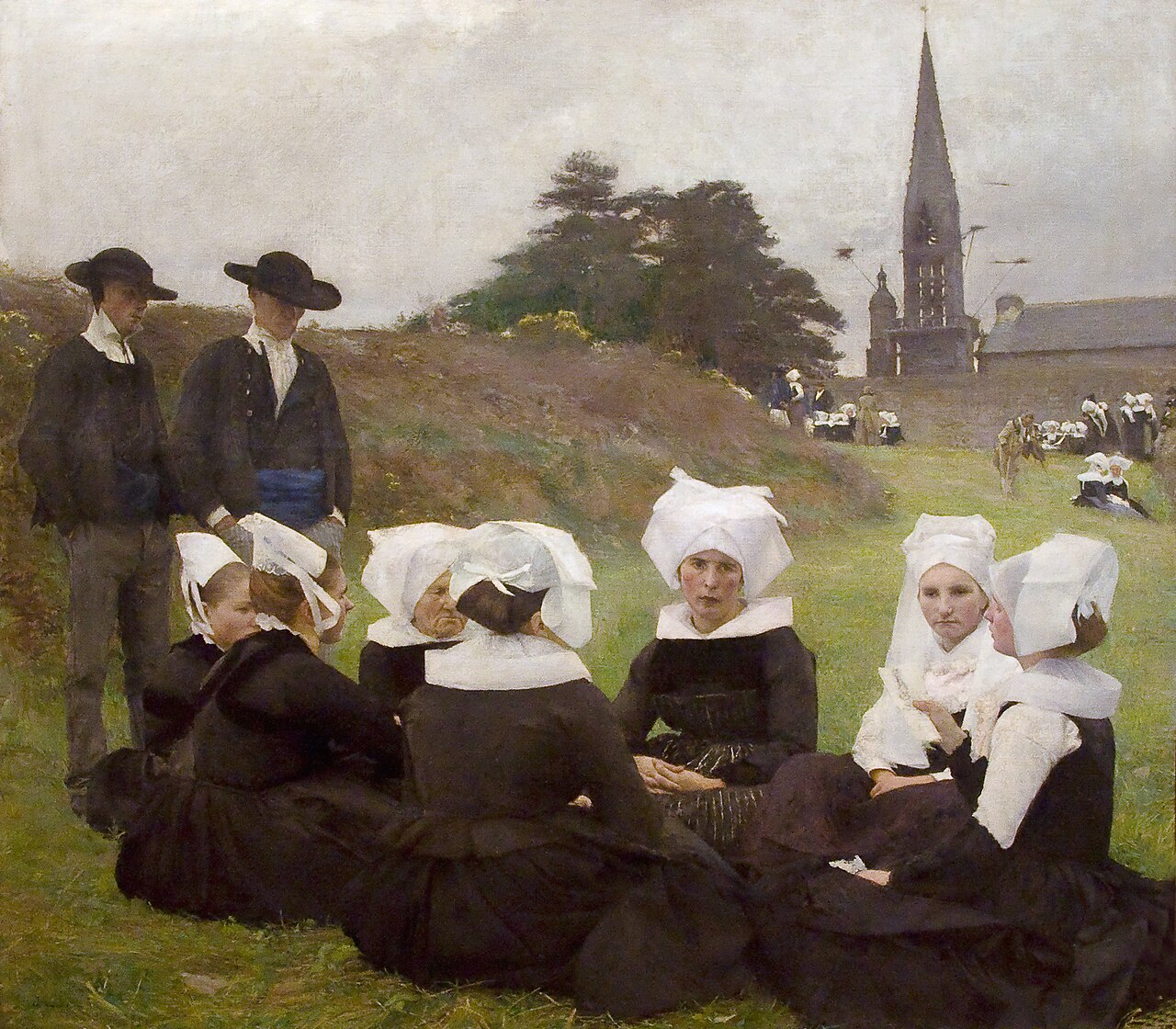
Bernard, Breton Women at a Pardon, 1888
Style: Cloisonnism / Synthetism (flat color areas, bold outlines like enamel or stained glass; Japanese-print influence).
Iconography: Breton women in regional dress and white coifs at a pardon (a religious festival or procession). Your notes: the white coifs are fashion, not religious; the women are dressed in the fashion of the day.
Form: No perspective, flattened space, simplified shapes, no modeling.
Context: Painted in Pont-Aven and sent to Van Gogh (who painted his own version, after Bernard, in 1888) and an influence on Gauguin. Bernard and Gauguin later argued over who invented Synthetism.
Say on the exam: The origin of Cloisonnism/Synthetism; shows the peasant subject (as in Millet and Courbet) treated as symbol and pattern rather than realism.

Gauguin, Vision after the Sermon (Jacob Wrestling with the Angel), 1888
Style: Symbolism / Synthetism / Cloisonnism. Your notes call it his most famous painting at that point, "symbolist."
Iconography: Breton women in white coifs pray after a sermon, and see in their imagination the Bible story of Jacob wrestling the angel: Jacob fights an angel until dawn, is injured in the knee, accepts defeat and is renamed Israel. A priest at the right edge; a cow in the corner for local color.
Form: A bold diagonal tree trunk divides the real world (women) from the vision (wrestlers). The ground is flat, pure red; there is no consistent perspective; the wrestlers are influenced by Japanese woodblocks (Hokusai-type wrestlers).
Context: Not a record of something he saw. Aurier says it is a vision described by a priest; the church disappears and the women remain in prayer. It is a painting of imagination, belief, and ideas, not observation.
Say on the exam: The break with naturalism: the painting depicts an idea; color is arbitrary and expressive; primitivism's early stage (Gauguin later "establishes primitivism" with his Tahiti paintings in 1891, such as Ia Orana Maria).
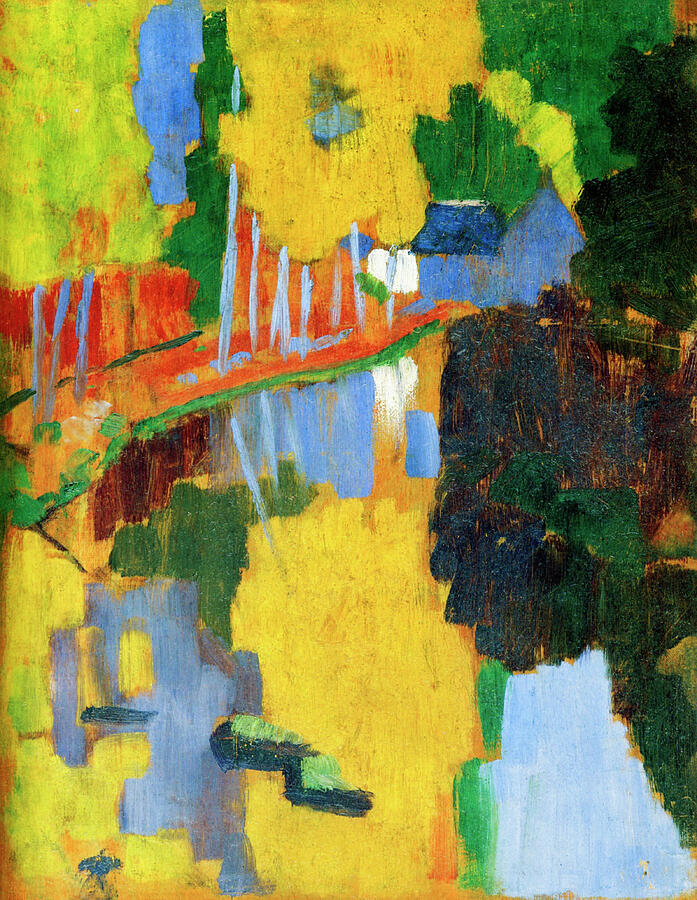
Serusier, The Bois d’Amour (The Tailsman), 1888
Style: Synthetism; the founding painting of the Nabis.
Iconography: A landscape of the Bois d'Amour ("Wood of Love"), a woodland by the Aven river at Pont-Aven, reduced to patches of near-pure color.
Form: Painted on a small wood panel (the lid of a cigar box) in a few hours under Gauguin's direction. Gauguin told him to paint what he felt, with pure colors. Shadows in pure blue, trees in pure yellow and red, no blending. Your notes: he begins to paint exactly what he feels, color on a flat surface; the starting point of abstract painting.
Context: Sérusier brought it back to Paris, showed it to his friends at the Académie Julian (Denis, Bonnard, Vuillard, Ranson), who called it The Talisman and became the Nabis ("prophets").
Say on the exam: How Gauguin's ideas were passed to a new generation; color and surface before subject; the road to abstraction and to Denis's formula that a painting is "essentially a flat surface covered with colors in a certain order."

Seurat, Chahut, 1889-90
Style: Neo-Impressionism at its most theoretical.
Iconography: The chahut is a boisterous, slightly scandalous dance-hall dance (a cousin of the cancan) performed in a Montmartre music hall. Male dancer and female dancers kick in line before gas-lit light; the scroll of a double bass at the lower left; a stiff, almost mechanical crowd. The faces have upturned noses and curled mustaches, the poses are caricatured: gaiety that looks forced.
Form: Built on dynamogenous lines (upward lines, rising skirts, upturned mouths and eyebrows) that Seurat believed produce joy and energy, versus inhibitory lines (downward, drooping) that produce sadness. This comes from the aesthetic theory of Charles Henry, promoted by Fénéon. Warm colors and light tones also read as gay. Your notes (on Circus): swooping lines are meant to make you feel happy.
Context: Cafés-concerts and music halls were popular, democratic entertainment; Seurat makes them into a scientific, structured picture. Seurat died in March 1891 at 31.
Say on the exam: Dynamogenous vs. inhibitory lines; optic/logic: that the feeling can be calculated from lines and colors; modern entertainment as a rigid, almost mechanical pattern.

Signac, Portrait of M. Felix Feneon in 1890, 1890
Full title: Against the Enamel of a Background Rhythmic with Beats and Angles, Tones, and Tints, Portrait of M. Félix Fénéon in 1890 (Opus 217).
Style: Neo-Impressionism with decorative, Japonisme-influenced pattern.
Iconography: Fénéon (critic, the writer who coined "Neo-Impressionism" and a defender of Seurat) in profile, holding a cyclamen and a top hat, in a swirling, rainbow-colored radiating background. The title itself shows the theory: a rhythm of lines, tones and tints.
Context: Fénéon was an anarchist (he was tried in 1894 in the "Trial of the Thirty" after an anarchist bombing, and acquitted). Signac also sympathized with anarchism, as did Pissarro and several Neo-Impressionists. This ties the style to anarchism: a new, free, scientific harmony of society and art. In the Dreyfus affair (from 1894), Signac and Pissarro were Dreyfusards; Renoir, Degas and Cézanne were anti-Dreyfusard (your Renoir note: he was an antisemite and against Dreyfus).
Say on the exam: Portrait of the theorist-critic; the role of critics; politics and style; the decorative background.
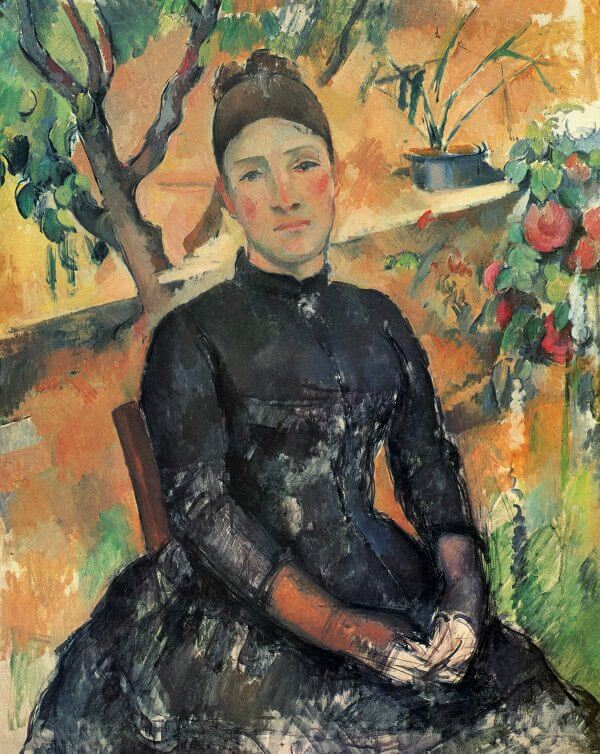
Cezanne, Madame Cezanne in the Greenhouse, 1891-1892
Style: Mature Post-Impressionism.
Iconography: His wife, Hortense Fiquet, seated in a greenhouse (the Jas de Bouffan) among plants and pots. The face is a mask, calm and unreadable; no flattery, no story, no gaze that invites us in.
Form: Stiff, frontal pose; vertical and horizontal lines of the greenhouse structure; planes of color built with parallel strokes; the figure's body is simplified like a cylinder and fused with the background. The space is shallow; some areas of the canvas are left unfinished. He worked slowly with long sittings (he demanded stillness of sitters).
Context: A portrait with no social or psychological anecdote; it is about the problem of painting a figure in space. Compare Cassatt's absorbed women and Manet's gaze.
Say on the exam: Structure over sensation; flattening and constructive brushwork; the figure as a formal problem.

Cezanne, The Basket of Apples, c. 1895
Style: Post-Impressionism; sets up the later move to Cubism.
Iconography: A still life of apples, a basket, a bottle, a plate of biscuits and a rumpled tablecloth. Ordinary objects, no symbolism.
Form: The table edge disagrees on each side of the bottle and the basket is tilted: Cézanne combines several viewpoints in one picture. The cloth is folded like a sculpted form. Color is used to model volume. The result feels both solid and unstable.
Context: Painted when Cézanne's reputation was beginning to grow (first one-man show at Vollard's gallery, 1895), long after he left the Impressionist group. Works like this became models for the next generation of artists, including Denis's circle.
Say on the exam: Multiple viewpoints; deliberate distortion of perspective; the "optic/logic" problem (what the eye sees vs. how the mind constructs it

Toulouse-Lautrec, At the Moulin Rouge, 1892-1895
Style: Post-Impressionist; flat color, strong contour and cropping borrowed from Japanese prints and from Degas.
Iconography: The Moulin Rouge dance hall in Montmartre (opened 1889). A table of Lautrec's friends (the critic Édouard Dujardin, the photographer Paul Sescau, Maurice Guibert and others) in the foreground; the dancer La Goulue arranging her hair in the background mirror; in the far background, Lautrec himself (a very short figure) walking beside his tall cousin. In the right foreground a woman's face is lit green by artificial light.
Form: A strong diagonal railing cuts the picture; figures are cropped at the edges as in a snapshot; unnatural color from gas and electric light (green face, orange hair, purple shadows). Perspective is tilted and the space is flattened.
Context: Cafés-concerts and music halls were democratic: workers, bourgeois, artists and prostitutes in one room (your notes). The date "1892/95" reflects that he worked on it and later trimmed the canvas. Lautrec also made posters, so popular and fine art mix. Like Manet, he studies mass culture and the blasé modern attitude.
Say on the exam: Modern urban nightlife; class mixing; artificial light; Japonisme in cropping and flat color; artist as observer inside the scene

Denis, Homage to Cezanne, 1900
Style: Nabis / Symbolism.
Iconography: A group portrait of the Nabis and friends gathered around a still life by Cézanne on an easel: Maurice Denis, Odilon Redon, Édouard Vuillard, Pierre Bonnard, Paul Sérusier, Ker-Xavier Roussel, Paul Ranson, the critic André Mellerio and the dealer Ambroise Vollard (who hosts the display). The painting on the easel is Cézanne's Still-Life with Fruit Dish (the 1879 to 80 work from this same study guide), once owned by Gauguin.
Form: A flat, decorative composition with figures arranged in a shallow, frieze-like room. Dark clothes against pale walls; the Cézanne glows at the center.
Context: A tribute to Cézanne as the master of a new, structural, painterly art. Like Dantan's Un Coin du Salon en 1880 (in your notes), it shows art being viewed in a private setting (dealer, collectors) rather than a state Salon: the art world shifts from state-sponsored to private. Nabis: flat patches of color, bold contours, simplified drawing, focus on the decorative.
Say on the exam: Cézanne's influence; the new art market (dealers, private viewing); the Nabis and the decorative; a self-portrait of an avant-garde community.
Anarchism
Political belief in a society without state authority. Fénéon, Signac and Pissarro; Neo-Impressionism's "harmonious" ideal; see Signac's Fénéon portrait. |
Arts incoherents
1880s Paris exhibitions of jokes and spoofs, no jury (founded by Jules Lévy, 1882). Bilhaud's black rectangle.
Avant-garde
Art or artists that develop new or experimental concepts (a term from the Saint-Simonians; your notes say Realism was the first avant-garde). Applies to Neo-Impressionists, Synthetists, Nabis
Cafe-concert
A café with a light-music program; democratized theater, cheap, mixed class. Manet's Bar, Lautrec, Seurat's Chahut.
Music hall
Theater for various acts (animals, comedians, singers). The Folies-Bergère, the Moulin Rouge.
Cloisonnism
Flat zones of color separated by dark outlines, like cloisonné enamel or stained glass. Anquetin, Bernard, Gauguin. (Not "colonialism": see the flag above.)
Complementary colors
Opposites on the color wheel (red/green, blue/orange, yellow/violet). Placed together they intensify each other. Seurat, Van Gogh.
Simultaneous contrast
A color induces its opposite in an adjacent color. Seurat, Van Gogh's Night Café (green hair against red).
Optical mixing
Dots of pure color blend in the viewer's eye at a distance instead of on the palette. Pointillism.
Pointilism
Applying small dots of color so they blend from afar. Seurat, Signac.
Neo-impressionism
Late 19th-century attempt to make Impressionism more precise and scientific, using pointillism. Seurat, Signac, Fénéon (the critic who named it). |
Dynamogeneous lines
Downward lines that create sadness or restraint. Contrasted with dynamogenous lines.
Optic/logic
Likely the idea (Seurat/Fénéon) that perception (optic) and reasoned, calculated structure (logic) are combined. Confirm this definition with your professor.
Decorative
Art that treats the picture as a flat, ornamental surface and relates it to its frame or room (Seurat's painted frames, Van Gogh's Yellow House ensemble, Nabis).
Dreyfusard
Supporter of Alfred Dreyfus, the Jewish army officer wrongly convicted of treason in 1894. Signac, Pissarro, Monet; opposed by Renoir, Degas, Cézanne.
New Woman
Late-19th-century woman resisting traditional controls and seeking a full role in the world. Cassatt and her subjects who read the newspaper.
Spaces of femininity
Griselda Pollock's idea (in your notes): the interiors, the lowered viewpoint, and the space where women make art. Cassatt.
Nabis
Group of French post-Impressionist painters (1888 to 1900) whose work has flat patches of color, bold contours and simplified drawing. Sérusier, Denis, Bonnard, Vuillard. "Nabi" = prophet.
Primitive / primitivism
Art that imitates non-industrial, "tribal" cultures or early Western art as a reaction against modernity. Gauguin in Tahiti. The word "primitive" is now seen as offensive and colonial.
Salon des Independants
Annual exhibition founded 1884 with no jury: artists pay dues and show. Artistic autonomy. Seurat's Bathers.
Symbolism
Late 19th-century movement that expressed an idea instead of describing nature. Gauguin, the Nabis, Aurier's theory.
Synthetism
A painting is a formal arrangement of color on a flat surface before it represents anything. Gauguin, Bernard, Sérusier.