P3.1&3.2
 Call Kai
 Learn
Learn Practice Test
 Spaced Repetition
 Match
Match Flashcards
 Knowt Play
1/24

Earn XP
Description and Tags
Name | Mastery | Learn | Test | Matching | Spaced | Call with Kai | Chat |
|---|
No analytics yet
Send a link to your students to track their progress
25 Terms
Displacement
Distance travelled from a given starting point in a particular direction
Instantaneous speed
Speed at a given moment
Average speed
Mean speed over a given time period
Velocity
Rate of change of displacement (Speed in a given direction)
Acceleration
Rate of change of velocity
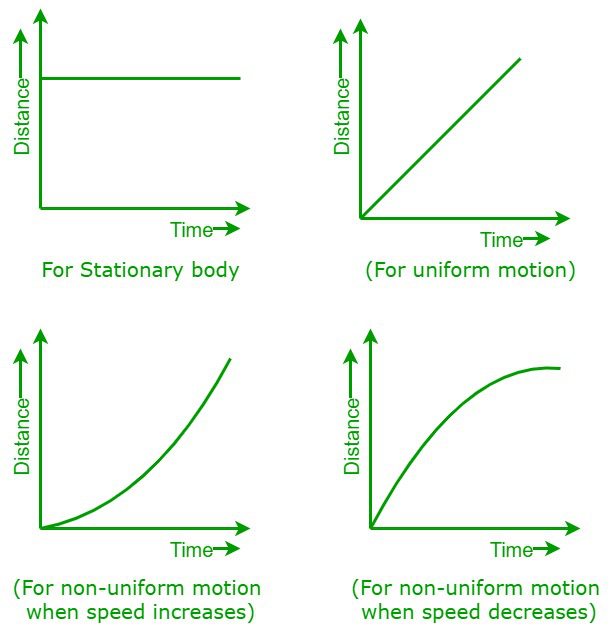
Displacment-Time graph
Gradient=velocity
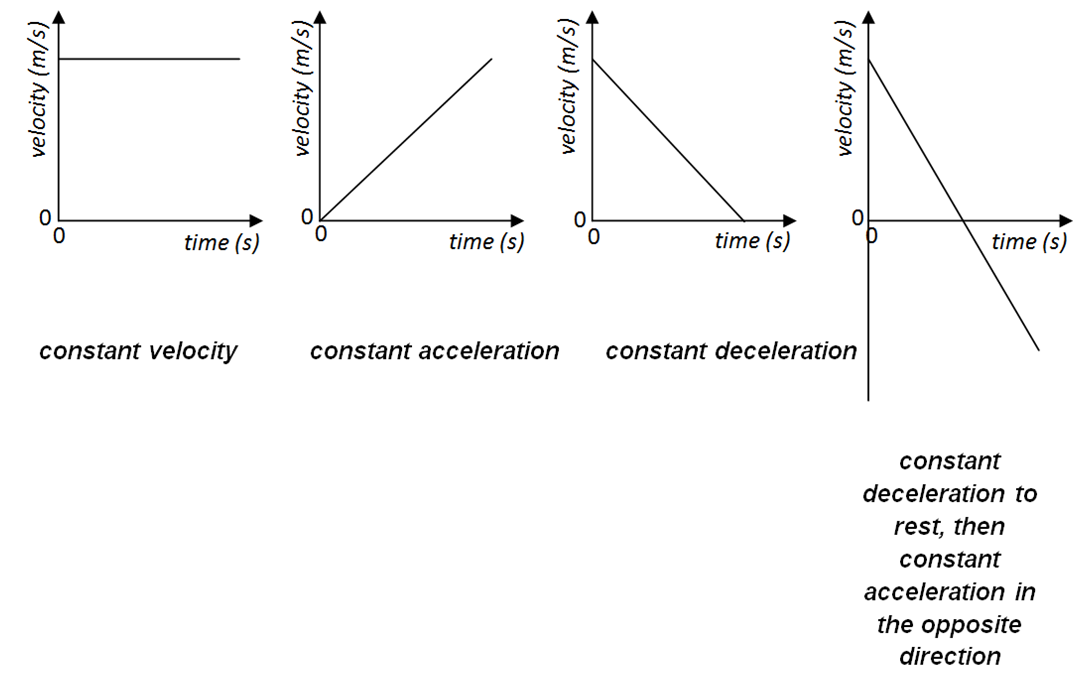
Velocity-Time graph
Gradient=acceleration Area under graph=displacement
SUVAT
S=displacement, U=initial velocity, V=final velocity, A=acceleration and T=time
Free fall
g=free fall=accleration due to gravity=9.81
Reaction time, hinking distance, breaking distance and stopping distance
Reaction time time for driver to act on breaking, thinking distance distance travelled by object whilst driver realieses whats happening, Breaking distance distance car decelerates for and stopping distnce sum of all.
F=ma
F=force (newtons) m=mass (kg) a=acceleration(m/s2)
W=mg
W=weight (newtons), m=mass (kg), g=9.81 (m/s2)
Tension
Force on a medium like a rope equal at both ends
Normal contact force
Equal and opposite force exerted on an object at rest perpendicular from object it is on
Friction
Force opposing motion
Upthrust
Upward force exerted on an object partially or completely submerged in a liquid.
Drag
Force opposing movement due to being in a fluid like air or water. Proportional to speed and changes due to shape of the object.
Terminal velocity
Maximum speed an object can reach when speed and drag are in equilibrium.
Moment of force
Force*perpendicular distance from pivot to the line of action of the force
Principle of moments
For a body to be in equilibrium the sum of clockwise moments about a point must = sum of anticlockwise moments
Couple
Paralelle forces of qual size which act in opposite directions produces turning force
Torque of a couple
size of one force*perpendicular distance between forces.
Density formula
p = m/v p=denisty, m=mass and v=volume
Pressure formula
p=f/a p=pressure, f=force and a=area
Upthrust in a fluid/Archimemeds principle
p=hpg p=pressure, h=height, p=denisty and g=9.81