WQ Macroflaura and Fauna Identification
 Call Kai
 Learn
Learn Practice Test
 Spaced Repetition
 Match
Match Flashcards
 Knowt Play
1/22

There's no tags or description
Looks like no tags are added yet.
Name | Mastery | Learn | Test | Matching | Spaced | Call with Kai | Chat |
|---|
No analytics yet
Send a link to your students to track their progress
23 Terms

Banded coral shrimp (Stenopus hispidus) - Cleaner shrimp that sets up cleaning stations on the reef, usually living in monogamous male-female pairs in crevices; feeds on ectoparasites, mucus, and dead tissue picked off client fish, plus detritus. Long planktonic larval stage before settling. Indicator: active cleaning stations signal a healthy fish community and low stress.

Butterfly fish (Chaetodon spp.) - Small, laterally compressed diurnal reef fish, many species obligate corallivores that pick polyps with a narrow snout; others eat small invertebrates and algae. Often form long-term monogamous pairs; have a distinctive armored "tholichthys" larval stage. Indicator: one of the best live-coral indicators — numbers drop quickly when coral cover declines.

Crown of thorns starfish (Acanthaster planci) - Large venomous-spined sea star and a major coral predator; everts its stomach over stony coral to digest polyps externally. Broadcast spawner releasing millions of eggs, with larvae favored by nutrient-rich runoff. Indicator: population outbreaks signal poor reef health, often tied to eutrophication and loss of predators like the triton.

Fleshy algae (Rhodophyta, Chlorophyta, Phaeophyta) - Red, green, and brown macroalgae; photosynthetic primary producers with alternation of generations life cycles. Grow fast under high nutrients and are kept in check by herbivores such as parrotfish and urchins. Indicator: heavy fleshy algal cover marks a coral-to-algae phase shift caused by nutrient pollution or overfishing of grazers.

Grouper >30 cm (Serranidae, Epinephelinae) - Large-bodied ambush predator that sucks in fish and crustaceans with a rapid gape expansion; solitary and territorial. Most are protogynous hermaphrodites (female first, later male) and form predictable spawning aggregations, which makes them easy to overfish. Indicator: abundant large individuals indicate an intact food web and low fishing pressure.

Hard/Stony corals (Scleractinia) - Colonial cnidarian polyps that secrete calcium carbonate skeletons, building the reef framework. Nourished mostly by symbiotic zooxanthellae, supplemented by capturing zooplankton with nematocyst-armed tentacles at night. Reproduce by broadcast spawning or brooding planula larvae, plus asexual budding. Indicator: percent live coral cover and bleaching status are the primary measures of reef health.

Lobsters (Nephropidae) - Clawed lobsters, nocturnal benthic scavengers and predators on mollusks, worms, and echinoderms; shelter in burrows or crevices by day. Grow by molting their exoskeleton and pass through planktonic larval stages before settling. Indicator: scarcity of large individuals signals overharvesting; sensitive to warming and low oxygen.

Long-spined black sea urchins (Diadematidae/Diadema spp.) - Nocturnal grazing herbivore with long venomous spines that scrapes algae off hard substrate, opening bare space for coral larvae to settle. Broadcast spawner with an echinopluteus larva. Indicator: the 1983–84 Caribbean mass die-off triggered algal overgrowth, so their abundance is a key control on algae.

Moray eel (Muraenidae) - Nocturnal ambush predator that hides in crevices by day and hunts fish, octopus, and crustaceans; uses a second set of pharyngeal jaws to drag prey down its throat. Passes through a long ribbon-like leptocephalus larval stage. Indicator: as a top reef predator, healthy populations show an intact prey base and complex reef structure.

Parrotfish (>20 cm) (Scaridae) - Herbivore that scrapes or excavates algae and endolithic turf from coral rock with fused beak-like teeth, grinding it with pharyngeal mill; excretes the rock as fine sand, making it a major bioeroder and sand producer. Protogynous hermaphrodites with distinct initial and terminal color phases; many sleep in a mucus cocoon. Indicator: large individuals keep algae in check, so their loss predicts algal phase shifts.

Pencil urchins (Eucidairis spp.) - Slow-moving urchin with thick, blunt primary spines; nocturnal grazer on algae, sponges, and encrusting invertebrates, and will also bite live coral. Broadcast spawner with a planktonic pluteus larva. Indicator: elevated numbers can mean bioerosion outpacing coral growth on stressed reefs.

Sea Cucumber (Holothuroidea) - Soft-bodied echinoderm deposit feeder that ingests sand and sediment, digesting organic matter and detritus, then excretes clean sediment — bioturbating and recycling nutrients. Defends itself by eviscerating internal organs, which it regenerates; mostly broadcast spawners. Indicator: heavily targeted by fisheries, so their absence points to harvest pressure and degrading sediment quality.

Snapper (Lutjanidae) - Mid- to upper-level carnivore hunting fish and crustaceans, mostly at dusk and night; juveniles often nursery in mangroves and seagrass before moving to the reef. Forms spawning aggregations. Indicator: dependence on mangrove nurseries makes them an indicator of connected, healthy coastal habitat as well as of fishing pressure.
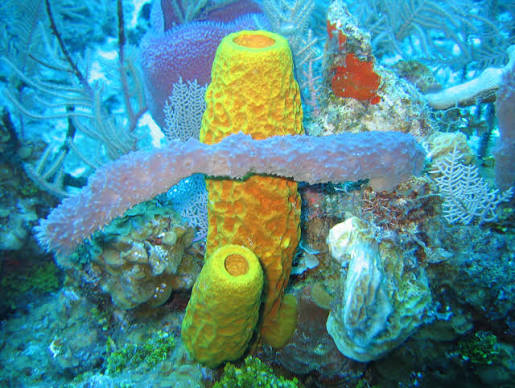
Demosponges (Demospongiae) - Largest sponge class, with skeletons of spongin fibers and siliceous spicules; sessile filter feeders drawing water through ostia and out the osculum, removing bacteria and dissolved organic matter. Reproduce sexually (mostly hermaphroditic, with swimming larvae) and asexually by budding or fragments. Indicator: drive the "sponge loop" recycling nutrients, but overgrow corals where water is nutrient-rich and turbid.

Sweetlips (Haemulidae) - Grunt-family fish that rest in loose schools under ledges by day and forage at night over sand and seagrass for benthic invertebrates. Juveniles have strikingly different colors and swimming patterns from adults. Indicator: presence of both juveniles and adults shows the reef is linked to functioning seagrass and sand-flat feeding grounds.

Triton (Charoniidae/Charonia spp.) - Giant predatory sea snail that hunts echinoderms, notably the crown of thorns starfish, paralyzing prey with saliva; slow-growing with a long-lived planktonic veliger larva. Heavily collected for its ornamental shell. Indicator: healthy triton numbers help suppress crown of thorns outbreaks, so their scarcity is linked to reef decline.

Barramundi cod (Cromileptes altivelis) - Indo-Pacific only. Slow-moving, humpbacked grouper of sheltered lagoons and reef slopes that ambushes small fish and crustaceans. Slow-growing, late-maturing, and protogynous, making it vulnerable to the live reef fish trade. Indicator: sensitive to both fishing and habitat loss, so presence reflects low exploitation.

Bumphead parrotfish (Bolbometopon muricatum) - Indo-Pacific only. Largest parrotfish, with a prominent forehead bump used to ram coral; eats live coral and algae and can erode tons of reef rock per fish each year into sand. Sleeps in large groups in shallow water, which makes it easy to spear at night. Indicator: extremely overfishing-sensitive; its presence indicates a lightly fished, structurally healthy reef.

Giant clams (Tridacna spp.) - Indo-Pacific only. Largest bivalve, a mixotroph that filter feeds on plankton while gaining most of its energy from symbiotic zooxanthellae in its colorful exposed mantle. Protandrous hermaphrodites that broadcast spawn. Indicator: because they rely on light and clear water, healthy clam beds indicate good water clarity and low sedimentation.

Humphead wrasse (Cheilinus undulatus) - Indo-Pacific only. Very large, long-lived wrasse with thick lips and a forehead hump; one of the few predators that eats toxic prey like crown of thorns starfish, boxfish, and sea hares, crushing hard-shelled mollusks with pharyngeal teeth. Protogynous and slow to mature. Indicator: prized in the live reef food fish trade, so its presence signals minimal fishing pressure.

Flamingo Tongue Snail (Cyphoma gibbosum) - Atlantic only. Small snail whose bright spotted "pattern" is actually living mantle tissue over a plain shell; feeds on soft corals, especially gorgonians, and can sequester their toxins. Lays egg capsules on the coral it has grazed. Indicator: grazing scars usually heal, but overabundance or heavy collection by divers reflects disturbed soft-coral communities.

Gorgonia (Octocorrallia) - Atlantic only. Sea fans and sea whips — colonial octocorals with eight-tentacled polyps on a flexible proteinaceous skeleton, oriented across the current to suspension-feed on plankton. Many host zooxanthellae; reproduce by spawning and fragmentation. Indicator: highly susceptible to aspergillosis fungal infection linked to runoff and warming, so diseased fans signal poor water quality.

Nassau grouper (Epinephelus striatus) - Atlantic only. Iconic Caribbean grouper that ambushes fish and crustaceans and can change color rapidly; famous for massive, predictable spawning aggregations at the same sites each winter full moon. Protogynous and slow-growing. Indicator: aggregation fishing collapsed many populations, so its presence marks well-managed, lightly fished reefs.