M1 Fricker- Eukaryotic DNA replication
 Call Kai
 Learn
Learn Practice Test
 Spaced Repetition
 Match
Match Flashcards
 Knowt Play
1/3

There's no tags or description
Looks like no tags are added yet.
Name | Mastery | Learn | Test | Matching | Spaced | Call with Kai | Chat |
|---|
No analytics yet
Send a link to your students to track their progress
4 Terms
how does the pre-replicative complex form in eukaryotic DNA replication?
in late M/G1- licensing
the origin, a weakly bound A/T rich region is bound by the ORC initiator (origin recognition complex), creating enough torsional stress to separate the strands
Cdc6 and Cdt1 loaders combine with ORC and load each strand with an Mcm2-7 helicase (mini chromosome maintenance) by opening the hexamer ring
the helicases remain inactive until S phase

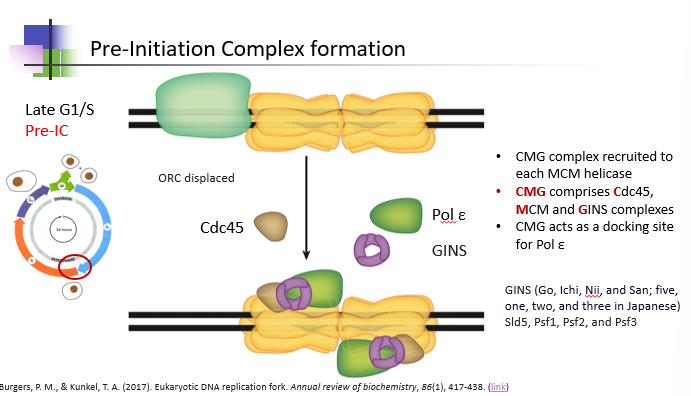
how is the pre-initiation complex formed and activated in eukaryotic DNA replication?
in late G1/S phase
the inactive pre-replicative complex (ORC, Cdc6, Cdt1 + 2 x MCM2-7 helicase) is activated to form the pre-initiation complex:
the CMG complex (Cdc45, MCM + GINS) is recruited to each MCM helicase, and acts as a docking site for inactive pol-epsilon on the leading strand
DDK and CDK (kinases) phosphorylate the MCMs and other binding proteins to activate the PIC
how is the replisome formed in eukaryotic DNA replication?
in late G1/S phase:
the inactive pre-initiation complex is converted into the replisome:
Ctf4 links pol-alpha to the CMG complex on the lagging strand
why can eukaryotic DNA replication only occur once per cell cycle?
different kinases are present at different points in the cell cycle, which are involved in initiation
CDC-6 has to be replaced by CDC-45 to start
phosphorylation during activation triggers irreversible ubiquitination of proteins