BIL 250 iClicker Question
 Call Kai
 Learn
 Practice Test
 Spaced Repetition
 Match
 Flashcards
 Knowt Play
1/51

There's no tags or description
Looks like no tags are added yet.
52 Terms
Mice (Mus musculus) have 40 chromosomes per diploid cell (2n = 40). How many double- stranded DNA molecules and how many chromosomes are there in a mouse cell that is in the G2 stage of the cell cycle?
A) 40 DNA molecules and 20 chromosomes
B) 40 DNA molecules and 40 chromosomes
C) 40 DNA molecules and 80 chromosomes
D) 80 DNA molecules and 40 chromosomes
E) 80 DNA molecules and 80 chromosomes
D) 80 DNA molecules and 40 chromosomes
Consider a non debilitating hereditary condition in humans. If two affected parents produce an unaffected daughter, then the allele responsible for the condition must be
A. autosomal dominant.
B. autosomal recessive.
C. X-linked dominant.
D. X-linked recessive.
E. either B or D.
A. autosomal dominant.
If a farmer crosses a plant homozygous for sd1 with a plant homozygous for Xa4 (assume the plants have identical alleles at all other gene loci, and do not carry any additional mutant alleles), which of these statements is correct regarding the progeny of this cross?
A. all the progeny will be monohybrids
B. all the progeny will be dihybrids
C. half of the progeny will be monohybrids, and half will be dihybrids
D. one-quarter of the progeny will be resistant to bacterial blight
E. one-quarter of the progeny will be short in stature
B. all the progeny will be dihybrids
If a farmer crosses a plant homozygous for sd1 with a plant homozygous for Xa4 (assume the plants have identical alleles at all other loci, and no other mutant alleles are present in these parent plants), which of these statements is correct?
A. all the progeny will be resistant to bacterial blight and of normal height.
B. all the progeny will be "pure-breeding."
C. all the progeny will be homozygous at both the sd1 and Xa4 loci.
D. all the progeny will be susceptible to bacterial blight and will be short.
Ε. none of these
A. all the progeny will be resistant to bacterial blight and of normal height.
A researcher is breeding rabbits, and in the progeny of his crosses he expects to find 50 rabbits with white coats and 50 rabbits with gray coats. Unexpectedly, he finds from his cross 52 white coats rabbits and 48 gray coats. What test can he use to determine if this deviation from the expected rabbit phenotypic ratio is due to chance?
A. the chi-square test
B. Mendel's independent assortment test
C. the heteroplasmon test
D. the quantitative trait locus test
E. the cytoplasmic segregation test
A. the chi-square test
A human disease associated with dysfunction of mitochondria, that results from a mutation in a single autosomal gene locus in nuclear DNA is most likely to:
A. Be inherited from the mother, because mitochondria are not inherited from the father.
B. Show heteroplasmy in the progeny of affected individuals, depending on chance events during meiosis.
C. Show a non-Mendelian inheritance pattern, because the number of mitochondria varies from cell to cell.
D. Show a Mendelian inheritance pattern.
E. None of the above.
D. Show a Mendelian inheritance pattern.
If two genes are tightly linked, such that no crossing over occurs between them, then
A. all progeny resulting from a cross will have a parental genotype
B. all progeny resulting from a cross will have a "nonparental" genotype
C. all progeny resulting from a cross will be recombinants
D. 50% of progeny resulting from a cross will have a parental genotype, and 50% will have a "nonparental" genotype
E. 25% of progeny resulting from a cross will have a nonrecombinant genotype, and 75% will have a recombinant genotype
A. all progeny resulting from a cross will have a parental genotype
To test for gene linkage, a dihybrid testcross of
A/a B/bx a/ab/b
is carried out resulting in 100 progeny. The phenotype and the number for each progeny group are shown as :
A B 30
A b 22
a B 20
a b 28
Assuming linkage of the genes A and B, what is the distance between the gene loci?
A. 42 m.u.
B. 58 m.u.
C. 48 m.u.
D. 52 m.u.
E. 50 m.u.
A. 42 m.u.
A male mouse of genotype A/a B/b is testcrossed multiple times. Overall, these testcrosses produce 11 mice of phenotype A B, 81 A b, 77 a B, and 14 a b. Based on these data, the genotypes of the male mouse's parents are most likely:
A) A/a;B/b and A/a;B/b.
B) AB/AB and ab/ab.
C) AB/ab and AB/ab.
D) Ab/Ab and aB/aB.
E) Ab/ab and Ab/ab.
D) Ab/Ab and aB/aB.
In chickens, the dominant allele Cr produces the creeper phenotype (having extremely short legs). However, the creeper allele is lethal in the homozygous condition. If two creepers are mated, what proportion of the living progeny will be creepers?
A) 1/4
B) 1/3
C) 1/2
D) 2/3
E) 3/4
D) 2/3
Two new pure-breeding strains of mouse (strain 1 with mutant type 1 and strain 2 with mutant type 2) have been obtained. Crosses between strain 1 and wild type, as well as crosses between strain 2 and wild type and between strain 1 and strain 2 always produce 100% wild-type mice.
What kind(s) of interactions between mutant genes and the wild type gene can be deduced from these results?
A) complementation only
B) dominance only
C) epistasis only
D) complementation and dominance
E) complementation, epistasis, and dominance
D) complementation and dominance
In a certain breed of dog, the alleles B and b determine black and brown coats, respectively. However, the allele Q of an unlinked gene is epistatic to the B and b color alleles, resulting in a gray coat (q has no effect on color). If animals of genotype B/b; Q/q are intercrossed, what phenotypic ratio is expected in the progeny?
A) 1 black, 2 gray, 1 brown
B) 3 black, 12, gray, 1 brown
C) 4 black, 9 gray, 3 brown
D) 9 black, 1 gray, 6 brown
E) 9 black, 4 gray, 3 brown
B) 3 black, 12, gray, 1 brown

The diagram below shows a part of the biochemical pathway responsible for fruit color in peppers (Caspicum annuum). Enzyme 1 is responsible for catalyzing the reaction that turns the colorless precursor into yellow pigment, whereas Enzyme 2 catalyzes the step that turns the yellow pigment into red pigment. A breeder crosses a pure-breeding plant that makes yellow peppers to a pure-breeding plant that makes red peppers. What proportion of the offspring will make red peppers?
All

What is the order of compounds A to E in the pathway?
a. A - B- C- D- E- G
b. E - D- C- B- A- G
c. E A- C- B- D- G
d. E - B- C- D- A- G
c. E A- C- B- D- G
Which of the following events contributes significantly to genetic change in prokaryotes?
A. Mutations
B. Gene transfer
C. Meiotic recombination
D. A and B
E. All of the above
D. A and B
A strain of E. coli has the genotype (and phenotype) leu - lac -. This notation means that this strain of bacteria is unable to:
A) metabolize the amino acid leucine and synthesize the sugar lactose.
B) utilize the amino acid leucine and synthesize the sugar lactose.
C) utilize the amino acid leucine and the sugar lactose.
D) synthesize the amino acid leucine and utilize the sugar lactose.
E) synthesize the amino acid leucine and the sugar lactose.
D) synthesize the amino acid leucine and utilize the sugar lactose.
When an F+ cell "mates" (conjugates) with an F- cell, which of the following is most likely to happen?
a. The original F+ cell becomes F-, and the recipient F- cell becomes F+.
b. Both cells end up being F+.
c. The F+ DNA always integrates into the chromosome of the F- cell by homologous recombination.
d. Both cells end up being resistant to ampicillin.
b. Both cells end up being F+.
An Hfr microbial strain would best be described as:
A) any bacterium that readily takes up naked DNA through its membrane.
B) a bacterial strain with specific auxotrophic characteristics.
C) a bacterium containing a chromosomally integrated plasmid conferring mating competency.
D) a bacterium carrying an Hfr phage with membrane fusion competency.
E) a bacterium that lacks the histidine frequenase gene.
C) a bacterium containing a chromosomally integrated plasmid conferring mating competency.
If a met-thr - Hfr strain is mated with an F- of genotype leu -thi, prototrophic recombinants can be detected by plating the mixture on minimal
A) medium.
B) medium supplemented with leucine and methionine.
C) medium supplemented with leucine and thiamine.
D) medium supplemented with methionine, threonine, leucine, and thiamine.
E) medium supplemented with threonine and thiamine.
A) medium.
Which of the following are characteristics of an E. coli strain of genotype F-gal +lac-pur+ile-strr?
A) It can act as a donor in conjugation experiments.
B) It can form a pilus.
C) It can grow on minimal media where lactose is the only carbon source.
D) It is auxotrophic for lactose.
E) It is susceptible to streptomycin.
D) It is auxotrophic for lactose.
From one F+ strain, three distinct Hfr strains were derived. The first three markers transferred during an Hfr X F- cross (different for each of the three Hfr) are:
Hfr 1:... DAF→
Hfr 2: ... EBF→
Hfr 3: ... ECD→
Which of the following must be the order of the genes on the bacterial chromosomal circle? (A is shown at both ends to represent circularity. Assume that the Hfr picks up all intermediates between any two represented genes.)
A) ADCEBFA
B) ABCD FEA
C) ACDFEВА
D) AEFBCDA
E) AFBDEСА
A) ADCEBFA
A bacterial chromosome has four markers, A, B, C, and D, evenly spaced throughout the circle. A generalized transducing phage will:
A) always transduce at least two of the four markers.
B) never transduce more than one marker.
C) transduce any of the markers by different transduction events.
D) transduce only one specific marker such as A.
E) pick up all the markers in one particle.
C) transduce any of the markers by different transduction events.
Suppose that on an alien world, DNA exists but does not undergo semiconservative replication; instead, a conservative mechanism is used. Imagine that a scientist repeats the Meselson and Stahl experiment on this world and grows bacteria in 15N medium for many generations before transferring them to 14N medium for two generations. In the resulting CsCl gradient, what will be the distribution of DNA molecules?
A. Only heavy DNA
B. Only light DNA
C. Both light and heavy DNA
D. Both light and hybrid DNA
E. Only hybrid DNA
C. Both light and heavy DNA

Where the gene promoter is located?
a. A region
b. B region
c. C region
d. D region
c. C region
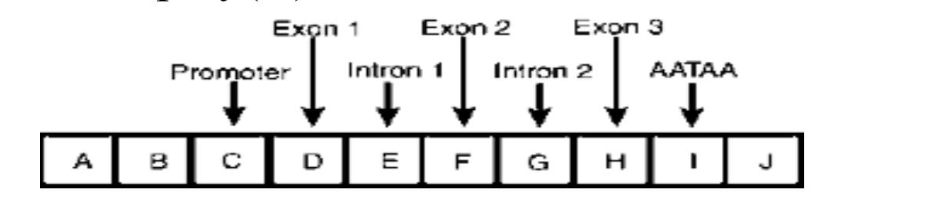
Shown below is the structure of a Drosophila gene, divided into 10 segments, designated A-J. The gene contains three exons, two introns, a promoter, and a site in I for poly(A) addition.
a) What segment or segments of the gene will be represented in the initial RNA transcript? List the appropriate letter or letters.
DEFGHI

b) What segment or segments of the gene will be found in the completely processed transcript?
DFHI
In an actively dividing eukaryotic cell, which type of RNA makes up the least fraction of total cellular RNA?
A. mRNA
B. rRNA
C. tRNA
D. ncRNA
A. mRNA
A researcher is studying the structure of an amino acid. The presence of which group in this amino acid specifically determines its unique properties (compared to other amino acids)?
A. the carboxyl group
B. the R group
C. the amino group
D. the a carbon group
E. the COOH group
B. the R group
Formation of the peptide bond could be described as:
A) a spontaneous reaction between two peptides, forming a covalent bond.
B) a ribosome-catalyzed process occurring in the nucleus.
C) a tRNA catalyzed process.
D) a ribosome-catalyzed dehydration reaction (H20 released).
E) transcription, a key process in gene expression.
D) a ribosome-catalyzed dehydration reaction (H20 released).
Each one of the listed features distinguishes translation in bacteria from that in eukaryotes, except
a. process of translation
b. ribosomes
c. protein regulatory factors involved in phases of translation
d. Location where transcription and translation take place in the cell
a. process of translation
The mutations of what genes could reverse the effect of nonsense mutations?
1. Genes encoding mRNAs.
2. Genes encoding rRNAs.
3. Genes encoding tRNAs.
4. Genes encoding ncRNAs.
3. Genes encoding tRNAs.
Where do we find all human nuclear DNA?
A. 23 pairs of chromosomes
B. 46 chromosomes
C. 22 autosomes and two sex chromosomes
D. 22 autosomes, one X chromosomes and one y chromosomes
D. 22 autosomes, one X chromosomes and one y chromosomes
What is meant by "codon bias"?
A) Codons are specific for the amino acids they specify.
B) Certain viruses like to infect particular DNA sequences in our genome.
C) Some organisms will use specific codons for amino acids they specify.
D) Certain viruses like to infect particular DNA sequences in our genome, and some organisms will use specific codons for amino acids they specify.
E) None of the answer options are correct.
C) Some organisms will use specific codons for amino acids they specify.
The most closely related genes either within a single organism or between two different organisms are called:
A) homologs.
B) orthologs.
C) paralogs.
D) heterologs.
E) alleles.
A) homologs.
Genes that have been inherited from a common ancestor are called:
A) homologs.
B) orthologs.
C) paralogs.
D) heterologs.
E) alleles.
B) orthologs.
Genes that are related by gene-duplication events within the same genome are called:
A) homologs.
B) orthologs.
C) paralogs.
D) heterologs.
E) alleles.
C) paralogs.
The golden standard to establish the function of a gene is to disrupt its function and understand phenotypes in the native condition, such approach is known as reverse genetics. The following are the strategies, except
A. Introduce random mutations
B. Create phenocopies
C. Conduct targeted mutagenesis
D. All except B.
A. Introduce random mutations
The fluctuation experiment and replicate plating experiment demonstrated the "paradigm" of Mutation, which stated that
a. Spontaneous mutation arises in bacteria cells and occurs when in contact with phage.
b. Spontaneous mutation arises in all cells of all organisms and occurs randomly.
c. Some bacteria cells are mutated by phage, some are not.
d. Mutation in all cells of all organisms will occur when in contact with inducing agents.
b. Spontaneous mutation arises in all cells of all organisms and occurs randomly.
McClintock induced mutations in maize with X-ray that cause frequent chromosomal breaks. She noticed her treated plants produced progeny exhibiting cytologically abnormalities on chromosome 9. When she crossed one plant CI/C carrying colorless kernels with a plant C/C carrying purple kernels, what result that surprised her?
a. All kernels are colorless.
b. All kernels are blue.
c. Some kernels have multiple blue sectors in the colorless background.
d. Some kernels have multiple colorless sectors in the blue background.
c. Some kernels have multiple blue sectors in the colorless background.
A corn plant is homozygous for a mutant allele that results in no pigment in the seed (i.e., white). The mutant is caused by Ds insertion that often exits late in seed development, when there is an active Ac element in the genome. If there is NO active Ac element, the seeds of this plant will be:
A) no pigment (i.e., white).
B) pigmented all over.
C) white with small spots of pigment.
D) white with large spots of pigment.
E) weakly pigmented.
A) no pigment (i.e., white).
How many possible haplotypes for the chromosomal segment on which these two loci (A, B) are located?
a) 2
b) 1
c) 3
d) 4
d) 4
You are studying a sample of 10 mice with the following genotypes: four mice are D/D, two mice are D/d, and four mice are d/d. In this scenario, what is the frequency of the d allele?
Α. 1.0
B. 0.8
C. 0.5
D. 0.2
Ε. 0
C. 0.5
A population is reproductively isolated. Which of the following is primarily responsible for the introduction of new alleles into this population?
A. mutations in the germ line
B. assortative mating
C. inbreeding
D. mutations in somatic cells
E. both A and D
A. mutations in the germ line
A partial diploid of genotype I- P+ O+ Z+ / I+ P+ O+ Z- will show:
A) inducible production of repressor.
B) inducible production of b-galactosidase.
C) constitutive production of b-galactosidase.
D) no production of b-galactosidase.
E) constitutive production of lactose.
B) inducible production of b-galactosidase.
A partial diploid of genotype I ^ S P^ + O^ + Z^ + /I^ + P^ + O^ + Z^ - will show:
A) inducible production of repressor.
B) inducible production of b-galactosidase.
C) constitutive production of b-galactosidase.
D) no production of b-galactosidase.
E) constitutive production of lactose.
D) no production of b-galactosidase.
A scientist is culturing bacteria in media containing lactose, but no glucose. Which of these statements is likely true of these cells?
A. The concentration of cAMP in these cells will be high.
B. In these cells, the CAP-CAMP complex will be bound to the lac operon.
C. The lac operon will be transcribed in these cells.
D. In these cells, the Lac repressor will not be bound to the operator of the lac operon.
E. all of these
E. all of these
A scientist studying attenuation of the tryptophan operon would find which result when there is an abundance of tryptophan?
A. Segments 2 and 3 of the leader sequence mRNA will base pair with each other.
B. A ribosome will stall on the multiple trp codons found in the leader sequence.
C. Transcription will terminate when segments 3 and 4 of the leader mRNA base pair with each other.
D. Translation of the leader peptide is prevented because the operon is being repressed.
E. The TrpE gene mRNA is translated because of its close proximity to the leader sequence.
C. Transcription will terminate when segments 3 and 4 of the leader mRNA base pair with each other.
An enhancer is best described as a:
A. regulatory sequence in DNA that acts to promote the expression of specific eukaryotic genes.
B.regulatory protein that alters the structure of chromatin.
C.long DNA sequence found in constitutive heterochromatin at telomeres.
D.protein that binds to RNA polymerase II, thereby increasing the rate at which RNA polymerase II transcribes a specific eukaryotic gene.
E. TATA box-containing DNA element that defines the promoter for a eukaryotic gene transcribed by RNA polymerase II.
A. regulatory sequence in DNA that acts to promote the expression of specific eukaryotic genes.
A student is studying two types of chromatin. The first type is "open" or loosely packed and would be referred to as _____ The second type is "closed" and tightly packed and would be considered _____
A. constitutive heterochromatin; facultative heterochromatin
B. heterochromatin; euchromatin
C. euchromatin; heterochromatin
D. insulators; enhancers
E. enhancers; nucleosome free region
C. euchromatin; heterochromatin
1. Ubx (Ultrabithorax) is a Drosophila homeotic gene that normally has two key functions: promote hindwing development and repress forewing development. A nonlethal loss-of-function allele of Ubx might be expected to
a) transform the forewing into a hindwing
b) transform the hindwing into a forewing
c) result in no development of either the hindwing or forewing
d) result in growth of an eye structure in place of a hindwing
e) transform the forewing into a leg structure
b) transform the hindwing into a forewing
2. The primary role(s) of Hox genes during normal Drosophila development is (are) to
a) produce miRNAs that regulate the "larval-to-adult transition"
b) determine the identity of segments
c) promote cell division
d) form the zone of polarizing activity and regulate limb development
e) All of the above
b) determine the identity of segments
3. The homeodomain found in all proteins encoded by Hox genes has what function?
a) binding RNA
b) binding histones
c) repressing transcription
d) binding DNA
e) targeting proteins for degradation
d) binding DNA