Organic Chemistry 1 Complete Set
 Call Kai
 Learn
 Practice Test
 Spaced Repetition
 Match
 Flashcards
 Knowt Play
1/162

Earn XP
Description and Tags
This is the complete set of flashcards covering all of semester 1 of organic chemistry module. The flashcards are made from details on slides and edited to keep updated after lectures.
163 Terms
Structure determination
How to find out the structure of new compounds.
Theoretical Organic Chemistry
How to understand structures in terms of atoms and electrons that bind them together.
Reaction mechanisms
How to find out how molecules react with each other and how to predict their reactions.
Synthesis
How to design and make new molecules.
Biological Chemistry
How to find out what Nature does and how the structures of biologically active molecules are related to what they do.
Draw a methyl cation:

Draw a methyl anion:

Draw a methyl radical:

Draw n-butanol:

Draw sec-butanol:

Draw tert-butanol:

Draw 2,2-dimethylpropan-1-ol:

What is General Formula for propan-1-ol?
CnH2n+1OH
What is Empirical Formula for propan-1-ol?
C3H8O
What is Molecular Formula for propan-1-ol?
C3H7OH
What is the structural/condensed formula for propan-1-ol?
CH3CH2CH2OH
Draw displayed formula for propan-1-ol:

Draw skeletal formula for propan-1-ol:

Draw Perspective projection Staggered, Ethane style:

Draw Perspective projection Eclipsed, Ethane style:

Draw Newman projection Staggered, Ethane style:

Draw Newman projection Eclipsed, Ethane style:

Draw Fischer projection, Ethane style:

Draw Sawhorse projection Staggered, Ethane style:

Draw Sawhorse projection Eclipsed, Ethane style:

List abbreviations for alkyl groups up to (including) butyl:
Me, Et, Pr, Bu
How can you form a propyl group from propane? Draw an example for the formation of an isopropyl group:
Remove a hydrogen from either a secondary or primary carbon on propane.

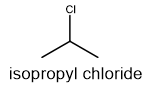
Draw isopropyl chloride:
Draw isopentyl alcohol:

Draw isobutylamine:

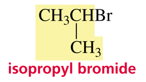
Draw isopropyl bromide:
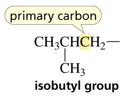
Draw isobutyl group:
Draw sec-butyl group:

Draw tert-butyl group:

What is Ph an abbreviation of?
Phenyl
What is Bn an abbreviation of?
Benzyl
What is Ac an abbreviation of?
Acetyl
Draw Vinyl molecule:

Draw Allyl molecule:

What is R an abbreviation of?
Any group
What is Ar an abbreviation of?
Aromatic group
What is i-Pr an abbreviation of?
isopropyl
What is t-Bu an abbreviation of?
tert-butyl
What is X an abbreviation of?
Halide
Draw the 3D structures for CH2BrCl with different perspectives:

Draw the 3D structures for CH2ClCH2Br with different perspectives:

Draw the standard tetrahedral 3D skeletal model, which has hash and wedge bonds:

Define Isomer
Compounds that have the same molecular formula but different structures
What is a constitutional isomer?
Has the same molecular formula, but differ in atom connectivity and possibly functional groups.
What is a configurational isomer?
Has the same molecular formula and atom connectivity, but differs in spatial arrangement of atoms.
What are geometric isomers?
Compounds that differ in how their substituents are arranged around the double bond. Geometric isomers can be separated,
What are cis isomers?
Cis isomers have the chain of the same side of the double bond/ring.
What are trans isomers?
Trans isomers have the chain on opposite sides of the double bond/ring.
What are the Cahn-Ingold-Prelog Rules?
1) Assign priority to substituents according to atomic number.
2) If two substituents have the same atomic number, go to the next set of atoms in line.
3) If the highest priority groups are on opposite sides, the isomer is E.
4) If the highest priority groups are on the same side, the isomer is Z.
How would a C-C triple bond be treated according to Cahn-Ingold Prelog rules?
Treated as CCC
Describe rotation around a single bond:
Electron density is in the middle of two atoms. The overlap of orbitals is undisturbed by rotation around the bond. This allows for a variety of conformations of a molecule.
Why is the Newman projection useful?
The best way to judge the stability of the different conformations of a molecule.
Describe the difference in energy between staggered and eclipsed conformations:
The steric hinderance and therefore steric strain is greater when the electron clouds of large substituents overlap with each other.
Greater repulsion means more energy is required to keep the molecule stable, so the molecule is generally more stable when staggered and less stable when eclipsed.
What is the meaning of syn-periplanar, synclinal, gauche, anticlinal and anti-periplanar?
Syn-periplanar (eclipsed) = both of the bulkiest substiuents are eclipsing each other.
Synclinal/gauche (staggered) = both of the bulkiest groups are 60 degrees apart from each other.
Anti-clinal (eclipsed) = both of the bulkiest groups are 120 degrees apart from each other.
Anti-periplanar (staggered) = both of the bulkiest groups are 180 degrees apart (staggered formation)
Draw the anticlinal conformation for butane in Newman projection:
Draw the anti-periplanar conformation of butane as a Newman projection:
Draw the syn-periplanar conformation of butane as a Newman projection:
Draw the synclinal/gauche conformation of butane as a Newman projection:
Draw the butane conformations on an energy diagram showing the positions and Newman projections of each conformation:
Can conformers be separated?
Pure conformers can be observed and predicted, but cannot be isolated in most cases, because the molecules are constantly rotating through all the possible conformations.
Name this structure:
2-methylpentane
Draw the structure 3-ethyl-3-methylhexane:
Name the structure:
3,3-dimethylhexane
Draw the structure 4-ethyl-3,3-dimethylheptane
Name this structure:
4-ethyl-5-isopropyloct-2-ene
Draw this molecule 6-(1,2-dimethylpropyl)-4-propyldecane:
Name this structure:
2,3-dimethyl-5-(2-methylbutyl)decane
Name this structure:
1-cyclobutylpentane
Draw the molecule 1-methyl-2-propylcyclopentane:
Name this molecule:
1,1,2-trimethylcyclopentane
Draw the molecule 4-ethyl-2-methyl-1-propylcyclohexane:
Name this molecule:
trans-cyclodecane
Draw the molecule cyclooctene:
Name this molecule:
phenylmethanol
Name this functional group:
Alcohol
Name this functional group:
Ether
Name this functional group:
1,1-diol
Name this functional group:
hemiacetal
Name this functional group:
acetal
Name this functional group:
Aldehyde
Name this functional group:
Ketone
Name this functional group:
Carboxylic acid
Name this functional group:
Acid chloride
Name this functional group:
Acid anhydride
Name this functional group:
Ester
Name this functional group:
Amide
Name this functional group:
Lactone (cyclic ester)
Name this functional group:
Lactam (cyclic amide)
Name this functional group:
Imide
Name this functional group:
Carbamate (urethane)
Name this functional group:
Urea
Name this functional group:
Amines
Name this functional group:
Imine
Name this functional group:
Oxime
Name this functional group:
Hydrazone