BIOL 320 Lab Practical 2
 Call Kai
 Learn
 Practice Test
 Spaced Repetition
 Match
 Flashcards
 Knowt Play
1/67

There's no tags or description
Looks like no tags are added yet.
68 Terms
What is another name for the digestive tract?
Alimentary canal
What do accessory organs of the digestive system do?
Secrete substances for digestion, but do not come in contact with food
What kind of tissue is the oral cavity lined with?
Nonkeratonized stratified squamous epithelium
What is the major muscle of the tongue
Genioglossus
Where do nerves and blood vessels enter the tooth through?
Apical foramen
What set of human teeth appear first?
Primary/deciduous teeth (20 total)
What set of teeth appear second?
Secondary/permanent teeth (32 total)
Visceral peritoneum (serosa)
Membrane lining the outer surface of the digestive tract
Mesentery
Double-folded membrane that attaches the digestive tract to the back of the body wall
Parietal peritoneum
Membrane on the inner side of the body wall
3 mucous membrane layers of digestive organs
mucosa
lamina propria
musclaris mucosae
Identify the 3 parts of the stomach
Cardia + fundus
Body
Pylorus
Esophageal sphincter function
Prevent stomach contents from moving into esophagus
Pyloric sphincter function
Prevent stomach contents from premature release into small intestine
Identify the three major layers of the small intestine
Duodenum: receives fluid from pancreas and gallbladder
Jejunum
Ileum
What structure distinguishes the small intestine from the stomach and large intestine?
Villi: projections that increase surface area of mucosa; contain blood vessels that carry sugars and amino acids from intestine to liver, contain lacteals that carry fatty acids to venous system
Identify the 6 major regions of the large intestine
Cecum
Ascending colon
Transverse colon
Descending colon
Sigmoid colon
Rectum
What distinguishes large intestine histology from the stomach?
Presence of a large number of goblet cells
Name the three salivary glands
Parotid glands: anterior to ears
Submandibular glands: medial to mandible
Sublingual glands: inferior to the tongue (multiple ducts)
What is the function of the gallbladder?
Releases bile, which emulsifies lipids in the duodenum
What vascular level does the separation between the renal cortex and renal medulla occur at?
Arcuate arteries/veins
What vessels exit from the hilum of the kidney?
Renal artery, renal vein, ureter
What role do juxtamedullary nephrons play, and what % of nephrons do they cosntitute?
Produce concentrated urine; 15%
What 2 fluids do the kidneys regulate?
Blood and urine
Explain the kidney portal system
Blood flows from glomerulus (site of filtration) to peritubular capillaries (site of reabsorption)
What tissues make up the ureters?
Transitional epithelium inner lining, smooth muscle outer wall
How is urine moved from the kidney to the bladder?
Peristalsis (wave-like muscle contractions)
What tissues line the bladder?
Transitional epithelium inner surface, detrusor muscle in the wall
Micturition reflex
Bladder stretches, neurons stimulate the internal sphincter of the bladder to open
What structures is the nasal septum composed of?
Perpendicular plate of ethmoid bone, vomer, septal cartilage
What moistens air coming into the nasal cavity?
Respiratory epithelium
What warms air coming into the nasal cavity?
Superior venus plexus
What are the auditory tubes?
Openings on the lateral walls of the nasopharynx
What vertebrae is the larynx situated near?
Fourth thru sixth cervical vertebrae
What is the most prominent cartilage of the larynx and what is it made up of?
Thyroid cartilage, hyaline cartilage
Which cartilage of the thyroid attaches to the vocal cords?
Arytenoid cartilages (2)
What is the most inferior part of the trachea called?
Carina; place right before the primary bronchi diverge
List the tubes of the tracheobronchial tree in order of decreasing size
Primary bronchi → lobar bronchi → segmental bronchi → bronchioles → respiratory bronchioles
How many lobes does each human lung have?
Right has three, left has two
Where does the heart sit relative to the left lung?
In an indentation called the cardiac notch
What is emphysema?
The breakdown of alveoli, which decreases oxygen diffusion as a result of decreased surface area
What is pulmonary ventilation?
The mechanical process of moving air into and out of the lungs
What is tidal volume?
Normal inhale and exhale
What is expiratory reserve volume?
A larger exhale than normal
What is residual volume?
Air that remains in the lung after a full exhale
What is inspiratory reserve volume?
A larger inhale than normal
What is inspiratory capacity?
Taking a deep breath
What is vital capacity?
A maximum inhale followed by a maximum exhale (like during vigorous exercise)
What is functional residual capacity?
Amount of air left in lungs after a normal exhale
What is total lung capacity?
Total volume of air in the lungs

Duodenum (presence of duodenal glands)

Jejunum

Ileum (presence of Peyer’s patches)

Large intestine (presence of goblet cells)

Stomach (presence of gastric pits)
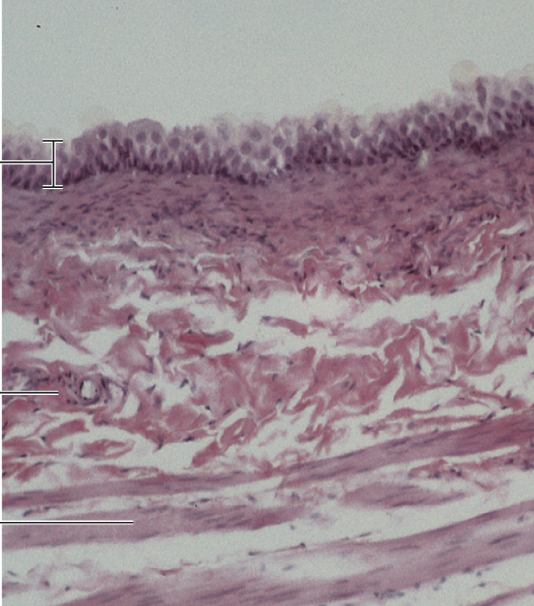
Bladder
What is the name of the connective tissue surrounding the testes?
Tunica albuginea
What temperature is required for spermatozoa production?
35 degrees C
What muscles are responsible for regulating the temperature of the testes?
Dartos muscle (scrotum) and cremaster muscle (spermatic cord)
Where does sperm capacitation (maturation) occur?
Epididymus
Name the three types of male urethra
Prostatic, membranous, penile
Name the male and female lubricating glands
Bulbourethral (male) and Bartholin’s (female)
Trace the sperm pathway
Seminiferous tubules (testes) → epididymus → vas deferens → ejaculatory ducts (prostate, seminal, bulbourethral) → urethra → peanits
Name the steps of oogenesis
Oogonia → primary oocyte → secondary oocyte → ovulation (evacuation of ovum into follicular tube) → corpus luteum → corpus albicans (if no fertilization occurs)
Name and describe the phases of the female menstrual cycle
Proliferative phase: building endometrium, follicles are developing
Secretory phase: begins with ovulation, endometrium continues to grow, large corpus luteum
Menses: breakdown of endometrium and degeneration of corpus luteum into corpus albicans
What hormones peak RIGHT after ovulation?
Lutenizing hormone and follicular stimulating hormone
During which menstrual phase does progesterone peak?
Secretory phase
What hormones decline before menstruation?
Progesterone and estrogen