CHEE 370: module 4
 Call Kai
 Learn
 Practice Test
 Spaced Repetition
 Match
 Flashcards
 Knowt Play
1/46

There's no tags or description
Looks like no tags are added yet.
47 Terms
metabolism
anabolism +catabolism
metabolic pathways consist in several enzyme-catalyzed steps
pathways that lead to biosynthesis→ anabolic
pathways that lead to degradation of complex metabolites →catabolic
metabolic pathways are coupled: one produces high-energy compound and energy carriers can then be re-invested to drive anabolic pathways

energy rich carriers
high energy intermediates are produced during catabolism
typically converted into ATP or NADH to drive other reactions, then drives anabolism (by re-oxidizing FADH2 and NADH to regenerate NAD+ and FAD)
ATP is considered the universal “currency” used by most cells
ex. glycolysis and gluconeogenesis
reaction control
enzymes are modulated by allosteric regulation, via conc. gradients (prokaryotes) and segregation (eukaryotes
due to compartmentalization in euks, they have developed shuttle systems to import/export metabolites., energy carriers and other intermediates to/from organelles
reaction types
a restricted number of reaction types can be identified:
group-transfer reactions (e.g., the transfer of a phosphate group from one molecule to another, often involving ATP or ADP)
oxidation and reduction
elimination, isomerization and rearrangements
reactions that make or break carbons
Free energy change
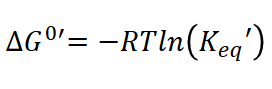
the molar free energy of a substance can be related to its standard conditions and actual conditions in solution (activity of the substance).
in dilute solutions, the activity of a molecule can be assumed to be equal to its conc. (ideal behavior)
Free energy change equation
standards biochemical conditions:
25 degrees Celsius
1 atm
pH 7.0
Q= the ratio of the activities of products to reactants (what’s inside the brackets of ln)
Q can be replaced with K’_eq

free energy change at eqm
delta G’ = 0
Coupled reactions
catabolic and anabolic reactions are coupled via energy-rich molecules
energy carriers are created during catabolism and consumed during anabolism
the overall Gibbs energy change of two coupled reactions can be calculated from the sum of the two coupled reactions
the values can be found in literature

Overall Gibbs free energy for coupled reactions
If ∆G of reaction 1 > 0, it will not occur spontaneously.
• However, if ∆G of reaction 2 is sufficiently exergonic so that their sum <0, although equilibrium concentration of D in Reaction 1 will be relatively small, it will be larger than that in Reaction 2
• As Reaction 2 converts D to products, Reaction 1 will operate in the forward direction to replenish the equilibrium concentration of D. The highly exergonic Reaction 2 therefore drives the endergonic Reaction 1, and the two reactions are said to be coupled through their common intermediate, D

coupled electrochemical reactions
Oxidoreduction reactions can be coupled within cells.
Can be coupled with directly by oxidoreductase enzymes
Can occur across organelle membranes, since these membranes can create electrochemical gradients across the membrane


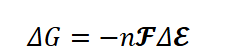
coupled electrochemical reaction equation
spontaneous if delta E >0
when delta E is positive → delta G is negative
The more positive the standard reduction potential, the greater tendency for the redox couple’s oxidized form to accept electrons and be reduced.
Get values from table based on reaction
energy metabolism
the amount of energy available to create ATP depends on the final free energy of the products obtained
in aerobic metabolism, glucose is fully oxidized to CO2 (complete “burning” of glucose)
in anaerobic metabolism, glucose is partially oxidized to form lactate or ethanol (partial “burning” of glucose, small free energy change)
more ATP can be obtained per molecule of glucose for aerobic metabolism than for anaerobic metabolism
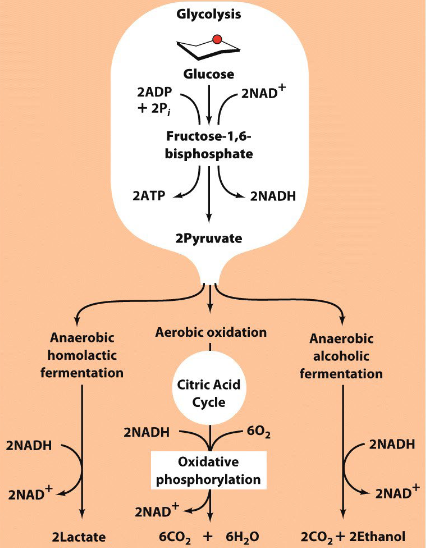
the first step in both fermentations is the conversion of glucose into pyruvate
Glycolysis: oxidation of glucose to pyruvate is coupled to the reduction of NAD+ into NADH and to the production of 2 ATP molecules
in anaerobic metabolism, NADH is then re-oxidized into NAD+ via the production of ethanol or lactate
in aerobic metabolism, pyruvate is completely oxidized into CO2, creating more NADH (and FADH2), which is then used to produce further ATP via oxidative phosphorylation
Glycolysis: phases and overall equation
Preparatory phase (phase I): 2 ATP “invested” to convert glucose into GAP
Energy production phase (phase II): 2 GAP converted into 2 pyruvate, producing 4 ATP and 2 NADH
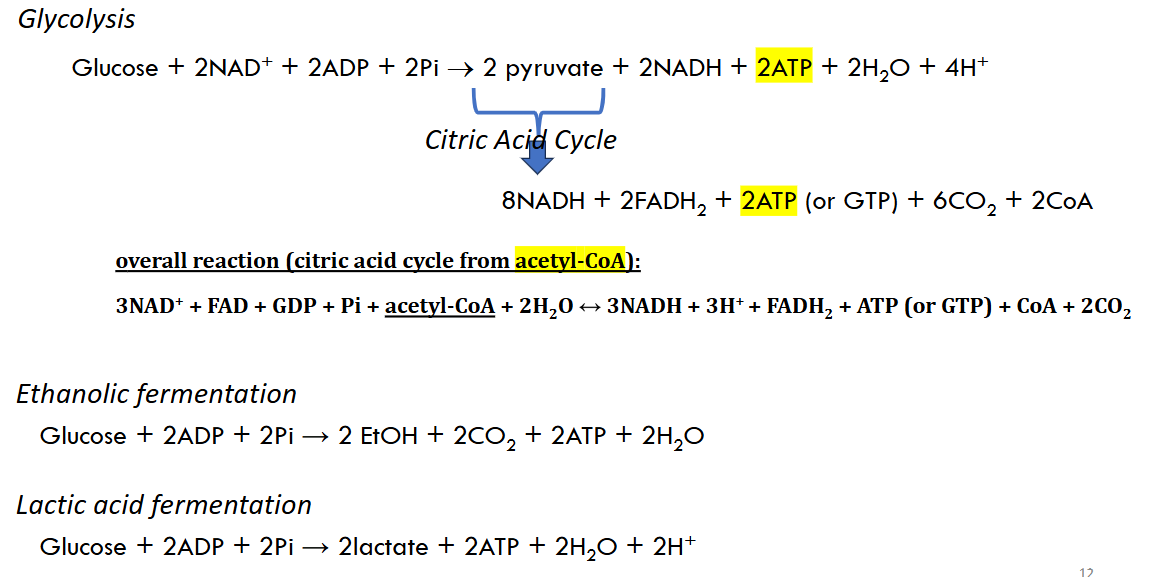
Glucose +2 NAD+ +2ADP +2Pi → 2 pyruvate +2NADH +2ATP +2H2O +4H+
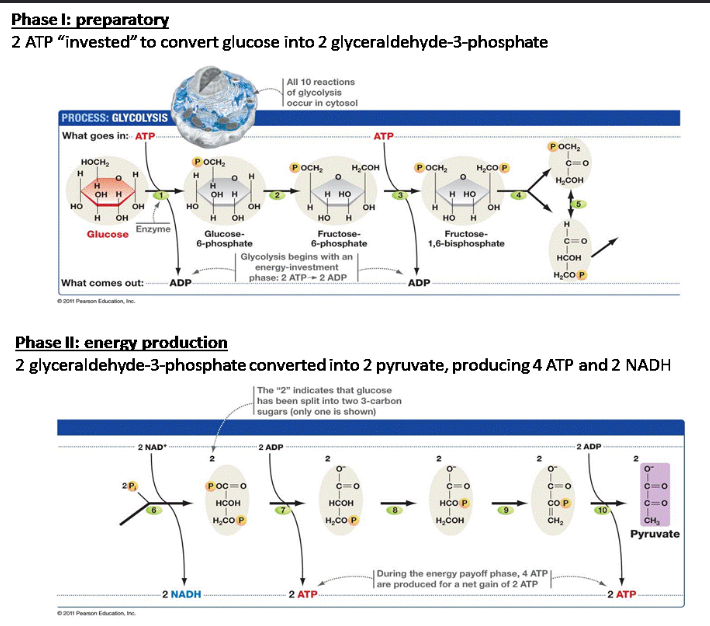
Glycolysis step 1
Addition of phosphate group to carbon 6 of glucose
requires Mg2+
catalyzed by hexokinase
glucose +ATP →G6P
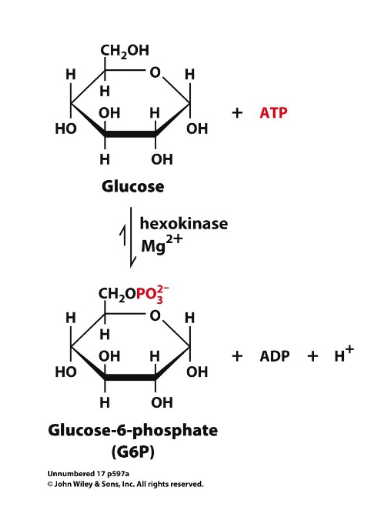
Glycolysis step 2
G6P → F6P
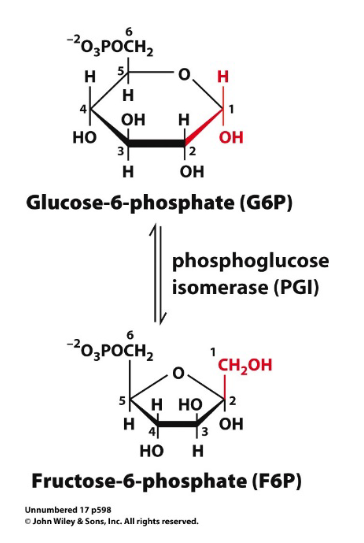
Glycolysis Step 3
F6P+ ATP → FBP +ADP + H+
This reaction is one of the rate-limiting steps of glycolysis

Glycolysis Step 4 and 5
FBP → DHAP+ GAP
DHAP → GAP
you have two GAPs since DHAP is also converted
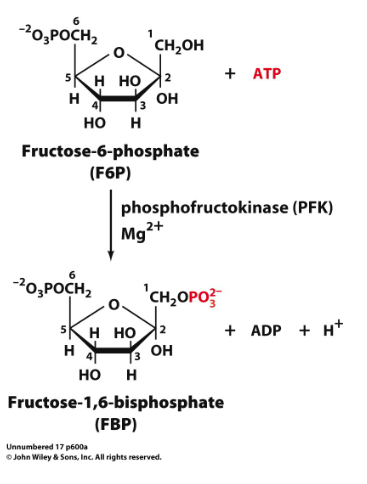
Glycolysis step 6
Start of phase II : everything is done twice since we have two GAP molecules
GAP + NAD+ +Pi → 1,3 -BPG +NADh + H+
This step marks the transition between energy investment and “payoff” in the glycolysis pathway
1,3-BPG is the first high-energy molecule intermediate in glycolysis
The high free energy state of this molecule reflects the instability caused by the presence ow two negatively charged phosphate groups close to one another on the triose sugar

Glycolysis step 7
First formation of ATP
1,3-BPG +ADP→ 3PG +ATP
Although kinase denotes enzymes that add phosphate groups to molecules using ATP, reaction can occur in both directions

Glycolysis step 8
3PG → 2PG
mutase enzyme catalyzes the transfer of a functional group within a molecule

Glycolysis step 9
2PG → PEP
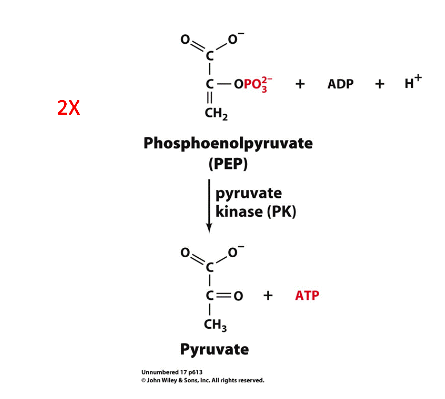
Phosphoenolpyruvate is a second high-energy intermediate
The phosphate bond in this molecule has the highest energy of the phosphate of the phosphate bonds found in molecules from living organisms.
Glycolysis step 10
This step is coupled to ATP production
PEP +AP+ H+ → pyruvate +ATP
this formation of phosphoenolpyruvate is required to obtain the highest yield possible of ATP
Gibbs free energy and rate-limiting steps
can observe that the free energy at standard conditions and the measured conditions deviate significantly
the accumulation of certain intermediate in the pathway therefore drives forward the flux through certain steps that would otherwise be non-spont.
when considering solely the deltaG value, most reactions in the pathway are near eqm (small deltaG), except step 1, 3, and 7.
These steps constitute the rate-limiting steps of the pathway
As the reactions are slower that the other steps in the pathway, the products can be formed
the enzymes that lead to the rate-limiting steps in the pathways typically function as flux control points
the enzyme are under stringent control via several allosteric regulators
Anaerobic metabolism: fermentation
Glycolysis also leads to the production of NADH from NAD+
in anaerobic metabolism, NAD+ is regenerated either by the production of ethanol in ethanol fermentation or via the production of lactate in lactic acid fermentation

Ethanolic fermentation (general)
allows for the regeneration of NAD+ needed for further glycolysis reactions
the production of ethanol may also confer a certain evolutionary advantage by damaging organisms that are more sensitive to ethanol
yeast cells can grow in up to 12% (or even higher) ethanol environments, while few other organisms survive at >5% ethanol
ethanolic fermentation steps
the first step is decarboxylation of pyruvate to produce acetaldehyde and CO2
the second steps is the reduction of acetaldehyde to ethanol, allowing for oxidation of NADH into NAD+
Overall reaction:
Glucose +2ADP+2Pi → 2EtOH +2CO2 +2ATP+2H2O

Lactic acid fermentation (general)
pyruvate is converted into lactic acid with the simultaneous oxidation of NADH into NAD+
lactic acid fermentation steps
one lactic acid molecule per pyruvate
this reaction occurs in muscle cells during vigorous activity when the oxygen supply is insufficient
overall reaction:
Glucose +2ADP +2Pi → 2 lactate +2ATp+2H2O+2H+

pyruvate to acetyl-CoA
Pyruvate +CoA +NAD+ → acetyl-CoA +CO2+NADH

Citric acid cycle
acetyl-CoA passes through the citric acid cycle where the enzymes completely oxidize the acetyl groups into CO2
Overall reaction from acetyl-CoA:
3NAD+ +FAD+GDP +Pi +acetyl-CoA +2H2O → 3 NADH +3H+ +FADH2 +GTP +CoA +2CO2
we know that it is a cycle due to recovery of CoA at the “end”

where does the reactions occur
prokaryotes:
citric acid cycle: cytoplasm
oxidative phosphorylation: across cytoplasmic membrane
can use different electron acceptors (other than O2)
eukaryotes:
citric acid cycle: mitochondria matrix
oxidative phosphorylation: across mitochondrial inner membrane
needs shuttle system for NADH, citric acid cycle intermediates
amount of production after citric acid cycle
1glucose produces 2 pyruvate in glycolysis
the 2 pyruvate then generate:
6 NADH
2FADH2
2 ATP (or GTP)

Summary of aerobic and anaerobic fermentation
introduction to oxidative phosphorylation
C6H12O6 +6H2O → 6CO2 +24H+ +24e- (during glycolysis and citric acid cycle)
6O2 +24H+ +24e- →12 H2O (during oxidative phosphorylation)
during this process, NAD+ and FAD act as intermediates that couple the two half-reactions
the e- and H+ obtained from glucose are first transferred to NAD+ and FAD to from NADH and FADH2 during glycolysis and citric acid cycle
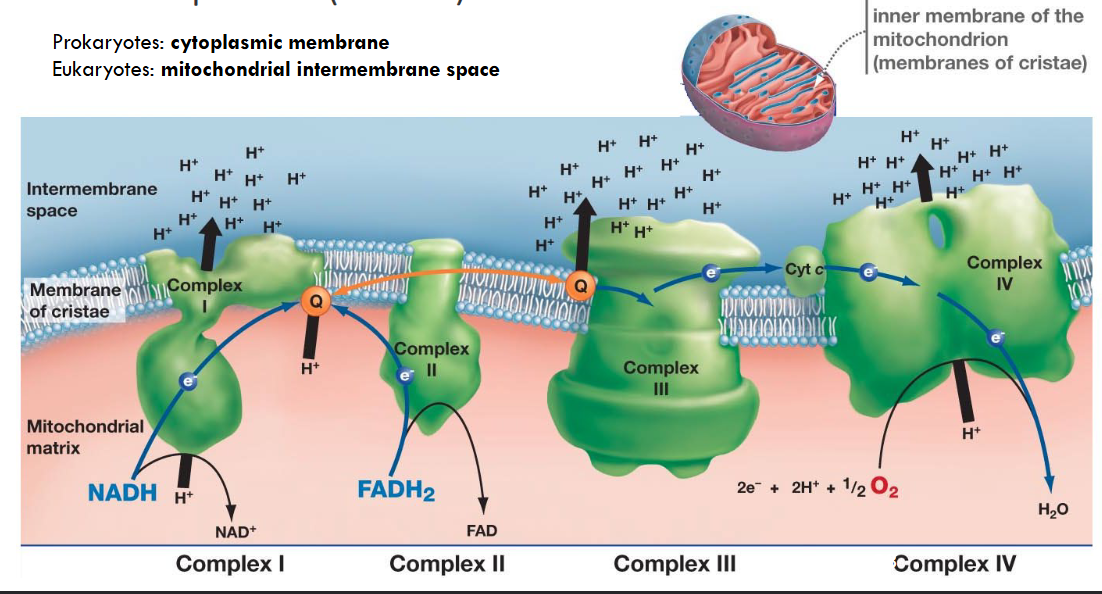
then the e- are passed form NADH and FADH2 to the proteins in the electron transport chain. this is used to create H+ gradient across a membrane called proton motive force and used by an enzyme called ATP synthase
Oxidative phosphorylation (part 2)
Oxidation: the redox reactions that occur in the electron transport chain are coupled to the transport of H+ across a membrane, creating proton motive force (H+ electrochemical gradients across the membrane
Phosphorylation: ATP synthase uses the proton motive force to perform the phosphorylation reaction by chemiosmosis
Electron transport chain
24 electrons created from glucose oxidation to CO2 are not directly transferred to O2, but rather to NAD+ and FAD to form 10 NADH and 2 FADH 2 molecules.
essentially: 12 electron pairs are “stored” in the 12 molecules of NADH+ FADH2 created during glucose oxidation.
these e- pairs are then passed on to a sequence of integral proteins that from the electron transport chain
As these proteins undergo sequential redox reactions, the free energy obtained from these reactions is coupled to the passage of H+ from one side of the membrane to the other side of the membrane by these same electron transport chain proteins to create the proton motive force

proton motive force

ATP produced from oxidative phosphorylation
FADH2 can translocate 6 H+ and NADH can translocate 10 H+
3 ATP per turn/12c subunits = 0.25 ATP/H+
10 NADH → 25 ATP +2FADH2 → 3ATP = 28 ATP
the cell produces 32 ATP per glucose (glycolysis, citric acid and oxidative phosphorylation)
max ATP yield at 100% efficiency → 92 ATP
so aerobic metabolism efficiency =35%
Summary of aerobic respiration

Cell growth stoichiometry
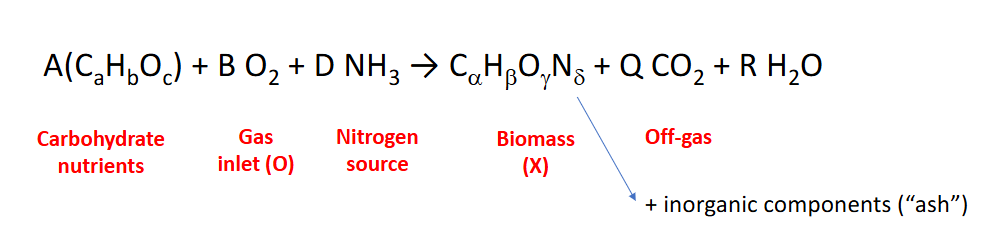
all the reactions that occur in cells can be lumped together in a highly simplified model of cell growth utilizing the main substrate supplied by cells
biomass only takes into account C, H, N, O
for aerobic growth of cells utilizing ammonium as a source of nitrogen, the equation can be written as (image)
use dry cell weight (dcw)
biomass consist of both organic components and inorganic components
inorganic components is termed ash content
ash content varies from 3% to 10%
elemental balance for cell growth stoic

respiratory quotient
molar flux ratio of CO2 produced relative to O2 consumed

cell and product yields
can be calculated in mass or molar yield
Y_(X/S, molar) = 1/A
Y_X/O2, molar) =1/B
a correction factor must be used to account for ash content
Y_(X/S) multiplied by (1/(1-r)) where r is the ash content of the biomass

product formation
if the cells produce large amounts of product, a significant amount of substrate may be used to generate product instead
if the product is intracellular, the product will be part of the biomass measured
if the product is secreted, the substrate conversion to product must be taken into account

product yield
can measure the product yield on substrate

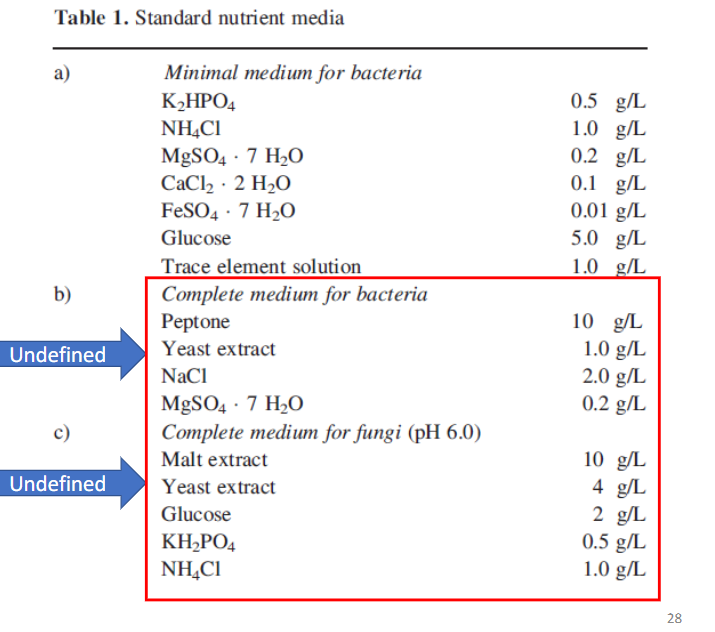
bacterial growth medium
defined: we know the exact composition of the medium
undefined: more general, less specific medium