Plant Biology
 Call Kai
 Learn
 Practice Test
 Spaced Repetition
 Match
 Flashcards
 Knowt Play
1/135

There's no tags or description
Looks like no tags are added yet.
136 Terms
What scientific process is transforming our understanding of the tree of life?
Comprehensive DNA analyses
What are the three main Kingdoms of Eukarya? What’s the fourth kind of kingdom (non monophyletic)?
Plantae
Fungi
Animalia
Protista (non monophyletic)
What is the method of energy intake in Plantae?
Photosynthesis
What is the main method of energy intake in Fungi?
Absorption
What is the main method of energy in Animalia?
Ingestion
What are the three main plant groups? (Technically supergroups/clades or whatever) What do they include?
Archaeplastids = land plants, green algae, some red algae, and glaucophytes
Viridiplantae = land plants and green algae
Embryophyta = land plants
What are the two main types of Embryophytes? What distinguishes them?
Bryophytes: non-vascular
Tracheophytes: vascular
What are the two green algae groups within Viridiplantae?
Streptophyte algae grade
Chlorophyte algae grade
Within Embryophytes (land plants), there are Tracheophytes and Bryophytes. What plants make up these groups? (3 for Bryphytes, 4 for Tracheophytes)
Tracheophytes:
Angiosperms
Gymnosperms
Ferns
Lycophytes
Bryophytes:
Mosses
Liverworts
Hornworts
Which of the Embryophytes produce spores? Which are seed plants?
Spore producers:
Bryophytes (mosses, liverworts, and hornworts) and ferns and lycophytes of the Tracheophytes
Seed producers:
Angiosperms and gymnosperms of the Tracheophytes
Why are seeds so important?
They are the means by which progeny of an individual plant are dispersed
What are some of the advantages of seeds?
They can travel considerable distances
They are resilient to adverse environmental conditions
Utilize dormancy in which they persist in an “inactive” state until conditions are favorable for germination
How do seeds know when to come out of their dormant state and/or begin germination?
Their tissues sense environmental cues that trigger germination
Mature seed contain an ______, encased within a _______ _____ _____. (aka a _____)
Embryo, protective seed coat (aka testa)

Can the embryo in a mature seed be folded over?
Yes, seen in mustard and quinoa
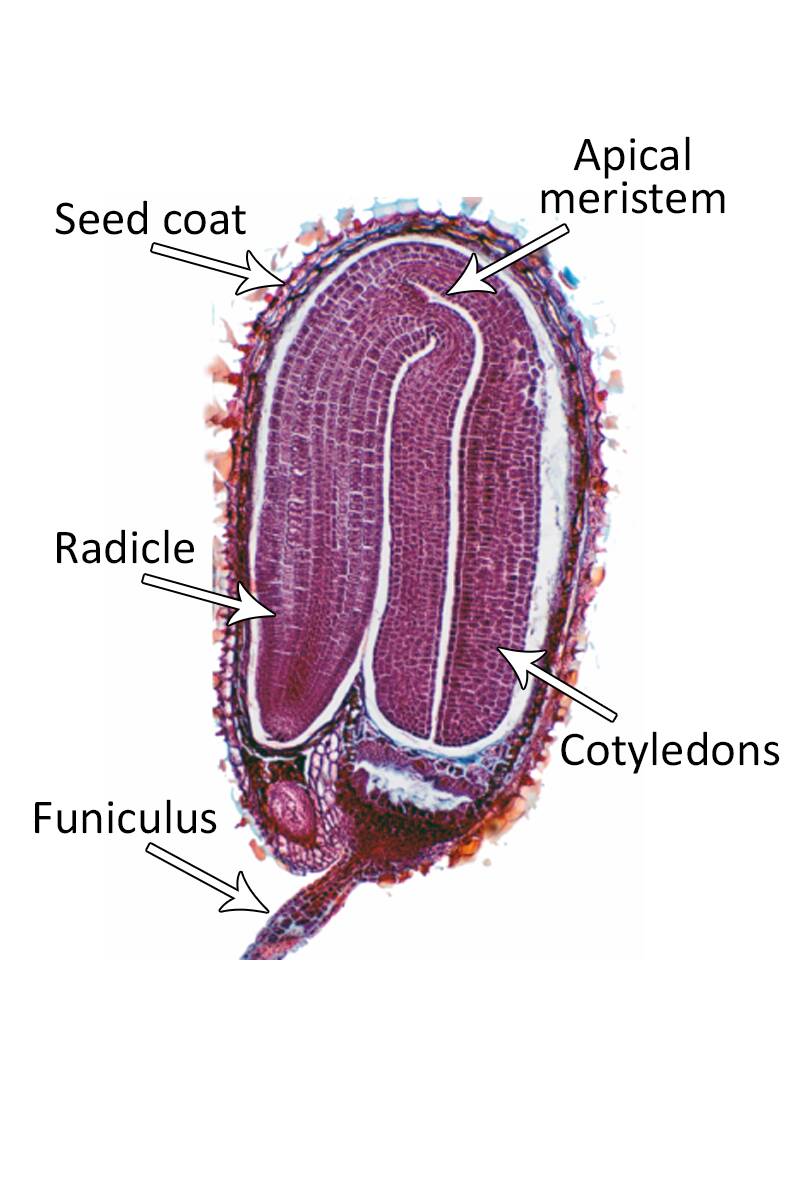
What are the different parts of the embryo of mature seeds?
Cotyledons: embryonic leaves
Radicle: embryonic roots
Hypocotyl: embryonic “stem” connecting the cotyledons and the radicle
Axis: hypocotyl and radicle together
Nutritive tissue (technically not part of embryo): endosperm in angiosperms, megagametophyte in gymnosperms
Also development of apical meristem
Do both gymnosperms and angiosperms have nutritive tissue?
YES in angiosperms it is the endosperm, in gymnosperms it is megagametophyte
What is the endosperm? (is it present in all angiosperm seeds at maturity?) When does it form? Is it haploid, diploid, or triploid?
Nutritive tissue that is not part of the embryo (in species like orchids endosperm does not persist to maturity)
Forms at fertilization
Triploid = 3n
Within seed plants, what are we focusing on?
Eudicots (ang), Monocots (ang), and Conifers (gym)
What are angiosperms? (basic)
Flowering plants with fruit that develops from ovaries
What are gymnosperms? (basic)
Plants with cones or analogous structures, with no ovaries
What are the main traits that distinguish conifers (gym) from angiosperms? (Think SnLAWFR)
Seed nutritive tissue: con - megagametophyte, ang - endosperm
Leaves: con - needles, ang - broadleaf
Anatomy: stems, leaves, roots
Wood: con - yes, ang - sometimes (woody vs herbaceous stems)
Fruit: con - no (no ovaries**), ang - yes
Reproductive unit: con - cones or analogous structure, ang - flowers (can be highly modified)
** some may have scales that house ovaries actually
What are the key traits that distinguish monocots from eudicots? (CLAF)
Cotyledons: eudicots - two, monocots - one
Leaf venation: eu - reticulate (netted), mono - parallel
Anatomy: roots, stems, leaves, flowers
Flower parts: eu - 4s or 5s, mono - 3s
What are meristems?
Centers of undifferentiated cells where cell divisions take place (like stem cells).
What are the different types of meristems?
Apical meristems which include:
Shoot meristems
Root meristems
Axillary meristems (located between leaf and stem for lateral branch, leaf, or flower growth)
Are the mature plant’s organs present in the seed’s embryo?
Nope, they arise from cell divisions that take place at the shoot and root apical meristems following germination.
What are the shoot and root apical meristems responsible for?
Primary growth (growth in vertical axis)
Do shoot and root apical meristems keep producing new cells throughout the plants life? Why is it important?
Yes, gives plants the ability to respond to environmental cues.
What are 3 prominent features that distinguish plant cells from animal cells?
Cell wall
Chloroplasts
Central vacuole
Explain what a cell wall is and what it is responsible for?
A cell wall is the outermost layer of a plant cell (exterior to the plasma membrane)
Contributes mechanical strength
Supports adhesion (H2O to cell walls) and transport of H2O and nutrients
Acts as a barrier to protect cell membrane
Helps control cell expansion
What is protoplasm?
Plant cell minus cell wall
What is the cytoplasm?
Protoplasm, minus the nucleus and vacuole, but includes other organelles
What is the cytosol?
Cytoplasm minus the organelles
What are chloroplasts? What is their function/role?
Double membraned organelles in plant and algal cells. The internal structures are involved in fixing carbon through photosynthesis.
What is the central vacuole? What is its function/role?
A fluid filled storage organelle found in plant cells.
They are involved in:
Maintaining structure
Controlling turgor pressure
Storage of water, nutrients, and minerals
What is something that all plant cells have?
Primary cell walls
What are primary cell walls composed of? (mainly)
Carbohydrate polymers
What are some examples of carbohydrate polymers found within primary cell walls of plant cells? What are their traits?
Cellulose (glucose-glucose-glucose) microfibrils:
Composed of glucose chains
Not branched
High tensile strength, provide main structural framework
Hemicellulose (hexoses)
Composed of glucose and other hexoses
Somewhat branched
Flexible, tether cellulose microfibrils together
Pectin (hexoses)
Composed of glucose and other hexoses
Very branched
Forms a gel in which other components are embedded

Some plant cells have secondary cell walls. What makes them different from primary cell walls?
They are thicker
They contain lignin (which add strength and rigidity)
They are laid down after primary cell walls
Deposited between the cell membrane and primary cell wall
Composition differs as well
Higher proportions of cellulose
Reduced hemicellulose
Little pectin
What are the two main compartments in plant tissues? Explain dem
Symplast: shared collective cytoplasm and contents of cells internal to the plasma membrane, connected to others via plasmodesmata/pits
Apoplast: cell walls and associated intercellular spaces, external to the plasma membrane system
So water can move both apoplastically and symplastically. What differs between the two pathways?
Apoplastic pathway:
Water and molecules can move faster and more freely
No filtering
Will be stopped by casparian strip
Passive movement driven by hydrostatic pressure
No crossing of cell membranes (until it reaches a barrier like casp strip)
Symplastic pathway:
Slower movement
Highly selective
Active/osmotic movement via plasmodesmata (remains in cytoplasm)
What are plasmodesmata? Why are they important?
Tunnel-like structures that connect the protoplasts of neighboring cells. They allow movement of specific molecules between cells (based on if they fit), so traffic is tightly regulated (high filtering)
What shared things do plasmodesmata contain?
Cytosol
Plasma membrane
Endoplasmic reticulum (where ER threads thru plasmodesmata, forms a desmotubule)
What are primary pit-fields? What effect do these have on cell walls?
Clusters of plasmodesmata. Cell walls tend to be particularly thin in primary pit-fields

What is the middle lamella?
a thin, sticky layer that acts as a natural glue to hold the cell walls of adjacent plant cells together
Does any secondary cell wall deposition occur at primary pit fields? For cells that synthesize secondary cell walls, what does this lead to?
No. For cells that synth secondary cell walls, this leads to the formation of deep narrow pits.
What are pit-pairs?
When the pits of two adjacent cells align
What is the cell wall material between pit-pairs? Why is the name misleading?
Pit membrane. Name misleads because the pit membrane is not a true lipid bilayer membrane.
Is it necessary for a pit to have plasmodesmata?
No
How do pits form?
As a result of little or no secondary cell wall deposition where there are primary pit fields (clusters of plasmodesmata traversing the primary cell wall)
What is the torus?
Thicker part of the primary cell wall in bordered pits that is able to plug either side of the pit to prevent gas bubbles from moving.

Bordered vs simple pits
Bordered pits: have an overarching rim of 2ndary cell wall material
Simple pits: have straight cell walls surrounding pit membrane

What are the three different cells according to their cell wall structures?
Parenchyma
Sclerenchyma
Collenchyma

What are the traits of Parenchyma?
Found in primary cell walls only
Primary cell walls are not thickened
Typically living at maturity
Often isodiametric (expanded equally in all directions)
Have many subtypes with specialized functions

What are the traits of Collenchyma?
Found in primary cell walls
Unevenly thickened, usually at corners
Provides mechanical support but plasticity at the same time
Typically living at maturity
Often elongated
Generally found in tissue that requires support, but is still growing (like shoot tips, celery)
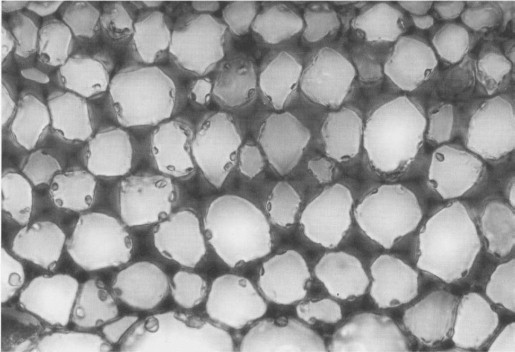
What are the traits of Sclerenchyma?
Found in primary and secondary cell walls
Often NOT living at maturity
Fibres: elongated, provide more rigid, mechanical support and toughness than Collenchyma
Sclereids: shorter, sometimes funky shapes, also provide support and toughness
Specialized sclerenchyma cells in xylem conduct water

What are stone cells? Whats an example (think fruit)
A type of sclereid (sclerenchyma) cell. Give pears their grittiness.
What are the three tissue systems plant organs are made up of?
Dermal tissue: interface between plant and its environment
Ground tissue: internal tissue that lends volume, shape, and support to the plant, and carries out metabolic functions
Vascular tissue: long distance transport of resources.
What type of cells do each of the three tissue systems contain? (in general)
Parenchyma, collenchyma, and/or sclerenchyma cells
What cells compose the dermal tissue system?
Epidermal cells: parenchyma - barrier to entry of foreign material, barrier to exit of plant resources
Stomata: parenchyma - pores that enable gas to move in and out of plant (found in leaves) (specialized epidermal cells)
Guard cells: parenchyma - border stomatal apertures, can change their shape through turgor pressure
Trichomes: parenchyma - uni or multicellular, variable morphology, protect against pests and water.
Root hairs - parenchyma - single celled, absorbs water and nutrients from soil.
What cells compose the ground tissue system
Parenchyma - provides form, can be specialized for photosynthesis, storage, secondary metabolism (synth of defensive compounds), secretion, etc.
Collenchyma and Sclerenchyma - provide mechanical support
What cells compose the vascular tissue system?
(spec.) Sclerencyma - makes up xylem
(spec.) Parenchyma - makes up phloem
Many cell types in vasc system have thickened cell walls, giving mechanical support to the plant.
What is the xylem
cells in plants that conduct sap (= water and dissolved mineral nutrients), made up of multiple cell types
What is the phloem
cells in plants that transport mainly sugars, also amino acids and other compounds, made up of multiple cell types
What are tracheary elements? What are they made up of? What tissue are they?
Dead, hollow cells at maturity that facilitate efficient water/sap movement
Have thick secondary cell walls to create efficient conduits
Made up of sclerenchyma
Xylem tissues (vascular)
What are the two types of tracheary elements? Whats the difference? Do they have any similarities?
Tracheids: longer, thinner, tapered ends
Vessel elements: shorter, wider, blunter ends, perforated ends (perforation plates)
They both can have bordered or simple pits, are sap conductors, dead and hollow secondary cell walls.
Which tracheary elements do angiosperms have? What about gymnosperms?
Angiosperms have both tracheids and vessel elements.
Gymnosperms have tracheids only.
What are sieve elements? What are they made up of? What tissue are they?
Living cells at maturity that have functional cytosol and plasma membrane, however lack nuclei, vacuoles, and other organelles.
Cell walls are non lignified
Made up of highly modified parenchyma cells
Phloem tissue (vascular)
What are the two types of sieve elements? Whats the difference? Do they have any similarities?
Sieve cells: longer, thinner, tapered ends, have sieve areas only
Sieve tube elements: shorter ish and wider, blunter ends, have sieve areas and sieve plates, will have companion cells
What are sieve areas? What are sieve plates?
Sieve areas - clusters of smaller pores with high number of plasmodesmata (both sieve elements)
Sieve plates - larger pores on end walls (sieve tube elements)
What are companion cells?
Cells that can be connected to sieve tube elements via plasmodesmata, they have nuclei so they are able to synthesize new proteins and export them to sieve tube elements.
What sieve elements do angiosperms have? What about gymnosperms? Which has Companion cells?
Angiosperms have sieve tube elements and companion cells
Gymnosperm (and ferns actually) have sieve cells, and albuminous cells (thought to play a similar role as companion cells)

What is the difference between primary and secondary growth in stems?
Primary growth is mainly herbaceous (not woody)
Occurs in the longitudinal plane from the shoot apical meristem (up)
Secondary growth is mainly wood and bark
Occurs in the radial plane from the vascular cambium
How does the shoot apical meristem maintain dominance? What happens if damage occurs to it?
Maintains dominance via hormones. If damage occurs to SAM, axillary buds/meristems may take over
What is the vascular cambium?
An area of cell division responsible for secondary growth; vascular cambium cells are meristematic and undergo cell divisions to generate xylem to the inside, and phloem to the outside.
Whats the difference between vascular system formation in primary stems of eudicots and monocots?
In eudicots the vasc system forms a ring.
In monocots vas bundles are scattered throughout the ground tissue.
How may eudicot stems differ between themselves in regard to their vasc system formation?
Some eudicot stems have narrow intrafascicular regions (more tightly packed vascular bundles in a ring) (ex. woody trees)
Others have wide intrafascicular regions (space between vasc bundles but still in ring formation) (ex., herbaceous plants)
From outwards to inwards, what is the basic arrangement of tissues in a vascular bundle?
Towards epidermis
Bundle sheath (type of sclerenchyma; goes all around vasc bund; are nonvascular support cells)
Sclerenchyma
Primary phloem
Primary xylem
Towards pith or center
Whats the difference in the vascular bundles of monocots vs eudicots?
Monocots may have visible companion cells
Monocots typically have air spaces created by destruction of xylem during mid and final maturation stages (later xylem will have thicker cell walls)
Do both conifers and eudicots undergo some degree of secondary growth? And what is secondary growth?
Yes.
Secondary growth is the growth in the radial direction from lateral meristems rather than apical meristems. Specifically in stems, secondary growth arises from the vascular cambium.
In woody plants, the secondary phloem and secondary xylem are also referred to as what?
2ndary phloem: inner bark
2ndary xylum: wood
When cells of the vascular cambium divide, it generates xylem cells to the ______, and phloem cells to the ______ of the stem.
Interior (xylem), and exterior (phloem)
Some eudicots are capable of making wood. There are many though that don’t, but still have a limited amount of secondary growth arising from a vascular cambium. Where do we tend to see this in the stem? Where is this secondary growth limited to?
We tend to see this more in mature stems/older regions of the stem closer to the base of the plant (for rigidity and structure)
This secondary growth is often limited to within the vascular bundles, providing additional mechanical growth to the stem.
From outer to inner, what does the structure of a woody stem look like?
Outer
Periderm (outer bark) - contains meristematic cells
Phloem (inner bark)
Vascular cambium - type of meristem
Xylem (wood) - contains vessels and rays (parenchyma)
Pith (ground tissue) - non-vascular
Why are rays significant?
Provide metabolic support via lateral movement of water and nutrients
produced by vascular cambium - when they are close to it they are still living cells
Tracheary elements (xylem) and fibers are found in varying proportions and arrangements in wood of different species. How do they differ between conifers and angiosperms?
Conifers:
Wood only contains tracheids and fibers
Angiosperms:
Wood contains tracheids, vessel elements, and fibers
What is the difference in growth in early vs late wood?
Early wood is formed in the first part of the growing season - rapid growth
Late wood is formed in the latter part of the growing season - slower growth
What is sapwood?
Part of tree stems (outer xylem); found in more recently formed rings (annual layers of xylem), the outermost rings of sapwood conduct xylem sap
(this is within the xylem/inner part before the vascular cambium)
What is heartwood?
Part of tree stems (inner xylem); earlier formed rings, serve as mechanical support, impregnated with defensive secondary compounds (tannins, terpenes, flavenoids, stilbenes, oils, and gum) that give heartwood its distinctive color.
What is the periderm?
Outer bark which consists of three layers:
Phelloderm - inner layer between phloem and phellogen, composed of living parenchyma
Phellogen (cork cambium) - lateral meristem which forms the periderm
Phellem (cork) - mature cells that are non-living and water proof (cell walls have suberin), forms the surface of bark which varies in texture by species.
What are lentosils?
Pores that occur in the bark (periderm) of some trees (like birch) that allow for gas exchange
What are the three different descriptive surfaces that give us different vies of the cells that make up wood?
Transverse (cross section)
Radial (center out - radius)
Tangential (doesn’t cross center)
What are rhizomes? Why are they useful? Examples?
Horizontal stems that grow belowground. They allow for vegetative growth and reproduction. Ex., aspen trees, grasses, asters, goldenrods.
How do rhizomes produce other above ground stems?
When given an environmental cue, a node will begin forming into a stem.
What are runners (or stolons)? Examples?
Horizontal stems that grow above ground. Ex., strawberries
What are the exception to stolons?
In potatoes, stolons grow below ground and form stem tubers (aka potato), which are thickened, modified rhizomes/stolons that are specialized for reserve storage (starch)
What are bulbs? Examples? Are the annual, biannual, or perennial?
Belowground buds enclosed within large fleshy modified leaves. Ex., onion, garlic, tulips. They are perennial
What are some of the structures of bulbs?
Tunic - papery outer covering for protection from damage and desiccation
Scales - modified fleshy leaves
Flower bud - tender baby flower bud in center of bulb
Basal stem - compressed stem connecting flower, scales, and roots
Roots - come out of basal stem
What are cladophylls? Example?
Flattened stems that have a leaf-like appearance. Ex. cacti
What are some structures of cladophylls? Do they have leaves?
Cladode - singular chaldophyll
Areoles - nodes that can develop into spines, lateral buds, fruits, etc.
Their true leaves are reduced or absent; the stems (cladodes) do the photosynthesizing