Dr. Chaibi's Lab Practical

0.0(0)
Studied by 1 person
call kaiCall Kai
learnLearn
examPractice Test
spaced repetitionSpaced Repetition
heart puzzleMatch
flashcardsFlashcards
GameKnowt Play
Card Sorting

1/73

encourage image

There's no tags or description

Looks like no tags are added yet.

Last updated 3:37 AM on 10/2/26
Name
Mastery
Learn
Test
Matching
Spaced
Call with Kai
Chat

No analytics yet

Send a link to your students to track their progress

74 Terms

1
New cards

Common Duckweed (Lemna)

Floating macrophyte;

tiny frond with one root;

lentic systems

<p>Floating macrophyte;</p><p>tiny frond with one root;</p><p>lentic systems</p>
2
New cards

Watermeal (Wolffia)

Floating macrophyte;

smallest angiosperm, tiny bright green, without roots, fronds in pairs;

lentic systems

<p>Floating macrophyte;</p><p>smallest angiosperm, tiny bright green, without roots, fronds in pairs;</p><p>lentic systems</p>
3
New cards

Water Fern (Azolla)

Floating macrophyte;

small reddish fern, contains symbiotic nitrogen-fixing bacteria;

lentic systems

<p>Floating macrophyte; </p><p>small reddish fern, contains symbiotic nitrogen-fixing bacteria;</p><p>lentic systems</p>
4
New cards

American lotus (Nelumbo lutea)

Floating macrophyte;

very large broad circular leaves, solitary pale yellow flower, dried seed pods;

lentic systems

<p>Floating macrophyte; </p><p>very large broad circular leaves, solitary pale yellow flower, dried seed pods;</p><p>lentic systems</p>
5
New cards

Water Shield (Brasenia schreberi)

Floating macrophyte;

floating circular leaves with green upper and purple under, purplish roots and creeping stems with gelatinous coating;

lentic littoral areas

<p>Floating macrophyte;</p><p>floating circular leaves with green upper and purple under, purplish roots and creeping stems with gelatinous coating;</p><p>lentic littoral areas</p>
6
New cards

Cow Lily, Spatterdock (Nuphar lutea)

Floating macrophyte;

ovate shiny leaves with lateral veins, solitary yellow flower;

lentic systems < 5ft in depth

<p>Floating macrophyte; </p><p>ovate shiny leaves with lateral veins, solitary yellow flower;</p><p>lentic systems < 5ft in depth</p>
7
New cards

Waterlily (Nymphaeae)

Floating macrophyte;

circular leaves with cleft at base and fanlike leaf veins, solitary white or pink/purple flower;

lentic systems

<p>Floating macrophyte; </p><p>circular leaves with cleft at base and fanlike leaf veins, solitary white or pink/purple flower;</p><p>lentic systems <5ft in depth</p>
8
New cards

Coontail Ceratophyllum)

Submerged macrophyte;

olive to dark-green, branched stems, no roots, leaves divided into multiple narrow segments;

lentic systems, can be extremely abundant

<p>Submerged macrophyte; </p><p>olive to dark-green, branched stems, no roots, leaves divided into multiple narrow segments;</p><p>lentic systems, can be extremely abundant</p>
9
New cards

Southern Naiad, Bushy Pondweed (Naja)

Submerged macrophyte;

slender with linear greenish-purple leaves;

lotic or lentic systems, very common in ponds

<p>Submerged macrophyte; </p><p>slender with linear greenish-purple leaves;</p><p>lotic or lentic systems, very common in ponds</p>
10
New cards

Bladderwort (Ultricularia)

Submerged macrophyte;

rootless, threadlike leaves with bladders that trap small invertebrates and fish, small clustered yellow or purple flowers that extend above water;

lentic systems, especially ponds and lakes

<p>Submerged macrophyte; </p><p>rootless, threadlike leaves with bladders that trap small invertebrates and fish, small clustered yellow or purple flowers that extend above water;</p><p>lentic systems, especially ponds and lakes</p>
11
New cards

Pondweed (Potamogeton)

Submerged macrophyte;

submerged floating elliptical leaves with variable shape depending on species, seeds on cylindrical spikes extending above water;

lentic and lotic systems

<p>Submerged macrophyte; </p><p>submerged floating elliptical leaves with variable shape depending on species, seeds on cylindrical spikes extending above water;</p><p>lentic and lotic systems</p>
12
New cards

Cabomba, Fanwort (Cabomba)

Submerged macrophyte;

leaves opposite or whorled, floating leaves look different from submerged leaves;

lentic systems

<p>Submerged macrophyte; </p><p>leaves opposite or whorled, floating leaves look different from submerged leaves;</p><p>lentic systems</p>
13
New cards

Eel-grass, Tape Grass (Vallisneria americana)

Submerged macrophyte;

dark-green, ribbon-like leaves that are several feet long;

lakes, swift-flowing spring-fed streams, coastal areas

<p>Submerged macrophyte; </p><p>dark-green, ribbon-like leaves that are several feet long;</p><p>lakes, swift-flowing spring-fed streams, coastal areas</p>
14
New cards

Bulrush (Scirpus)

Emergent macrophyte;

triangular or round stems up to 6 feet tall, fruit in terminal spikelet in drooping cluster;

mud banks, standing water
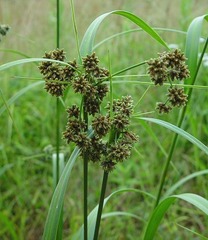
<p>Emergent macrophyte; </p><p>triangular or round stems up to 6 feet tall, fruit in terminal spikelet in drooping cluster;</p><p>mud banks, standing water</p>
15
New cards

Cattail (Typha)

Emergent macrophyte;

elongated flat leaves up to 10 feet tall, thickened cylindrical seed spikes;

saturated soil and in water

<p>Emergent macrophyte; </p><p>elongated flat leaves up to 10 feet tall, thickened cylindrical seed spikes;</p><p>saturated soil and in water</p>
16
New cards

Spike Rush (Eleocharis)

Emergent macrophyte;

slender segmented stems up to 8 feet tall, dark-brown scaly lance-shaped spikelet at tip, grows in clusters;

mud, shallow water

<p>Emergent macrophyte; </p><p>slender segmented stems up to 8 feet tall, dark-brown scaly lance-shaped spikelet at tip, grows in clusters;</p><p>mud, shallow water</p>
17
New cards

Soft Rush (Juncus effusus)

Emergent macrophyte;

pale-green hollow stems up to 3 feet tall, flowers grouped near tip of stem;

grows in clumps along shorelines dry or wet

<p>Emergent macrophyte; </p><p>pale-green hollow stems up to 3 feet tall, flowers grouped near tip of stem;</p><p>grows in clumps along shorelines dry or wet</p>
18
New cards

Flat Sedge (Cyperus)

Emergent macrophyte;

triangular stem up to 2 feet tall, large golden-brown seed heads located on stem terminus;

wetlands and marshes

<p>Emergent macrophyte;</p><p>triangular stem up to 2 feet tall, large golden-brown seed heads located on stem terminus; </p><p>wetlands and marshes</p>
19
New cards

Pickerel Weed (Pontederia cordata)

Emergent macrophyte;

ovate/heart-shaped leaves with shape variation, blue-purple flowers clustered on elongated terminal spikes;

lentic systems along shorelines

<p>Emergent macrophyte;</p><p>ovate/heart-shaped leaves with shape variation, blue-purple flowers clustered on elongated terminal spikes;</p><p>lentic systems along shorelines</p>
20
New cards

Water Primrose (Ludwigia)

Emergent macrophyte;

lance-shaped hairy leaves, small yellow flower;

floating in water or upright on dry land, lentic systems

<p>Emergent macrophyte;</p><p>lance-shaped hairy leaves, small yellow flower;</p><p>floating in water or upright on dry land, lentic systems</p>
21
New cards

Arrowhead (Sagittaria latifolia)

Emergent macrophyte;

arrowhead-shaped leaves, stout stem 3 feet tall, small white flowers in whorls;

shallow water areas

<p>Emergent macrophyte;</p><p>arrowhead-shaped leaves, stout stem 3 feet tall, small white flowers in whorls;</p><p>shallow water areas</p>
22
New cards

Smartweed (Persicaria, formerly Polygonum)

Emergent macrophyte;

sparse thin leaves, creeping rhizomes, hairy stems with swollen nodes, small pinkish-white flowers;

lentic systems like wetlands, streams, lakes, ditches

<p>Emergent macrophyte;</p><p>sparse thin leaves, creeping rhizomes, hairy stems with swollen nodes, small pinkish-white flowers;</p><p>lentic systems like wetlands, streams, lakes, ditches</p>
23
New cards

Cladophora

Green algae;

branched filaments;

stream periphyton that structures benthic communities

<p>Green algae;</p><p>branched filaments;</p><p>stream periphyton that structures benthic communities</p>
24
New cards

Rhizoclonium

Green algae;

coarse, wiry, unbranched filaments with holdfast;

fast-moving waters, hard waters

<p>Green algae;</p><p>coarse, wiry, unbranched filaments with holdfast;</p><p>fast-moving waters, hard waters</p>
25
New cards

Pithophora

Green algae;

branched filaments with akinetes, can form floating mats;

common in ponds in warm temperatures

<p>Green algae;</p><p>branched filaments with akinetes, can form floating mats;</p><p>common in ponds in warm temperatures</p>
26
New cards

Basicladia

Green algae;

filaments;

specializes in living on turtles

<p>Green algae;</p><p>filaments;</p><p>specializes in living on turtles</p>
27
New cards

Chlorella

Green algae;

small, unicellular spheres, cryptic speciation;

common in freshwater
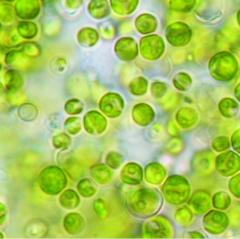
<p>Green algae;</p><p>small, unicellular spheres, cryptic speciation;</p><p>common in freshwater</p>
28
New cards

Chlamydomonas

Green algae;

unicellular with two flagella;

planktic in hard and soft freshwater lakes

<p>Green algae;</p><p>unicellular with two flagella;</p><p>planktic in hard and soft freshwater lakes</p>
29
New cards

Volvox

Green algae;

spherical colony of genetically-determined number of individual cells, coordinate movement by flegella, grow new colonies inside;

planktic in hard and soft freshwater lakes

<p>Green algae;</p><p>spherical colony of genetically-determined number of individual cells, coordinate movement by flegella, grow new colonies inside;</p><p>planktic in hard and soft freshwater lakes</p>
30
New cards

Scenedesmus

Green algae;

unicellular or in small colonies, with or without terminal spines;

freshwater streams
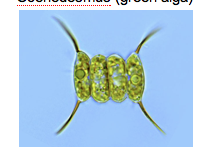
<p>Green algae;</p><p>unicellular or in small colonies, with or without terminal spines;</p><p>freshwater streams</p>
31
New cards

Pediastrum

Green algae;

flattened star-shaped colony with genetically determined number of cells;

planktic in streams

<p>Green algae;</p><p>flattened star-shaped colony with genetically determined number of cells;</p><p>planktic in streams</p>
32
New cards

Hydrodicton

Green algae;

name means 'water net' because flat, net-like colony;

planktic in streams and lakes
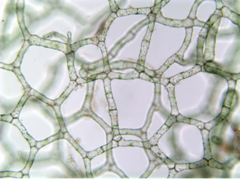
<p>Green algae;</p><p>name means 'water net' because flat, net-like colony;</p><p>planktic in streams and lakes</p>
33
New cards

Spirogyra

Green algae;

unbranched filament, spiral chloroplasts;

common in littoral zones of ponds, ditches, slow streams

<p>Green algae;</p><p>unbranched filament, spiral chloroplasts;</p><p>common in littoral zones of ponds, ditches, slow streams</p>
34
New cards

Mougeotia

Green algae;

unbranched filament with flat rectangular chloroplasts that can twist and rotate;

common in ponds, littoral zones of lakes, slow streams

<p>Green algae;</p><p>unbranched filament with flat rectangular chloroplasts that can twist and rotate;</p><p>common in ponds, littoral zones of lakes, slow streams</p>
35
New cards

Closterium

Green algae;

thick clear carbohydrate cell wall, one large chloroplast in two lobes with nucleus in center;

drying mud, oligotrophic and dystrophic lakes, stream periphyton, waterfalls

<p>Green algae;</p><p>thick clear carbohydrate cell wall, one large chloroplast in two lobes with nucleus in center; </p><p>drying mud, oligotrophic and dystrophic lakes, stream periphyton, waterfalls</p>
36
New cards

Chara

Green algae;

looks plant-like with stem and radial extensions that resemble whorls, but is smaller than a macrophyte and has distinctive reproductive structures, precipitates calcium carbonate so can look grey and crunchy;

common in lakes and slow streams, important fish nursery habitat

<p>Green algae;</p><p>looks plant-like with stem and radial extensions that resemble whorls, but is smaller than a macrophyte and has distinctive reproductive structures, precipitates calcium carbonate so can look grey and crunchy;</p><p>common in lakes and slow streams, important fish nursery habitat</p>
37
New cards

Chrysophyte

Golden algae;

cell wall composed of silica scales, forms spherical cyst with a pore in harsh conditions;

common in lakes, especially alpine

<p>Golden algae;</p><p>cell wall composed of silica scales, forms spherical cyst with a pore in harsh conditions;</p><p>common in lakes, especially alpine</p>
38
New cards

Synura

Golden algae;

colony of flagellated unicells that can move;

planktic in deeper water column in lakes and streams

<p>Golden algae;</p><p>colony of flagellated unicells that can move;</p><p>planktic in deeper water column in lakes and streams</p>
39
New cards

Dinobryon

Golden algae;

colonial, each cell builds its own cup-like theca and beats flagella to filter-feed nutrients;

benthic, connects to substrates

<p>Golden algae;</p><p>colonial, each cell builds its own cup-like theca and beats flagella to filter-feed nutrients;</p><p>benthic, connects to substrates</p>
40
New cards

Prymnesium parvum

Golden algae;

unicell with two flagella, one short and one long;

lakes with moderate to high salinity, can cause toxic algal blooms (golden blooms), may be non-native in Texas

<p>Golden algae;</p><p>unicell with two flagella, one short and one long;</p><p>lakes with moderate to high salinity, can cause toxic algal blooms (golden blooms), may be non-native in Texas</p>
41
New cards

Centric Diatom

Diatom, golden-brown algae;

silica cell wall, radial symmetry, unicellular or colonial in filaments;

planktic and common in lakes

<p>Diatom, golden-brown algae;</p><p>silica cell wall, radial symmetry, unicellular or colonial in filaments;</p><p>planktic and common in lakes</p>
42
New cards

Araphid Pennate Diatom

Diatom, golden-brown algae;

silica cell wall, bilaterial symmetry on both axes, unicellular or colonial;

tychoplanktic in turbulent waters and at thermoclines

<p>Diatom, golden-brown algae;</p><p>silica cell wall, bilaterial symmetry on both axes, unicellular or colonial;</p><p>tychoplanktic in turbulent waters and at thermoclines</p>
43
New cards

Symmetrical Raphid Diatom

Diatom, golden-brown algae;

silica cell wall, bilaterial symmetry on both axes, unicellular or colonial; raphe for movement;

benthic and common in streams, wetlands, lake littoral zones

<p>Diatom, golden-brown algae;</p><p>silica cell wall, bilaterial symmetry on both axes, unicellular or colonial; raphe for movement;</p><p>benthic and common in streams, wetlands, lake littoral zones</p>
44
New cards

Assymetrical Raphid Diatom

Diatom, golden-brown algae;

silica cell wall, bilaterial symmetry along only one axis, unicellular or colonial in mucilage tubes or stalks;

benthic and common in streams, wetlands, lake littoral zones

<p>Diatom, golden-brown algae;</p><p>silica cell wall, bilaterial symmetry along only one axis, unicellular or colonial in mucilage tubes or stalks;</p><p>benthic and common in streams, wetlands, lake littoral zones</p>
45
New cards

Isopoda

relatives of sowbugs, rigid segmented exoskeletons, flattened dorsoventrally, found in leaves and under stones in rivers, lakes, and temporary ponds

<p>relatives of sowbugs, rigid segmented exoskeletons, flattened dorsoventrally, found in leaves and under stones in rivers, lakes, and temporary ponds</p>
46
New cards

Amphipoda (scud - sideswimmer)

Common names "scud" or "sideswimmer," move horizontally on their side, rounded posterior, pair of strong stubby legs used for motion, found in stream bottoms, lake littoral and benthic zones

<p>Common names "scud" or "sideswimmer," move horizontally on their side, rounded posterior, pair of strong stubby legs used for motion, found in stream bottoms, lake littoral and benthic zones</p>
47
New cards

Artemia (brine shrimp)

Member of Amphipoda; common in hypersaline lakes; pinkish or reddish color; form resting stages in poor conditions, used as food in fish farming; sea monkeys

<p>Member of Amphipoda; common in hypersaline lakes; pinkish or reddish color; form resting stages in poor conditions, used as food in fish farming; sea monkeys</p>
48
New cards

Shrimp (Decapoda)

glass/ghost shrimp; river shrimp; not well studied, some species critically endangered

<p>glass/ghost shrimp; river shrimp; not well studied, some species critically endangered</p>
49
New cards

Crayfish (Decapoda)

ecosystem engineers due to tunnel building; beginning to go extinct due to invasive competitors, overharvesting, declining water quality and habitat

<p>ecosystem engineers due to tunnel building; beginning to go extinct due to invasive competitors, overharvesting, declining water quality and habitat</p>
50
New cards

Gilled operculate snails

When held with helix pointing upwards, shell opens to right; breathe through gills, gills = good water quality

51
New cards

Pouched/Lunged snails

When held with helix pointing upwards, shell opens to left; breathe using lungs (or sometimes left-handed gilled snails); pouches = poor water quality

52
New cards

Freshwater mussels

bivalves (two shells) with muscular foot; filter feed; many endangered due to water quality impairment, loss of flowing water and increased turbidity, barrier to fish movement (hosts to parasitic glochidia offspring); invasive competitors

<p>bivalves (two shells) with muscular foot; filter feed; many endangered due to water quality impairment, loss of flowing water and increased turbidity, barrier to fish movement (hosts to parasitic glochidia offspring); invasive competitors</p>
53
New cards

Mayfly (nymph)

nymph has 2-3 tails, gills along abdomen; live under rocks, in decaying vegetation, in sediments; presence indicates good water quality

<p>nymph has 2-3 tails, gills along abdomen; live under rocks, in decaying vegetation, in sediments; presence indicates good water quality</p>
54
New cards

Dragonfly (nymph)

Nymph has bulbous abdomen with 2 tail stubs, spindly legs, bulbous eyes; major predator - nymph predates upon zooplankton and young fish, adult predates upon midges and mosquitoes
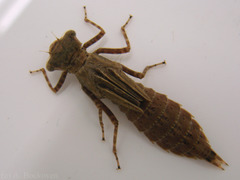
<p>Nymph has bulbous abdomen with 2 tail stubs, spindly legs, bulbous eyes; major predator - nymph predates upon zooplankton and young fish, adult predates upon midges and mosquitoes</p>
55
New cards

Damselfly (nymph)

nymph has 3 gills at tail end, 2-3 tails that can look feathery; predator of insects; indicates good water quality in wide variety of water bodies

<p>nymph has 3 gills at tail end, 2-3 tails that can look feathery; predator of insects; indicates good water quality in wide variety of water bodies</p>
56
New cards

Stonefly (nymph)

Nymph has 2 tails, gills in "armpits," can have bold stripe patter; live in benthic zone of well-oxygenated streams and lakes, indicate excellent water quality

<p>Nymph has 2 tails, gills in "armpits," can have bold stripe patter; live in benthic zone of well-oxygenated streams and lakes, indicate excellent water quality</p>
57
New cards

Caddisfly (larvae)

larvae build protective cases of sediment or debris and make nets to catch food; predators, shredders, grazers, filterers; live in still/calm waters; indicate good water quality
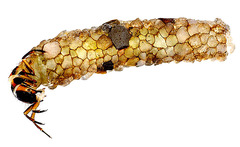
<p>larvae build protective cases of sediment or debris and make nets to catch food; predators, shredders, grazers, filterers; live in still/calm waters; indicate good water quality</p>
58
New cards

Alderfly (larvae)

Larva has 1 tail, strong sharp mandibles, light-colored; larval habitats are species specific; as a group, wide range of tolerance in water quality

<p>Larva has 1 tail, strong sharp mandibles, light-colored; larval habitats are species specific; as a group, wide range of tolerance in water quality</p>
59
New cards

Dobsonfly (larvae)

Larva has 2 tail stubs, spiky appearance, prominent mandibles, gills and spiracles; live under rocks in swift areas of large streams; predators of insects and small fish

<p>Larva has 2 tail stubs, spiky appearance, prominent mandibles, gills and spiracles; live under rocks in swift areas of large streams; predators of insects and small fish</p>
60
New cards

Gerridae (water strider)

live on water surface; predatory on insects that fall in water and cannibalistic

<p>live on water surface; predatory on insects that fall in water and cannibalistic</p>
61
New cards

Veliidae (riffle bug)

live on water surface; smaller and broader-shouldered than water striders; predatory

<p>live on water surface; smaller and broader-shouldered than water striders; predatory</p>
62
New cards

Notonectidae (backswimmer)

long back legs; swim upside down with hindlegs in backstroke; predatory on tadpoles and small fish; live in lakes, ponds, marshes

<p>long back legs; swim upside down with hindlegs in backstroke; predatory on tadpoles and small fish; live in lakes, ponds, marshes</p>
63
New cards

Corixidae (water boatmen)

forelegs adapted like oars; swim upright just above sediment surface; predators; live in ponds, slow streams

<p>forelegs adapted like oars; swim upright just above sediment surface; predators; live in ponds, slow streams</p>
64
New cards

Water penny (beetle larvae)

small, low-profile, suction cup look; common on underside of stones near water surface; indicate good water quality

<p>small, low-profile, suction cup look; common on underside of stones near water surface; indicate good water quality</p>
65
New cards

Diving beetle

have gills or elytra cavity (air bubble under abdomen), might have feathery back legs; herbivores, scavengers, predators

<p>have gills or elytra cavity (air bubble under abdomen), might have feathery back legs; herbivores, scavengers, predators</p>
66
New cards

Whirligig beetle

two sets of eyes, one above waterline and one below water; live at water surface; named for distinctive whirling swimming motion

<p>two sets of eyes, one above waterline and one below water; live at water surface; named for distinctive whirling swimming motion</p>
67
New cards

Chironomidae (non-biting midges, larvae)

Larvae have segmented body with stubby limbs at anterior-most and posterior-most segments; head capsule most useful for identification; herbivores or predators; benthic, sensitive to temperature and oxygen conditions

<p>Larvae have segmented body with stubby limbs at anterior-most and posterior-most segments; head capsule most useful for identification; herbivores or predators; benthic, sensitive to temperature and oxygen conditions</p>
68
New cards

Chaoborus (glass worm)

Diptera midge; larva has large hooked jaws and fanned tail; larvae is major predator upon zooplankton and other aquatic insect larvae, common in ecology studies

<p>Diptera midge; larva has large hooked jaws and fanned tail; larvae is major predator upon zooplankton and other aquatic insect larvae, common in ecology studies</p>
69
New cards

Rotifer (Rotifera)

microscopic, multicellular animal with transparent soft bodies; simple body plan of body cavity with large stomach, foot, cilia-lined mouth (corona); omnivorous filter feeder or predator, corona shape specialized to food source; can be anchored to substrate or free swimming; common and abundant in various aquatic habitats

<p>microscopic, multicellular animal with transparent soft bodies; simple body plan of body cavity with large stomach, foot, cilia-lined mouth (corona); omnivorous filter feeder or predator, corona shape specialized to food source; can be anchored to substrate or free swimming; common and abundant in various aquatic habitats</p>
70
New cards

Daphnia (Cladocera)

micro-crustacean with unsegmented body, carapace covers back, head angled downward, one compound eye and one eyespot, two pairs of antennae with second pair adapted for swimming; Daphnia commonly found in limnetic habitats; herbivorous

<p>micro-crustacean with unsegmented body, carapace covers back, head angled downward, one compound eye and one eyespot, two pairs of antennae with second pair adapted for swimming; Daphnia commonly found in limnetic habitats; herbivorous</p>
71
New cards

Chydorus (Cladocera)

micro-crustacean with unsegmented body, carapace covers back, head angled downward, one compound eye and one eyespot, two pairs of antennae with second pair adapted for swimming; Chydorus commonly found in littoral habitats; herbivorous

<p>micro-crustacean with unsegmented body, carapace covers back, head angled downward, one compound eye and one eyespot, two pairs of antennae with second pair adapted for swimming; Chydorus commonly found in littoral habitats; herbivorous</p>
72
New cards

Bosmina (Cladocera)

micro-crustacean with unsegmented body, carapace covers back, head angled downward, one compound eye and one eyespot, two pairs of antennae with second pair adapted for swimming; Bosmina commonly found in littoral habitats; herbivorous

<p>micro-crustacean with unsegmented body, carapace covers back, head angled downward, one compound eye and one eyespot, two pairs of antennae with second pair adapted for swimming; Bosmina commonly found in littoral habitats; herbivorous</p>
73
New cards

Copepod (Copepoda)

micro-crustacean with teardrop-shaped body, very long first antennae, transparent exoskeleton, one compound eye often red in color, rear appendance have setae ("oar feet"), males can have bent antennae, females can have two exterior egg sacs attached to body

<p>micro-crustacean with teardrop-shaped body, very long first antennae, transparent exoskeleton, one compound eye often red in color, rear appendance have setae ("oar feet"), males can have bent antennae, females can have two exterior egg sacs attached to body</p>
74
New cards

Ostracod (Ostracoda)

micro-crustacean with 2 hinged valves (but not a bivalve), unsegmented bodies, compound eye located near dorsal hinge of valves; littoral and benthic habitats; herbivores or omniovres

<p>micro-crustacean with 2 hinged valves (but not a bivalve), unsegmented bodies, compound eye located near dorsal hinge of valves; littoral and benthic habitats; herbivores or omniovres</p>



