DRAFT GCSE Chemistry- Organic Chemistry (Y11)
 Call Kai
 Learn
 Practice Test
 Spaced Repetition
 Match
 Flashcards
 Knowt Play
1/72

Earn XP
Description and Tags
Topic 4 (alcohols, fermentation, carboxylic acids, condensation polymerisation)
73 Terms
What does a functional group tell you?
Chemical properties
What is an alcohol’s functional group?
OH
What do all alcohols end in?
-ol
What is the general formula for an alcohol?
CnH2n+1OH
What is the OH part of an alcohol called (other than functional group)?
Hydroxyl
Properties of alcohols
Soluble in water
Solutions have a neutral pH
Flammable
Word equation for alcohol combustion
alcohol + oxygen → carbon dioxide + water
Symbol equation for combustion, using methanol as an example.
CH3OH(l) + 1.5O2(g) → CO2(g) + 2H2O(g)
Why is water a gas in alcohol combustion?
Because it is being given off as steam
Word equation for alcohol’s reaction with sodium
alcohol + sodium → sodium alkoxide + hydrogen
Symbol equation for alcohol’s reaction with sodium
2CH3OH + 2Na → 2CH3ONa + H2
What do you do to form an alkoxide in a symbol equation?
Remove the hydrogen from the functional group (OH)
Replace with a sodium atom (OH → ONa)
Word equation for oxidation of alcohols
alcohol + oxygen → carboxylic acid
Uses of alcohols in industry
Methanol and Ethanol are used as solvents
dissolve most substances insoluble in water
The first four alcohols are used as fuels
they burn cleanly and without smell
Formula for Methanol
CH3OH
Formula for Ethanol
C2H5OH
Formula for Propanol
C3H7OH
Formula for Butanol
C4H9OH
Describe how you could compare the reactivity of different alcohols with sodium metal. [3]
Reacting the different alcohols (e.g. methanol, ethanol) with the same mass of sodium metal
In a test tube with a rubber bung and a tube leading from that connecting to a gas syringe
The more hydrogen gas given off, the more reactive the alcohol
Which of the four alcohols has the lowest boiling point?
Methanol
Which of the four alcohols has the highest boiling point?
Butanol
Why is this?
There are more strong covalent bonds to break, thus requiring more energy.
Give three reasons why ethanol, propanol and butanol are part of the same homologous series. [3]
Same functional group (OH)
Same general formula (CnH2n+1OH)
Similar physical properties
How can ethanol be made?
Fermentation
Word equation for fermentation
glucose →ethanol + carbon dioxide
Symbol equation for fermentation
C6H12O6 → 2C2H5OH + 2CO2
Fermentation
Using yeast to convert sugar into alcohol
Fermentation: Step 1
Yeast and a carbohydrate solution are mixed in a clean container
sealed and kept in a warm place
Fermentation: Step 2
Temperature is kept between 30-40 degrees Celsius for fastest fermentation
Fermentation: Step 3
Glucose is broken down anaerobically
Fermentation: Step 4
When concentration of ethanol reaches 10-20%, fermentation stops
yeast cells are killed by the alcohol
Fermentation: Step 5
Once yeast falls to the bottom of the container, ethanol can be collected from the top
What happens if oxygen is allowed into the container?
Ethanoic acid (vinegar) is created
What is ethanol produced via fermentation like?
Very dilute
How would you make ethanol more concentrated?
By distilling it
What is ethanol’s boiling point like in comparison to water’s?
Low
What does this mean for distillation?
Ethanol can be collected after water
Describe how the solution of sugar in water is used to produce the mix of ethanol & water. [2]
add yeast
ferment it with absence of air
Explain why fermentation is carried out in the absence of air and with a temperature below 40 degrees Celsius. [4]
Carried out in absence of air to prevent formation of ethanoic acid instead of ethanol
Carried out < 40 degrees because yeast is an enzyme, which denatures above optimum temperature, causing fermentation to slow down.
What is the functional group of a carboxylic acid?
COOH

What is the functional group of a carboxylic acid called?
Carboxyl
What is the functional group of an alcohol called?
Hydroxyl
What is a C=O bond called?
Carbonyl
What is the general formula for carboxylic acids?
Cn-1H2n-1COOH
What happens when something is oxidised?
It gains oxygen
What happens when alcohols are oxidised?
They form carboxylic acids
What can carboxylic acids do in solution?
Neutralise (alkali) metals
Example of carboxylic acid neutralisation
methanoic acid + sodium → sodium methanoate + hydrogen
Formula for methanoic acid
HCOOH
Displayed formula for methanoic acid

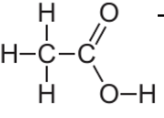
Formula for ethanoic acid
CH3COOH
Displayed formula for ethanoic acid
Formula for propanoic acid
C2H5COOH
Displayed formula for propanoic acid

Formula for butanoic acid
C3H7COOH
Displayed formula for butanoic acid

acid + metal →
salt + hydrogen
acid + metal oxide →
salt + water
acid + metal hydroxide →
salt + water
acid + metal carbonate →
acid + water + carbon dioxide
How are esters formed?
When a carboxylic acid and an alcohol react
Word equation for reaction between ethanoic acid and ethanol
ethanoic acid + ethanol → ethyl + ethanoate + water
Displayed formula for reaction between ethanoic acid and ethanol

What is an ester’s functional group?
-COO-
What do the names of esters end in?
-oate (e.g. methyl methanoate)
What is also used in an ester reaction?
An acid catalyst, e.g. sulfuric acid
Describe what you would see when a piece of magnesium ribbon is added to dilute ethanoic acid. [2]
Effervescence
Solid (Mg) disappears
What is different about condensation polymerisation?
Involves two different types of monomer
What happens in condensation polymerisation?
The monomers reacts together and bonds form between them, making polymer chains.
How many functional groups does each monomer contain?
At least two, one on each end of the molecule
What happens when the functional groups of two adjacent molecules react?
A water molecule is lost
Diol
An alcohol with two hydroxyl (OH) functional groups
Diocarboxylic acid
A carboxylic acid with two carboxyl (COOH) functional groups