PROF- Healthcare Delivery System
 Call Kai
 Learn
 Practice Test
 Spaced Repetition
 Match
 Flashcards
 Knowt Play
1/27

There's no tags or description
Looks like no tags are added yet.
28 Terms
Key Term
Levels of care (primary, secondary, and tertiary)
For-Profit Hospitals
Not-for-profit Hospitals
State/Local Government Hospitals
4 models of healthcare systems
Integrated delivery system
The Joint Commission
Magnet Recognition
Government Insurance (Medicare, Medicaid, CHIP, ACA)
Private Insurance Models (HMO, PPO)
Healthcare reimbursement models (FFS, VBP, DRGs, P4P)
Healthcare Delivery Systems and Levels of Care
Healthcare delivery systems are “held together, glued together, enabled to function … by the nurses.”
Adapted from Lewis Thomas, physician, essayist, researcher
Levels of Care
Primary (health promotion, disease prevention)
Secondary
Tertiary
Primary Level of Care
Primary Care
• Focus on health promotion and disease prevention
• Any illness, new health concern, people start with primary care (first point of contact in the healthcare system!)
• Think of it as someone’s “medical home” – supplying comprehensive primary care, coordinating care across levels, aiming for higher quality of life
• Utilizing primary care services has shown to have improved health outcomes (early detection, earlier treatment, less use of resources, less cost)
Primary Care Providers
Medical Doctor (MD) or Doctor of Osteopathic Medicine (DO)
Nurse Practitioner
Clinical nurse specialist
physician assistant
Primary Care Services
Annual visits, sick visits, routine visits (q 3 months) to manage chronic illnesses
Lab tests (blood draws, flu/strep/COVID, etc.), injections/meds, immunizations, imaging, minor procedures
Nutrition consultations
Referrals
Secondary Level of Care
Secondary Health care
• Also, can be understood as specialty care, acute care, or hospital care
• When PCP is unable to manage the healthcare problem, secondary care is the next step
• Need a specialist to help manage a health condition, PCP makes referrals (e.g., gastroenterologist, pulmonologist, ENT, OBGYN)
• Need ER//hospital when an acute illness, injury, or exposure occurs
• Also, some people do not have insurance, resources, or access or may are fearful of HCP to use primary care, so we often see people skip primary care and utilize secondary health care services
Secondary Health Care Goals
MANAGE- manage acute problem
RETURN- return patient to baseline function
HELP- help patient control condition, provide education
REFER- at the end, refer care back to PCP
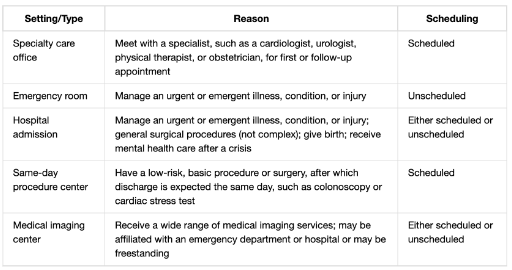
Secondary Health Care settings
specialty care office
Emergency room
hospital admission
same-day procedure center
medical imaging center
Tertiary Level of Care
Tertiary health care
• Specific and temporary
• Patients may go to tertiary care level when they have severe or rare conditions or multiple comorbidities
• May involve invasive medical procedures and major surgery, specialized tools and advanced medical treatments
• Goals are the same as secondary – to get patient back to baseline, manage condition, and return back to primary care
Examples
Primary care makes colonoscopy referral →
secondary care performs colonoscopy. Test is Positive for cancer. Care moves to tertiary care →
specialized center. Includes surgery, chemo, and radiation therapy. →
Patient cured and released back to secondary and primary care
Tertiary Care Providers
Cardiologist
Pulmonologist
Radiologist
Tertiary Care Settings
Usually large, urban hospitals (i.e., level 1 trauma centers), or specialty hospitals (i.e., MD Anderson, Texas Children’s)
Specialty medical clinics (i.e., dialysis clinic)
Specialty mental health facilities

Organization & Structure of Healthcare Delivery Systems
• For-profit, Not-for-profit, State/local government facilities
• Public or private institutions
• Federal institutions
• Providers
Models of Healthcare System
Beveridge model
Bismarck model
National health insurance
Out-of-pocket model

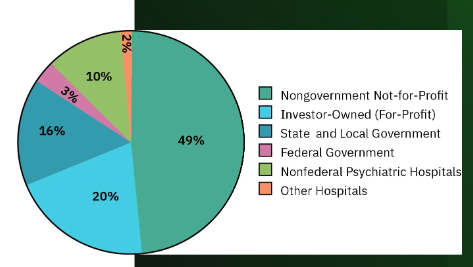
U.S. Healthcare System Types
• Not-for-profit
• For-profit
• State/local government
• To determine which delivery system applies to an organization, three economic questions and one healthcare question can help:
• Where do the funds to operate the organization come from?
• Are profits (money left after all bills, including staff salaries, are paid) expected?
• Are taxes (money paid to the local, state, or federal government for property and purchase of goods) paid by the organization?
• Is the organization required to function as a safety- net hospital (a facility that is required to provide care for a patient no matter their ability to pay)?
Comparison of healthcare delivery organization
Where do operating funds come from
How are profits managed
Are taxes paid
Is it a safety-net hospital

Profit Systems
For-Profit Systems
• Funded by investors – stakeholders expecting ROI, profits
• Must pay local, state, federal taxes
• Often do not deliver tertiary care services due to expenses/profit gap, and may not offer unprofitable services; very little if any are found in rural communities
• All hospitals are required to treat critically ill patients who come to their emergency departments. However, most for-profit hospitals will stabilize patients who are underinsured or without insurance and transfer them to other facilities (usually either not-for-profit or state/local government–run facilities).
• Examples: HCA, Methodist in SA, Women’s Hospital of Texas, Medical City Dallas & Plano Not-for-Profit Systems (NFP)
Not-for-Profit Systems (NFP)
• Account for 49% of hospitals in the U.S.
• Do not have to pay local, state, or federal taxes but is required to provide charity care and serve their communities
• Funding comes from private donations, fundraisers, public funding, and payment for services
• No profit to shareholders, it is expected to use profits to fund the hospital facility, employees, and community; these hospitals will offer more services
• Required to treat any critically ill patient, regardless of ability to pay, until they are stable; often transfer to state or local institutions
• Examples: BSW in CS, CHI St. Joseph in CS & Bryan, Memorial Hermann, Houston Methodist, Texas Children’s, Children’s Hospital, Cook Children’s, Driscoll Children’s, Ascension Seton, St. David’s, CHRISTUS Mother Frances Hospitals
Institutions
State and Local Government Institutions
Funded entirely or in part with public money (taxes) and charitable donations
Controlled by the state/local government
Tax exempt, little to no profits
Provide care to all –uninsured, underinsured, regardless of ability to pay
Healthcare Institutions: Public or Private
In health care, an institution is public if it is run and largely funded by the government and is for the good of the people it serves.
An institution is private if it is run and funded by a group other than the government and can be either a for-profit or a NFP institution.
Public Health Institutions
Include state and local hospitals and health departments
Also includes the federal government’s Department of Health and Human Services branch has nine agencies that focus on public health, five of which are the Centers for Disease Control and Prevention (CDC), the Food and Drug Administration (FDA), the Administration for Strategic Preparedness and Response, the Agency for Healthcare Research and Quality (AHRQ), and the Centers for Medicare and Medicaid Services (CMS)
Provide policies and guidelines for all healthcare systems in the US
Set policies at the population level
Private Health Institutions
Both for-profit and NFP hospitals (70% of hospitals in the US) and facilities, including doctor’s offices, O/P clinic, pharm, surgery centers
Integrated Delivery System – network of providers and agencies; attempt to meet the needs of communities with various facilities offering primary, secondary and tertiary care in one system
Example: BSW
Federal Hospitals and Systems
The U.S. federal government does not run public hospitals that can be accessed by any citizen. However, it does run IDSs for several specific populations: the Veterans Health Administration (VHA), the Indian Health Service (IHS), and the U.S. military all have their own IDS structures run by the federal government, and eligible persons can receive any level of care they need within those IDS structures.
Veterans Health Administration – treat all veterans and their families covered under the medical plan
Indian Health Services – 24 federally fun and 22 tribally run hospitals with numerous clinics, etc. around the US. It provides comprehensive care for 2.6 million American Indian and Alaskan Native people from 574 federally recognized tribes (IHS, 2020).
Providers
Independent practice
Medical office/clinic owned and run by a single physician, usually supported by other providers and a small group of support staff
Trending down, growing more difficult to navigate health systems and deal with insurance agencies
Single-specialty practice
Two or more physicians provide patients with the same category of care (such as primary care or specialty care)
Can support more patients and offer more services with larger number of providers and staff
Multispecialty group practice
Multiple different specialties within one organization
Common in IDS
Healthcare Regulation & Accreditation & Overview
Regulation
• State Regulation
• Regulatory agencies
• Quality assurance efforts
Overview
• Very complex, rapidly evolving, many different facets to consider
• Regulatory/Accreditation agencies
• Provide standards and guidelines on how healthcare facilities should provide safe, quality care and services
• State regulations
• Organizations, facilities, healthcare professionals must comply with state regulations, as well
• Regulates how funding for Medicaid dollars are dispersed
• Regulates how practitioners can operate in the state (e.g., TBON)
The Joint Commission (TJC)
• AKA The Joint Commission on Accreditation of Healthcare Organizations (JCAHO) → “new name” is TJC
• Nonprofit organization that accredits health care organizations
• Visits consist of documentation and policy review, observations, and interviews with administration and staff members to ensure quality and safe client care and to identify areas for improvement. Surveyors provide guidance on how to change and improve practices to enhance client outcomes within a health care facility (good for 3 years)
• Stays current with state regulations and states usually don’t provide more regulations outside of TJC
• NPSG published annually
Magnet Recognition & Patient Satisfaction
• A program recognizing health care organizations that provide excellence in nursing care throughout the facility.
• Created by American Nurses Credentialing Center
• Magnet health care facilities are known to demonstrate better client quality indicators, such as decreased fall rates and improved skin integrity. Magnet status facilities also have higher client satisfaction scores and demonstrate enhanced client communication.
• Good for 4 years
• 5 components that are addressed:
1. Structural empowerment
2. Exemplary professional practice
3. New knowledge, innovations, or improvements
4. Transformational leadership
5. Empirical outcomes
Patient Satisfaction
Hospital Consumer Assessment of Healthcare Providers & Systems (HCAHPS)
Standardized questions regarding their experience as a patient
Publicly reported results
Allows for people to compare apples-apples
*Insurance reimbursements
Press Ganey
Admin by third-party to evaluate healthcare delivery and pt satisfaction
Includes more data for internal quality improvement
Federal Health Insurance
Finance, Funding, and Resource Management of Healthcare Service
• Federal Health Insurance
• Private Insurance
• Healthcare Financing Models
Centers for Medicare and Medicaid Services (CMS)
Medicare
• Eligibility: 65 y/o or older, younger than 65 with disabilities or certain chronic medical conditions (ESRD, ALS)
• Parts: A, B, C, D
Medicaid
• Eligibility based on income in relation to the poverty level (not age)
• Jointly funded by state and federal government
• Services and coverage varies by state
Children’s Health Insurance Program (CHIP)
• Provides children who may not meet Medicaid’s requirements but need health coverage
• Federal govt provides matching funds to the state to admin this program
Private Insurance
• Examples of insurance companies: BlueCross BlueShield, Cigna, Aetna, UnitedHealthcare, Kaiser Permanente
Models
HMO
• Health Maintenance Organization; typically requires you to choose a PCP within network; must see PCP first before other services; do not usually cover services outside of network
• Typically costs less
PPO
• Preferred Provider Organization; Offer more flexibility, providers and specialist you choose do not have to be in network and do not need referrals within network
• Typically costs more, may have higher out-of- pocket costs but more choice
Complex rules i.e., deductibles, prior authorization, preferred providers/places and prescriptions
Private Insurance - Basics
• Monthly premiums → what you may each month for coverage
• Out-of-pocket costs
Deductibles → amount you have to pay before health insurance benefits are applied
Copayments → amount you have to pay at the time health care services are received
Majority of people in the US receive health insurance through their own or their spouse’s employer (health benefits)
Employer choses the coverage
Deducted from salary
Dependent on employment
Healthcare Financing
• Complicated
• Currently transitioning from traditional FFS to value-based and alterative payment methods
• Most hospital are financed through reimbursements from CMS, and there are various types of models and programs
• Payment methods are trending towards improving quality and safety; much health care reform is still needed in this area
FFS Model
• Traditional but outdated system of reimbursement was “fee for service” (FFS)
• Payment for each service provided
• Pros: Simple system of payment for services received, providers and facilities have choice of services
• Cons: inherently disincentives resolving health problems, and has not been shown to correlate with good health outcomes
Inpatient Prospective Payment System (IPPS)
• >3/4 of the country’s inpatient acute- care hospitals are paid under IPPS
• IPPS pays a flat rate based on the average charges across all hospitals for a specific diagnosis, regardless of whether that particular patient costs more or less
• Each pt case is categorized into Diagnosis-Related Groups to determine the base rate, and payments are adjusted for differences (geo area, teaching status, high % of low-income pts, new tech, etc.)
IPPS – DRGs Model
• Most hospitals are now paid through a DRGs model
• Newer system established by govt and private insurance companies to focus on providers delivering quality care = Diagnosis-Related Groups (DRGs)
• A client receiving services is coded into a specific DRG based on age, sex, and primary diagnosis. LOS and reimbursement rate are then assigned, and the facility is reimbursed based on a fee determined by IPPS formula (data used to determine appropriate LOS who have the same dx and the cost, regardless of the client’s actual LOS)
• Rather than paying the hospital for a line-item list of procedures and medications, Medicare pays the hospital a fixed amount based on the DRG, regardless of the actual cost of treatment. The DRG-based payments cover accommodation costs in a hospital (i.e., room and board, facility costs, etc.), procedure costs, support staff (nurses, technicians, etc.), and drug/medical device costs; however, this system does not include physician fees.
IPPS- Value-Based Purchasing (VBP) Model
• The CMS has introduced value-based purchasing programs specifically for hospitals and skilled nursing facilities (SNFs) to improve pt safety and experience by basing Medicare payments on quality of care provided and patient outcomes
• For example, for SNFs, CMS holds back 2 percent of their Medicare payments until the end of the year. Then they receive up to 60 percent of those payments back as long as their 30-day readmission rate falls below Medicare’s threshold (CMS, 2023)
• The program for hospitals is similar to that for SNFs but includes additional measures including mortality and complications, healthcare-associated infections, patient safety, and patient satisfaction (CMS, 2021a)
Additional IPPS Programs
Hospital-Acquired Condition Reduction Program - not only reduces payments to facilities that have poor patient outcomes related to HAIs, but CMS will not reimburse facilities for any HAI-related care.
Hospital Readmission Reduction Program – reduces payment reimbursements to hospitals for excess 30-day readmissions for certain conditions (e.g., MI, HF, COPD, PNA, CABG, THA/TKA)

Access to Healthcare
Access to Healthcare
• Statistics
• Barriers
• Impact on nursing
U.S. Healthcare Coverage Statistics
• Access to care – ability to receive services when you need it
• Health insurance status affects access to care
• 27.2 million people uninsured in this country, primary reason was cost
• Having no insurance often leads to little-no use of primary care services, which often leads to higher utilization of secondary services, additional resources and costs
Statistics by Age and Race
Barriers
• Cost
• Lack of insurance
• Geographical (rural, especially)
• Timing
• Availability
• Sociocultural issues
• Lack of education, low health literacy
• Racial disparities
• Previous treatment/distrust

Patient Protection and Affordable Care Act (ACA)
• ACA enacted in 2010
• Focused on affordable health insurance for all, offer subsidies to help pay for health insurance, and increase access
• 20 million people gained health insurance coverage
• Includes mandatory list of benefits that are required under any health insurance plan →
• Dependents can stay on parent’s health plans until 27
• Coverage for preexisting conditions
• Very complicated, but wanted to introduce
Patient Protection and Affordable Care Act: Essential Health Benefits
• Ambulatory (outpatient) patient services
• Emergency services
• Hospitalization
• Maternity and newborn care
• Mental health and substance use disorder services
• Prescription drugs
• Rehabilitative and habilitative services and devices
• Laboratory services
• Preventive and wellness services and chronic disease management
• Pediatric services, including oral and vision care
Impact on Nursing
Access
• Understanding and acknowledging health disparities and social determinants of health (focused on in NURS 434)
• Work towards addressing health inequity where possible
• Nurses are called on by the Code of Ethics to treat all individuals with respect and as having inherent worth and dignity regardless of race, ethnicity, disease, or lifestyle. The ANA’s Code of Ethics states that health is a universal right, and nurses must advocate reducing health disparities
Social Responsibilities
• Care Management/Coordination
• Helping pts navigate the healthcare system
• Help schedule follow-up appointments across the care continuum, various providers
• Share knowledge of services, processes
• Educate
Quality Care
• Across the world, more people die from medical errors than from lack of access to care. Researchers estimate that over 400,000 Americans die annually from medication errors and preventable causes such as infections and falls (Nahum, 2021).
• Technology integration and advances help promote safety and reduce errors, but this is still an area in need of improvement due to safety overrides and tech errors
• *Nurses are in a unique positive to ensure quality care is provided to pts not only for better pt outcomes and satisfaction but for reimbursements

Impact on Nursing
Person-Centered Care
• Historically, until around early 2000s, health care was very provider-driven and disease-focused, where providers would tell pts what to do and pts were expected to follow or else the fault was the patients.
• Now, there is a focus on PCC, where providers and nurses partner with patients to engage and include pts in plan of care – providing education, treatment options and include consideration for pt preferences and values.
Resource Stewardship
• Resource stewardship is defined as using appropriate resources to plan, provide, and sustain evidence-based nursing services that are safe, effective, financially responsible, and used judiciously (ANA, 2021)
• Nurses advocate for needed resources to provide care and prevent infection; minimize waste; cost-efficient
• Nurses are also needed to provide education not only patients but administrators, legislators, and others about necessary resources and services
Which example best represents secondary care in the U.S. healthcare system?
A. Annual wellness checkup at a family doctor’s office
B. Cardiac surgery in a specialty hospital
C. Referral to a dermatologist for a persistent skin condition
D. Rehabilitation after a major injury
C. Referral to a dermatologist for a persistent skin condition
What is a key characteristic for not-for-profit hospitals in the U.S.?
A. Maximizing profits for shareholders
B. Providing charity care and serving their communities
C. Avoiding treatment of critically ill patients
D. Paying local, state, and federal taxes
B. Providing charity care and serving their communities
What is a function of the Diagnosis-Related Groups (DRGs) reimbursement model in U.S. hospitals?
A. Hospitals are paid a fixed amount per diagnosis, regardless of actual length of stay or cost
B. Hospitals bill for each individual service provided
C. Physician fees are included in the DRG payment
D. Hospitals are reimbursed for all hospital-acquired infections
A. Hospitals are paid a fixed amount per diagnosis, regardless of actual length of stay or cost
Which organization annually publishes National Patient Safety Goals to improve client safety in healthcare settings?
A. Centers for Disease Control and Prevention (CDC)
B. Centers for Medicare & Medicaid Services (CMS)
C. American Hospital Association (AHA)
D. The Joint Commission (TJC)
D. The Joint COmmission (TJC)
What is the primary purpose of the Hospital Consumer Assessment of Healthcare Providers and Systems (HCAHPS) survey?
A. To assess the financial stability of hospitals
B. To standardize measurement of patient satisfaction and publicly report results
C. To determine nurse staffing ratios
D. To set medication prices for hospitals
B. To standardize measurement of patient satisfaction and publicly report results
Match the description with the appropriate type of healthcare model.
If you are employed, you have insurance paid by you and your employer Prices are controlled by the government Medical facilities are private
Correct match:
Bismarck model: social health insurance model
Patients pay for their own care Usually in countries without strong healthcare infrastructure
Correct match:
Out-of-pocket model: market-driven health care
Government pays for everyone’s health care Medical facilities are private Patients can contract for private insurance if they choose
Correct match:
National health insurance: single-payer national health insurance
Government alone pays for and controls all medical costs Paid for with income tax Medical facilities are public Universal coverage Focused on ensuring equal access, reducing disparities, and centralizing decision-making
Correct match:
Beveridge model: single-payer national health service
Why do individuals who live in rural areas have more barriers to accessing healthcare? List three reasons.
They may have challenges with transportation, time management, as well as access to providers.