Ch. 43 Muscles, Bones, and Body Movements
 Call Kai
 Learn
Learn Practice Test
 Spaced Repetition
 Match
Match Flashcards
 Knowt Play
1/58

There's no tags or description
Looks like no tags are added yet.
Name | Mastery | Learn | Test | Matching | Spaced | Call with Kai | Chat |
|---|
No analytics yet
Send a link to your students to track their progress
59 Terms
What type of muscles are controlled voluntarily by the somatic nervous system?
Skeletal muscles
What connects skeletal muscles to bones?
Tendons
What is the basic unit of contraction in a myofibril?
Sarcomere
What are the types of filaments found in myofibrils?
Thick filaments and thin filaments
What gives skeletal muscle its striated appearance under the microscope?
The arrangement of thick and thin filaments
What is the role of tropomyosin in muscle contraction?
It inhibits cross-bridge formation in low Ca2+ levels.
What happens to tropomyosin in high Ca2+ levels?
Ca2+ binds to troponin, displacing tropomyosin and allowing cross-bridge formation.
What is the function of the sarcoplasmic reticulum?
It encircles sarcomeres and regulates calcium ion concentration.
What is a muscle twitch?
A single, weak contraction caused by a single action potential.
What is twitch summation?
The addition of a second twitch to the first due to restimulation before complete relaxation.
What is tetanus in muscle contraction?
A peak level of continuous contraction due to rapid action potentials.
What type of muscle fibers contract relatively slowly and can remain contracted for long periods?
Slow muscle fibers
What are fast anaerobic muscle fibers known for?
Producing short bursts of rapid and powerful contractions but are more susceptible to fatigue.
What is the primary energy source for fast aerobic muscle fibers?
Oxidative phosphorylation
What are motor units?
Groups of muscle fibers controlled by branches of a single efferent neuron.
What happens when a motor unit contracts?
Its force is distributed throughout the entire muscle.
What is the role of myofibrils in muscle fibers?
They are cylindrical contractile elements that run lengthwise inside the cells.
What is the M line in muscle structure?
A disc of proteins in the center of the H zone that holds thick filaments together.
What is the Z line in muscle structure?
A thin disc in the center of each I band to which thin filaments are anchored.
What is the H zone in muscle structure?
The lighter middle region of an A band that contains only thick filaments.
What is rigor mortis?
A condition where muscles become stiff after death due to calcium diffusion into muscle cells.
What is the effect of botulinum toxin on muscle contraction?
It blocks acetylcholine release in neuromuscular junctions, leading to paralysis of body muscles.
What is the effect of curare on muscle fibers?
It blocks acetylcholine from binding to its receptors in muscle fibers, causing paralysis.
What determines the proportions of slow and fast muscle fibers in humans?
Inherited characteristics and the type of exercise performed.
What are the characteristics of fast anaerobic muscle fibers?
They contract quickly, contain high concentrations of glycogen, relatively few mitochondria, and a limited blood supply; generate ATP mostly by anaerobic respiration, fatigue quickly, and are pale in color.
What are the characteristics of fast aerobic muscle fibers?
They contract quickly, have abundant mitochondria, a rich blood supply, and a high concentration of myoglobin; and fatigue more quickly than slow fibers.
How do motor units contribute to muscle control?
For delicate movements, fewer motor units are activated; for powerful movements, more motor units are recruited.
What types of skeletons are found in animals?
Hydrostatic skeletons, exoskeletons, and endoskeletons.
What is a hydrostatic skeleton?
A support system consisting of compartments filled with fluid, providing mechanical support for muscle action.
How do hydrostatic skeletons work?
When muscles contract in one part of the compartment, pressurized fluid moves to the relaxed part, distending it.
Which animals primarily use hydrostatic skeletons?
Cnidarians, flatworms, roundworms, and annelids.
What is an exoskeleton?
A rigid external covering that supports and protects internal tissues.
What materials make up the exoskeletons of mollusks?
A hard calcium carbonate shell secreted by glands in the mantle.
What is the function of an exoskeleton?
It protects against dehydration, serves as armor against predators, and provides leverage for muscle movement.
What is an endoskeleton?
An internal support structure made of bones that protects soft tissues and allows muscle contraction.
What are the two main portions of the vertebrate endoskeleton?
Axial and appendicular portions.
What is the difference between spongy and compact bone?
Compact bone forms outer surfaces, while spongy bone is found in interior regions and has a more open structure.
What is red marrow's primary function?
It is the main source of new red blood cells in mammals and birds.
What is yellow marrow?
Adipose tissue found in the central canal of long bones, serving as a source of some white blood cells.
How do bones maintain blood ion levels?
Calcium and phosphate ions are deposited and withdrawn from bones, regulated by hormonal controls.
What are synovial joints?
They consist of cartilage-covered ends of bones, enclosed by a connective tissue capsule filled with synovial fluid.
What types of movements do hinge joints allow?
Movement in one direction to open or close the angle between the bones.
What is the role of antagonistic muscle pairs?
One muscle contracts while the other relaxes to produce movement at a joint.
What is an agonist muscle?
The muscle that causes movement in a joint when it contracts.
How do muscle-bone interactions vary among vertebrates?
They differ in how muscles connect to bones and the mechanical advantages of the levers produced.
What is the significance of muscle length and mechanical advantage?
They determine whether limbs are adapted for power or speed.
What is the function of ligaments in synovial joints?
They hold the bones together and provide stability to the joint.
What is the role of synovial fluid?
It lubricates the joints, reducing friction between the cartilage-covered ends of bones.
What is the function of the cartilage in joints?
It covers the ends of bones to provide a smooth surface for movement and absorb shock.
What are the components of the vertebrate endoskeleton?
Bones, which are composed of various types of bone cells, blood vessels, and nerves.
What is the primary function of the vertebrate skeleton?
To support and protect the body, store minerals, and facilitate blood cell formation.
How do muscles interact with bones during movement?
Muscles contract to pull on bones, creating movement around joints.

What are 1?
M line

What is 2?
A band

What is 3?
I band
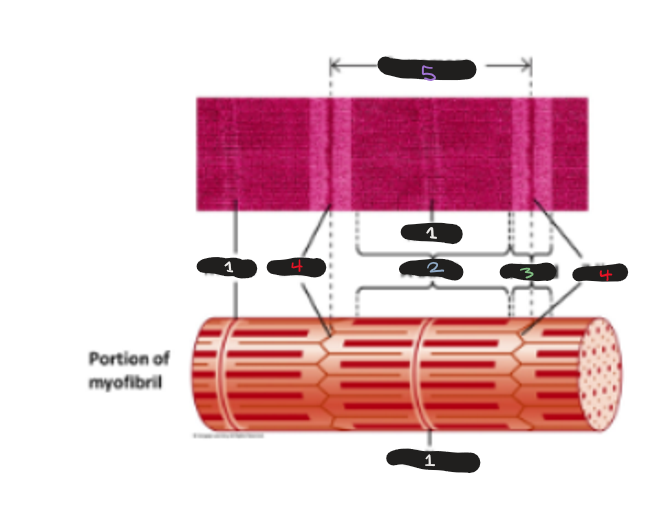
What is 4?
Z line

What is 5?
Sarcomere
What is the A bands of muscle structure?
Dark bands at both ends of stacked thick filaments where thin filaments overlap.
What is the I bands of muscle structure?
Light bands consisting of the parts of the thin filaments not in the A band.