2) Hydrostatic Pressure, Force, Velocity, & Surface Tension
 Call Kai
 Learn
 Practice Test
 Spaced Repetition
 Match
 Flashcards
 Knowt Play
1/25

There's no tags or description
Looks like no tags are added yet.
26 Terms
define pressure and provide the equation
the amount of force exerted over an area
P = F/A

What syringe size creates the highest pressure?
the one with the smallest radius because it has the smallest area
think snow shoes vs. stilettos
You have 2 syringes: 1 has area of A, the other has area of 4A, how do their pressures relate?
the one with area of 4A, will have ¼ of the pressure than the A one

absolute pressure
relative to full volume
psia = psi + psig

0 psig = ____ psia = ____ mmHg = ____ atm
0 psig = 14.7 psia = 760 mmHg = 1 atm
define hydrostatic pressure and provide the equation
pressure exerted as a result of a liquid’s weight
P = (p*h*g) where p is density, h is height, and g is gravitational acceleration

Does the shape of the container matter when considering hydrostatic pressure? Why or why not?
Shape does not matter for hydrostatic pressure because fluids, by nature, cannot resist shear stress. Thus, when applying a sideways force on a fluid, the molecules simply flow out of the way, and the fluid eventually returns to rest. So the fluid molecules have no internal sliding, no net sideways forces, and can only apply force perpendicular
How would you achieve a greater flow rate from a hanging IV bag?
raise the IV bag pole, which increases the height and hydrostatic pressure
Where do you place the transducer of an arterial line and why?
place transducer at the level of the patient’s heart (zero)
if placed below the patient’s heart level, the fluid in the connecting line adds hydrostatic pressure to the reading, making the BP look falsely high
if placed above the patient’s heart level, the fluid in the connecting line pulls away from transducer and creates negative pressure in the line, making the BP look falsely low
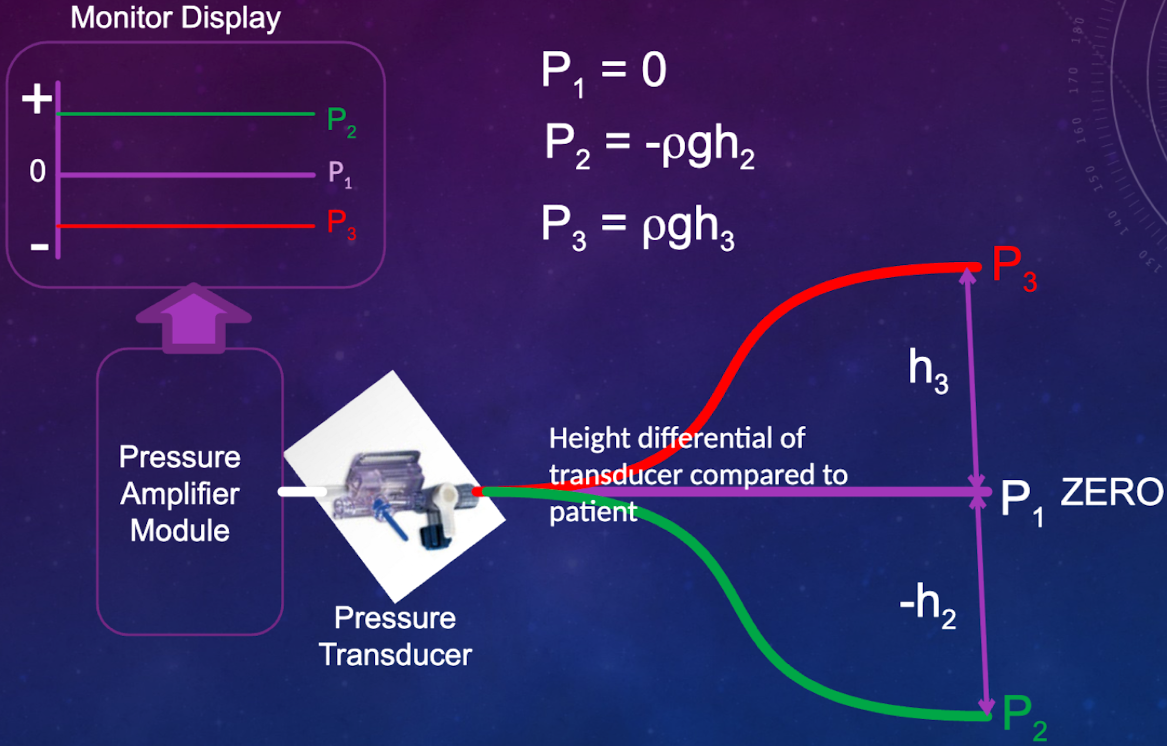
what’s the typically gauge sizes for arterial lines?
adults: 20G
small children: 22G
infants/neonates: 24G
what happens to systemic vascular resistance (SVR) when a person goes from supine to standing?
standing pools blood in the lower extremities, reducing venous return to the heart
this decrease in preload causes a decrease in stroke volume and cardiac output
stretch receptors detect the decrease in stretch of the arterial wall, triggering vasoconstriction in both arterial and venous beds
arteriolar constriction directly increases systemic vascular resistance (SVR) by narrowing vessel radius
venoconstriction forces pooled blood back up to the heart, restoring preload and cardiac output
Is blood pressure in the leg higher or lower when standing in comparison to laying down? Why or why not?
higher because standing increases hydrostatic pressure, which in turn causes increased systemic vascular resistance

why are compression socks used during surgery?
anesthetic agents (propofol, inhalation gases, spinals) can greatly impair a person’s ability to return blood to the heart so these socks apply graduated pressure to help return pooled blood to the heart
define viscosity and what is 1 factor that impacts it
a fluid or gas’ resistance to flow
a fluid or gas’ friction that prevents the layers from sliding smoothly
temperature affects viscosity
define Newtonian fluid and provide an example
maintains viscosity as a constant no matter the flow rate (when a force is applied)
ex: water keeps the same thickness/viscosity no matter how fast you stir, shake, or push it

define non-Newtonian fluid and provide an example
fluid viscosity changes with changes in flow rate (when a force is applied)
ex: blood will is less viscous at high flow rates because the red blood cells fall in line and slide past each other easier, whereas, at low flow rates, blood has a high viscosity because the cells clump and aggregate

if you have a higher hematocrit, what happens to viscosity?
increases because there are more red blood cells in solution

what is the equation for wall tension of a cylindrical vessel?
T = PR
what is the equation for wall tension of a spherical vessel?
T = (PR)/2
why is blood pressure so important when managing aneurysms?
aneurysm: a bulge or ballooning in the weakened wall of a blood vessel
risk for rupture as the spherical portion expands and the wall tension surpasses that of the normal cylindrical vessel
can’t control radius of the aneurysm, but you can control internal pressure

what allows surface tension to occur?
intermolecular forces → hydrogen bonding
what is the effect of surfactant on surface tension?
lowers surface tension by decreasing the density of water molecules at the air-water interface
the hydrophobic tail pulls the surfactant upward and allows for gas exchange → keeps the alveoli open and ensures even ventilation
how is gas flow in the alveoli affected when there’s no surfactant?
if there’s no surfactant, then all alveoli have the same surface tension
T = PR/2 rearranges to P=2T/R where the only thing changing is the radius
the smaller radius alveoli will have higher pressure
because pressure moves high to low, gas flows toward the larger alveoli, collapsing the smaller ones
how is gas flow in alveoli affected when surfactant is present?
2 situations:
alveoli can have equal pressure and varying tensions due to an unequal distribution of surfactant
stops the flow of air between alveoli → ex: end of inspiration or expiration
T = PR/2 rearranges to P=2T/R where tension and radius are variable
the larger alveoli have higher pressure so gas flows towards the smaller alveoli
What can you estimate using the arterial line waveform?
cardiac output
the area under the curve multiplied by heart rate

how does increasing the density of an IV solution affect pressure, viscosity, and flow rate?
increases hydrostatic pressure at the bottom of the column slightly and viscosity throughout, but decreases overall flow rate because viscosity and flow rate through a tube have an inverse relationship (Poiseuille’s Law)