A&P Exam 2: Chapter 7
 Call Kai
 Learn
Learn Practice Test
 Spaced Repetition
 Match
Match Flashcards
 Knowt Play
1/33

There's no tags or description
Looks like no tags are added yet.
Name | Mastery | Learn | Test | Matching | Spaced | Call with Kai | Chat |
|---|
No analytics yet
Send a link to your students to track their progress
34 Terms
Osteology
the study of bones.
Functions of the Skeletal system:
Support: helps hold up the body, supports muscles.—→ like the mandible and maxilla help support the jaw structure and function (teeth)
Protection: helps support vital organs —→ brain, spinal cord, heart, lungs
Movement: limb movements, action of muscle on bone.
Electrolyte balance: calcium and phosphate ions
Acid-base balance: helps to buffer blood against overly high pH changes.
Blood formation: bone contains red bone marrow, which is the sole creator of red blood cells.
*Bones → muscles attach → muscles pull on bones → movement
What exactly is bone?
It is a type of supporting connective tissue. The matrix is hardened by calcium phosphate and other minerals.
It combines with nerves and blood to complete the task of helping your body move.
Overall it consists of bone tissue, bone marrow, cartilage, adipose, nervous, and fibrous connective tissue
The hardening process of bone is called ______.
Mineralization/calcification
What are the 4 types of bones and where can you find them?
Flat—→ protects soft organs; curved, wide, and thin. *Sternum
Long bones—→longer than wide; muscles pull on these when they contract. * femur
short bones—→ equal in length; glide against one another in multiple directions. *carpals
irregular bones—→ have shapes that do not fit into the other categories. *vertebra

Look at the image and name the characteristics of spongy bone.
What are the three images representing
function; location; characteristics
Trabeculae develops along _____________.
1.= periosteum 2.=marrow cavity: red bone marrow 3.= trabeculae
2. to provide strength and lightens the bone; ends of long bones and middle of all other bone types; red marrow, trabeculae, spicules—→
🦴 Trabeculae = the main branching plates/struts that create the overall framework of spongy bone.
🦴 Spicules = smaller, thin bony projections/struts within that framework.
the bones mechanical lines of stress.


Look at the image and name the characteristics of compact bone.
location; characteristics
outer shell of long bones; lacunae, osteons(main structural unit), dense.
4 types of bone cells:
Osteogenic: stem cells that produces new bone cells
Osteoblasts: builds the bone
Osteocytes: maintains the bone
Osteoclasts: breaks down bone

Label the anatomy of the long bone


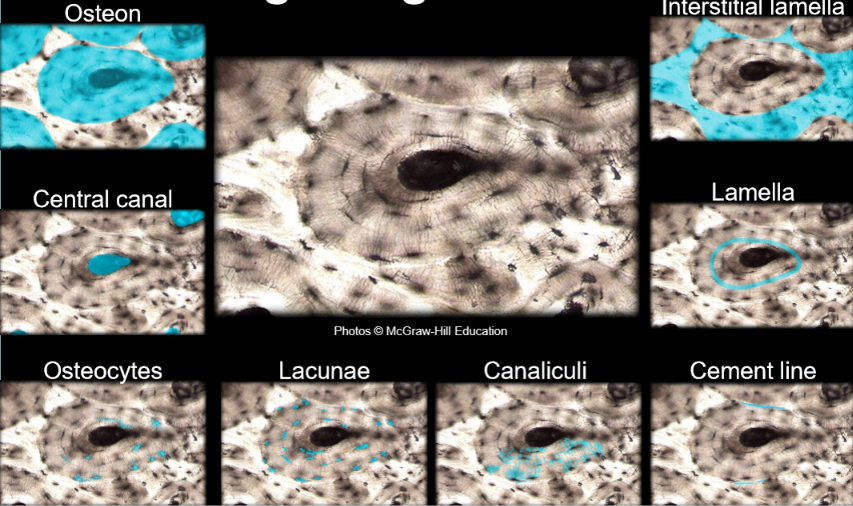
Histology of Compact bone:
What other things does it consist of that’s not labeled?
concentric lamellae? Perforating fibers/canals? nutrient foramina? central canals?
You should be able to look at the image and know its compact bone and label it.
concentric lamellae: the rings of the osteon
perforating canals: tunnels that run perpendicular to the osteons, connecting them. Allowing for blood vessels and nerves to pass through
perforating fibers: collagen fibers that help attach the periosteum to the
nutrient foramina: little holes within the surface of compact bone that allow for blood vessels to pass thru the denseness to get to the inner bone.
Central canal definition: space in the center of an osteon that contains blood vessels and nerves. And the blood vessels in the central canal supply the osteocytes with oxygen and nutrients.

Red bone Marrow: Yellow Bone Marrow:
function 1. function
location 2. location
Red bone Marrow: Yellow Bone Marrow:
produces red blood cells 1. Fat storage
spaces of spongy bone (trabeculae). 2. medullary cavity
What are the two ways bones can be developed?
Intramembranous & Endochondral ossification
Intramembranous Ossification:
What is this?
2. What’s the process?
bone develops directly starting with mesenchymal cells
1. Mesenchymal cells gather around blood vessels.
✔ Yes. The developing bone forms in an area where there are already blood vessels.2. Mesenchymal cells differentiate → osteoblasts.
✔ Exactly. The mesenchymal cells become osteoblasts, which are the bone-building cells.3. Osteoblasts secrete osteoid.
✔ Yes! construction analogy works:Osteoblast = construction worker 👷🏽♀️
Osteoid = framework/material they're laying down 🏗
Minerals = what hardens that framework into bone
Some osteoblasts become trapped in little spaces called lacunae → osteocytes (of trabeculae).
Trabeculae form around the blood vessels and has spaces for the red bone marrow to fill.
Some of the developing bone tissue at the outer surfaces becomes more dense. —> compact bone. And we also have lacunae and osteoclasts here.
The surrounding mesenchymal tissue differentiates to becomes the periosteum
Endochondral Ossification
What is this?
2. What’s the process
Bone develops through a cartilage model, that then breaks down as bone replaces it.
Before you have a bone, you have a hyaline cartilage model shaped roughly like the future bone.
the Perichondrium around the cartilage changes form and some of the perichondrium cells become osteoblasts. To then form the bony collar around the middle of the bone. —→ the first layer of bone.
in the middle of the cartilage, the cartilage cells begin to enlarge (hypertrophy).
The surrounding cartilage matrix in the middle calcifies. In doing so, the cartilage cells (chondrocytes) began to not be able to get access to nutrients due to the calcification. They leave behind spaces where they used to be
periosteal bud (a little bundle/package of stuff that enters the developing cartilage)- it literally pushes through the periosteum. It brings osteoblasts, osteoclasts, and importantly, blood vessels to the forming structure. (happening in the diaphysis portion) - Think of it like a delivery truck 🚚
The periosteal bud = delivery truck
Inside/along with the truck are:
🩸 blood vessels
🦴 osteoblasts
🧹 osteoclasts
➕ other cells
Now the osteoblasts deposit bone and the cartilage is being replaced now in the middle (Primary ossification center forms).
as the bone is still developing in the middle, some of those osteoclasts break down some of the bone that was just developed and creates the medullary cavity for the yellow bone marrow to fill.
After all that, Secondary ossification centers form: more bone starts to replace cartilage over time. The epiphyses areas start to form, like the spongy bone. Articular cartilage and epiphyseal plate stays cartilage (so the bone can still grow).
What is appositional growth?
bone grows wider/thicker by adding new bone to its surface.
What is Wolff’s law of bone?
Says that the way a bone is made is dependent on the areas of mechanical stress placed on it.
Fill in the blank:
A mature bone is an __________ ________, and is involved with its own maintenance, growth and ____________.
active organ
remodeling
Fill in the blank:
Disturbance of _________ homeostasis in skeletons can disrupt other organ systems.
Calcium; nervous, muscular, and cardiovascular system
What’s the mineral that calcifies your bones?
calcium hydroxyapatite, which is made up of calcium, phosphate, and hydroxide ions.
Why do other tissues not become calcified, but bones some how do?
other tissues have inhibitors that prevent it. But osteoblasts neutralize those inhibitors and allow the calcium hydroxyapatite to do its job.
What is mineral resorption?
Osteoclasts break down the bone by attaching onto its surface and releasing substances that break down the bone (by dissolving its mineral components and organic matrix.)
Hydrochloric acid breaks down the hydroxyapatite crystals- releases calcium and phosphate ions (what once made the bone hard), and enzymes break down the collagen of the bone.
calcium and phosphate is then released back into the blood, while collagen is broken down into smaller fragments.
**** the body needs that released calcium + phosphate in many other ways, its not just need for bone calcification and structure. Those minerals are withdrawn from the skeleton whenever they are needed somewhere else.********
What is Hypocalcemia? What can it be caused by?
Less and normal amount of calcium in the blood
Vitamin D deficiency, thyroid and parathyroid problems
What is Hypercalcemia?
Too high calcium concentration in blood.
Your body has to regulate calcium in the blood so it can prevent things like hyper/pocalcemia. (Calcium homeostasis)
What are the hormones it uses to do this?
Calcitriol
Calcitonin
Parathyroid hormone
What is Calcitriol?
It is a form of active vitamin D produced by the skin, liver, and kidneys.
The Epidermis’s keratinocytes use the suns UV radiation to convert 7-dehydrocholesterol to previtamin D3
Then the liver coverts that to calcidiol
Then the kidneys convert that to calcitriol
**** the liver and kidneys both do that by adding hydroxl groups.
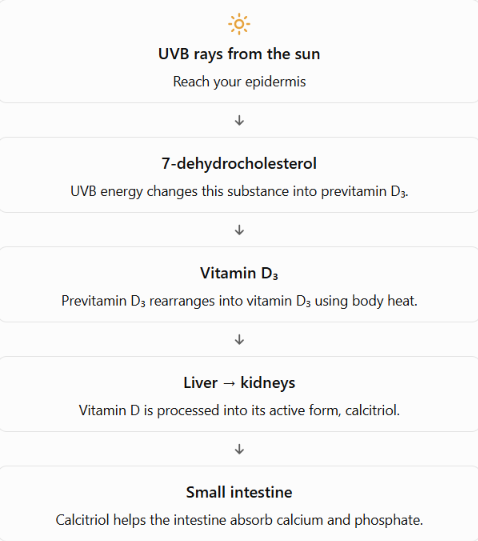
What is the job of the Calcitriol hormone? How does it work?
To raise blood calcium levels
How?
1. Small intestine + skeleton increases aborption
2. Kidneys don’t release as much calcium thru urine.
What can happen if someone’s calcitriol in their body doesn’t work properly?
Can cause soft bones (rickets in kids, osteomalacia in adults).
What is the parathyroid hormone?
secreted by the parathyroid glands
raises calcium levels by —→ promoting the kidneys absorb more calcium and not release as much thru urine, small intestine will absorb more calcium, bone deposition, enhancing calcitriol synthesis in the kidneys.
What is the Calcitonin hormone? What releases this hormone?
The thyroid gland
Lowers blood calcium levels in two ways:
Osteoclast inhibition—→reduces their activity=less calcium lost from the bones
osteoblast stimulation ——>increases their activity=more bone= more calcium being stored in the skeleton.
Explain Osteoporosis:
What?
Causes?
It is a bone disease in which bone density is severely lost (they are brittle). Bones lose mass. Really affects spongy bone because it is the most metabolically active in the bone.
Low estrogen (helps maintain bone density),
What is Osteogenesis imperfecta?
Excessively brittle bones due to insufficient collagen/protein.
What are sutures and what skeletal structures can you find them on?
they are immovable fibrous joints
can find them between the different bones of the skull
What is is Pathologic fracture? What causes it?
Occurs when the bone become weak and can break using little force, due to an underlying condition:
osteoporosis
cancer involving the bones
osteomalacia