Self and Identity
 Call Kai
 Learn
 Practice Test
 Spaced Repetition
 Match
 Flashcards
 Knowt Play
1/67

Earn XP
Description and Tags
Ideas and concepts of self, sources of self-knowledge and limits, self, affect and self-esteem, issues of self-presentation
68 Terms
What is self-concept?
Knowledge, idea or set or ideas, attitudes, beliefs about who I am
What was the first study about the self?
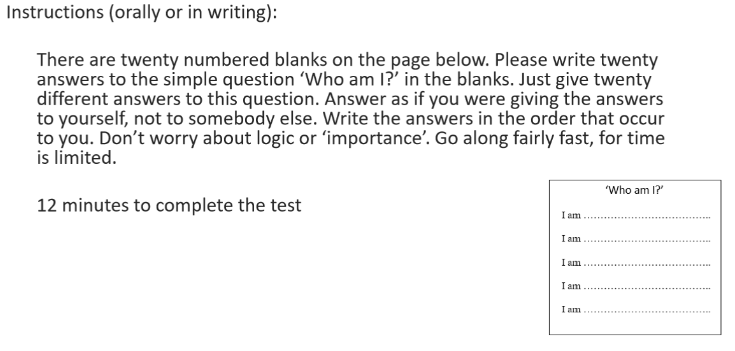
Kuhn + McPartland (1954) → 20 statements test
Testing the self in terms of attitudes towards the self (how we reflect on it)
288 UGs
Self-definition not only based on individual attributes (sub-consensual statements) but also tied to relations with others (consensual statements)
What are Brewer and Gardner’s (1996) different forms of self?
Individual self = based on personal traits that differentiate the self from all others
Relational self = based on connections and role relationships with significant others
Collective self = based on group membership that differentiates ‘us’ from ‘them’
Which 4 types of identity have been more recently proposed (Brewer, 2001; Chen, Boucher and Tapias, 2006)?
Person-based social identities = emphasising the way that group properties are internalised by individual group members as part of their self-concept
Relational social identities = defining the self in relation to specific other people with whom one interacts in a group context
Group- based social identities = equivalent to social identity
Collective identities = a process where group members share self-defining attributes + engage in social action to forge an image of what the group stands for, how it is represented + viewed by others
Where has evidence for the contextual sensitivity of self and identity come from?
Research where contextual factors are varied to discover that people describe themselves + behave differently in different contexts → people act different in group setting, interpersonal relationships + individually
What do social constructionists argue about the self?
Is entirely situation-dependent:
Extreme form of this position = we don’t carry self- knowledge around in our heads as cognitive representations, instead we construct disposable selves through talk (e. g. Potter and Wetherell, 1987)
A middle way = people do have cognitive representations of the self that they carry in their heads as organising principles for perception, categorisation and action, but that these representations are temporarily or more enduringly modified by situational factors (e. g. Abrams and Hogg, 2001; Turner, Reynolds, Haslam and Veenstra, 2006)
Less extreme form of this position = who does not emphasise the role of talk but still maintains that self- conception is highly context- dependent (e. g. Oakes, Haslam and Reynolds, 1999)
How are conceptions of the self (information, misinformation and related affects) organised and stored?
Cognitively as self schemas (Markus, 1977) + as separate context-specific nodes such that different contexts activate different nodes + thus different aspects of self (Breckler, Pratkanis + McCann, 1991; Higgins van Hook + Dorfman, 1988)
What are self-schemas?
Cognitive representations about the self/self-conceptions derived from past experiences (represent the way the self has been differentiated or articulated in memory)
Most of us have a large number of discrete self-schemas as our self-concept is neither a singular nor an averaged view of the self but multiple + complex
How do self-schema influence information processing and behaviour?
Self-schematic info is more readily noticed, overrepresented in cognition + associated with longer processing time
How do the concepts of aschematic and schematic related to the self?
People tend to have clear self schemas on some important dimensions (self-schematic) + not others (self-aschematic)
What are the disadvantages of having rigidly compartmentalised self-schemas (e.g. wonderful cook, awful musician vs reasonably good cook, not great musician)?
If some self-schemas are very negative + some are very positive, events may cause extreme mood swings according to whether a positive or negative self-schema is primed
What are Higgins’ (1987) 3 types of self-schema?
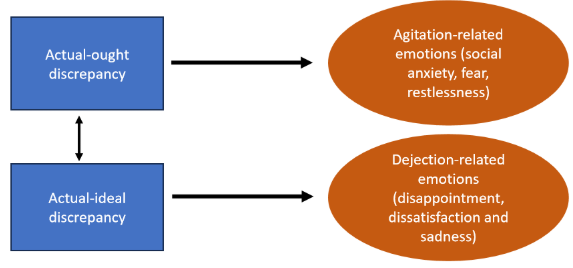
Actual self
Ideal self (how we’d like to be)
Ought self (how we think we should be)
Ideal + ought are self-guides but mobilise different types of self-related behaviours
What can discrepancies between actual-ideal selves and actual-ought selves lead to?
Regulatory focus theory → motivate different kind of behaviours (Higgins, 1987) to match our behaviour to an ideal/ought standard BUT left emotionally vulnerable (feel dejected when discrepancies aren't solved )
What is promotion focus?
Motivated to attain our ideals (hopes, aspirations) → sensitivity to presence + absence of positive events
Adopt an approach strategy to attain own goals
What is prevention focus?
Motivated to fulfil our duties + obligations (oughts) → sensitivity to presence of absence of negative events
Adopt an avoidance strategy
Can people be both promotion and prevention focused (Higgins and Silberman, 1998)?
No → tend to be either/or
How does upbringing affect whether one becomes promotion or prevention focused?
Children are habitually hugged + kissed for behaving in a desired manner + love is withdrawn as a form of discipline -> promotion-focused
Less likely to recall info relating to the pursuit of success by others (Higgins + Tykonicinski, 1992)
Look for inspiration to positive role models who emphasise strategies for achieving success (Lockwood, Jordan + Kunda, 2002)
Children are encouraged to be alert to potential dangers + punished when they behave undesirably -> prevention-focused
Recall info relating to the avoidance of failure by others
Most inspired by negative role models who highlight strategies for avoiding failure
Exhibit motivation + persistence of tasks framed in terms of losses + non-losses
How do intergroup contexts affect promotion and prevention focuses?
Shah, Brazy + Higgins (2004)
In intergroup contexts a measured or manipulated promotion focus strengthens positive emotion- elated bias + behavioural tendencies towards the ingroup
Aprevention focus strengthens more negative emotion-related bias + behavioural tendencies against the outgroup
What are some further examples of how concepts of self can guide behaviours?
Self-efficacy → sense of competence + effectiveness (Bandura, 1997)
Different from self-esteem/self-worth)
Locus of control (Rotter, 1973)
What do self-schemas influence?
The way we process info about self + others
Notice + spend more time thinking about info consistent with self-schemas (Markus, 1977)
Schematic info is easier to process (Druian + Catrambone, 1986)
Tend to judge others on dimensions that are important to our self (Markus + Wurf, 1987)
Mood (Linville, 1985)
Is the self represented in one area of the brain? If so, which on?
No → emerges from widely distributed brain activity across the medial prefrontal + medial precuneus cortex of the brain (e.g Saxe, Moran, Scholz + Grabieli, 2006)
How may self-conceptions differ across cultures (culturally located self-schemas)?
Collective + relational selves are more important in collectivist than individualist (Markus + Kitayama, 1991; Triandis, 1995; Yuki, 2003)
Consequences of culturally located self-schemas in terms of cognitive processing + affective responses (Markus + Kitayama, 1991)
How can the cultural differences in self-concepts be explained economically?
Arise from economic systems:
Western economies developed around labour mobility
People move frequently for work
Relationships are temporary
Independence + autonomy become adaptive values
Western self-concepts emphasise individuality, independence + uniqueness
What is the concept of self-coherence?
Self-concept changes in different situations + over time BUT most of us have a self of ‘being the same me’ → tend to maintain a fairly integrated/coherent picture of who we are (Hogg + Vaughan, 2011)
How do we achieve a sense of integration and coherence according to Baumeister (1998)?
Restricting our lives to a limited set of contexts → sense of consistency + sameness around these limits contexts/selves
Revising + integrating out autobiographies → rewriting history to suit current sense of self
Attributing change in self to circumstances
How do we know who we are?
Introspection → examine our own thoughts, feelings, motives + reasons for behaving in a particular way
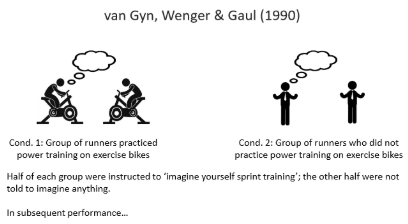
Self-perception (Bem, 1972) → make inferences from (imagined) behaviour (van Gyn, Wenger + Gaul, 1990)
Feedback from others
Self-categorisation theory (Turner, Hogg, Oakes, Reicher + Wetherall) → group membership produces a sense of social identity
What is a limit to introspection?
Poor awareness of influence of the situation (Carpenter, 2013; Nisbett + Wilson, 1977; Perkins + Wiseman, 2005)
What is a weakness of acquiring self-knowledge through feedback from others?
Can become a self-fulfilling prophecy:
Miller, Brickman + Boden (1975) → told they should be tidy vs attributes of being tidy vs control → attribution more effective in changing behaviour
What are Sedikides’ (1993) 3 motives associated with self-seeking information?
Self-assessment motive → seeking accurate/valid info to find out what kind of person we really are (reflects basic desire for realism + accuracy in self-understanding)
Weakest
Self-verification motive → seeking info that verifies/confirms our prior beliefs about what we are like (includes negative self-views + applies to social identities; confirming group stereotypes or group-related beliefi)
2nd strongest
Self-enhancement + protectionmotive → see oneself in a positive light + increase self-esteem (defend against threats to self-esteem)
Strongest
How can our self-esteem and self of self-worth be maintained or enhanced (self-protective function of positive illusions)?
Self-serving attributions (Campbell + Sedikides, 1999)→ attribution of positive outcomes to self + negative outcomes to other factors
E.g. Lau + Russell (1980) → wins (80% of explanations to internal factors; ability, teamwork) vs losses (80% attributed to external factors; weather, opponents’ luck)
Unrealistic optimism (Weinstein, 1982) → perceive ourselves to be more likely to have positive outcomes + less likely to succumb to negative outcomes
False consensus + uniqueness effect (Goethals, 1991) → think others will act + think like us (think our behaviour is more typical than it is) + when successful/in relation to ability we see our talent as relatively unique
What are the explanations behind the false consensus effect?
We usually seek out similar others -> shouldn't be surprised to find that others are similar to us
Own opinions are salient to us + at the forefront of our consciousness -> eclipse the possibility of alternative opinions
Motivated to ground our opinions + actions in perceived consensus to validate them + build a stable world for ourselves
In which circumstances is the false consensus effect stronger?
Stronger for important beliefs/beliefs we care about (e.g. Granberg, 1987) + certain beliefs (e.g. Marks + Miller, 1985)
External threat, positive qualities, perceived ssimilarity of others + minority group status inflate perceptions of consensus (e.g. Sander + Mullen, 1983; Sherman, Presson + Chassin, 1984; van der Pligt, 1984)
What are the 3 kinds of threats to our self-concept that affect our sense of self-worth?
Failures
Inconsistencies (events make us question who we are)
Stressors (events make it hard to cope)
Arouse negative emotions + contribute to physical illness (Strauman, 1993)
What are self-serving biases?
Attributional distortions that protect/enhance self-esteem or self-concept
What is self-enhancing bias?
Taking credit for our positive behaviours + successes as reflecting who we are + our intention + effort to do positive things
More common than self-protecting biases -> people with low self-esteem tend not to protect themselves by attributing their failures externally (attribute them internally) (Campbell + Fairey, 1985)
What is self-protecting bias?
Explaining away negative behaviours + failures as being due to coercion, normative constraints + other external situational factors which don't reflect who we really are
What is attribution of responsibility?
Influenced by an outcome bias
Tendency to attribute greater responsibility to someone who is involved in an accident with larger rather than small consequences
Links to illusion of control + belief in a just world -> general pattern of attribution where victims are deemed responsible for their misfortune + self-blame
What is Miller and Ross’ (1975) cognitive component behind self-serving biases (particularly for self-enhancing bias?
People generally expect to succeed -> accept responsibility for success (try hard to succeed -> associated with own effort)
Exaggerate amount of control over successful performances
Encourage internal attribution of success
What is a weakness of Miller and Ross’ (1975) cognitive explanation of self-serving biased?
Motivational factors -> hard to disentangle
How can one cope with threats to self-worth?
Escape physically from the threat situation or through denial
Downplay threat by re-evaluating or affirming other aspects of self (Steele, 1988)
Attack the threat by discrediting it, denying responsibility or through self-handicapping
What is self-handicapping?
Behaviours designed to sabotage our performance in order to provide a subsequent excuse for failure (safe excuse if we fail + enhances our perceived ability if we succeed)
When are we more likely to socially compare?
Similar others or those who are slightly inferior in some way (Festinger, 1954; Will, 1981) BUT self-evaluation maintenance model
What is Tesser’s self-evaluation maintenance model?
Lessen the relevance of comparing with the target person (exaggerating the ability of the target, changing the target of comparison, distance self from the target of comparison) or devalue the domain or dimension of comparison
How is the self constructed and expressed? How does this relate to impression management?
Socially through interaction with others
How we present ourselves affects how others respond to us → people actively try to control the image they project
Goffman (1958) → people = actors, social situations = stage, different audiences lead to different performances (roles)
How do we present ourselves to others?
Authentic self-presentation → image is consistent with private self-concept
Impression management → process by which we try to shape the way others perceive us
Claiming desired identities (e.g. Emler + Reicher, 1995; Manago, 2008)
Self monitoring (Snyder, 1987) → shape/manipulate our behaviours to project the impression that we feel audiences or situations demand
Self-presentation strategies (Jones + Pittman, 1982) → manipulating others’ view of self
What are the self-monitoring differences?
High self-monitors
Adapt their behaviour to fit the audience + situation
Use strategic self-presentation (to achieve goals)
Low self-monitors
Behave consistently across situations
Use expressive self-presentation → expressing + validating self-concept, more than manipulating others, goal of authenticity + self-consistency (not impression control)
What are the self-presentation strategic motives (Jones and Pittman, 1982)?
Self-promotion → motivated by a concern to get ahead + gain respect for one’s competence
Integratiation → motivated by a concern to get along with others + be liked
Exemplification → motivated by a concern to get others too regard oneself as a morally respectable individual
Supplication → attempt to get others to take pit on oneself as helpless + needy
Intimidation → attempt to get others to think we’re dangerous
What are the issues with expressive self-presentation?
People usually choose social environments + relationships that will validate their self-image
A self-concept only has meaning if it is recognised by others → need social validation
Private identity without social recognition is psychologically weak/unstable
People prefer situations that allow them to behave consistently with their identity
Prefer partners who confirm their self-views
What is the actor-observer effect/ self-other effect
Tendency to attribute our own behaviours externally + others' behaviours internally (part of their character vs result of experiences), attributed more dispositionally
Tend to consider the behaviour of other people as more stable + predictable than our own (Baxter + Goldberg, 1988)
Tend to make more dispositional attributions for socially desirable than socially undesirable behaviour, irrespective of the action (e.g. Taylor + Koivumaki, 1976)
Tendency for actors to be more dispositional in attributing positive behaviours + more situational in attributing negative behaviours than are observers (e.g. Chen, Yates + McGinnies, 1988)
How can the self-other effect be inverted?
If the actors knows that their behaviour is dispositionally caused → e.g. may adopt an injured hedgehog knowing that you are a sucker for injured animals + often done this in the past (Monson + Hesley, 1982)
How can the self-other effect be abolished or reversed?
If the actor is encouraged to take the role of the observer regarding the behaviour to be attributed + the observer the role of the actor -> actor becomes more dispositional + observer more situational (e.g. Frank + Gilovich, 1989)
What are the explanations behind the self-other effect?
Perceptual focus
Informational differences
How does perceptual focus explain the self-other effect?
Actor + observer have different perspectives on the behaviour + explain it in different ways
E.g. observer: actor's behaviour is figural against the bg of the situation BUT an actor can't see themself behaviour, so the bg situation assume s the role of figure against the bg of self
How do informational differences explain the self-other effect?
Actors have a wealth of info to draw on about how they have behaved in other circumstances -> observers aren't privy to this autobiographical info (tend to see the actor behaving in a certain way in 1/a limited range of contexts)
What is objective self-awareness?
State in which you are aware of yourself as an object
Can make comparisons to how you actually are + how you'd like to be -> have shortcomings -> overcome by bringing the self closer into line with the ideal self
Generated by anything that focuses your attention on yourself as an object (e.g. being in front of an audience)
What do Carver and Scheier (1981) argue about the types of self we can be aware of?
Private self = private thoughts, feelings, attitudes
Leads you to try to match your behaviour to your internalised standards
Public self = how others see you, public image
Oriented towards presenting yourself to others in a positive light
What is deindividuation?
People lose their sense of socialised individual identity + engage in unsocialised (often antisocial) behaviours
What is Bem’s self-perception theory?
We gain knowledge of ourselves only by making self-attributions (e.g. we infer our own attitudes from our own behaviour)
No essential difference between self + other attributions
We construct our self-concepts by being able to attribute our own behaviour internally
How we perceive ourselves can also be based on imagining ourselves behaving in a particular way (Anderson + Godfrey, 1987) -> van Gyn, Wenger + Gaul (1990)
What is the overjustification efffect?
In the absence of obvious external determinants of our behaviour, we assume that we freely choose the behaviour because we enjoy it
If someone is induced to perform a task by either enormous rewards or fearsome penalties, task performance is attributed externally → motivation to perform is reduced
If there are minimal or no external factors to which performance can be attributed, we cannot easily avoid attributing performance internally to enjoyment or commitment → motivation increases
E.g. Lepper, Greene + Nisbett (1973)
How can the effect of rewards be more useful?
Reduce reliance on rewards that are task-contingent + make use of ones which are performance-contingent
What is social comparison theory?
Comparing our behaviours + opinions with those of others to establish the correct or socially approved way of thinking + behaving
Seek validity -> ground them in the opinions of similar others
What is the self-evaluation maintenance model (Medvec, Madley, Gilovich, 1995)?
People who are constrained to make esteem-damaging upward comparisons can underplay or deny similarity to the target, or they can withdraw from their relationship with the target
What is self-categorisation theory?
The process of categorising oneself as a group member produces social identity + group/intergroup behaviours
How does self-concept transform into social identity?
Categorisation becomes salient → people’s self-concept shifts from a personal identity to a social identity
Begin to think, feel, and behave according to what is expected of their group → people often behave differently in group contexts + explains why groups interact with each other in stereotypical or conflict-driven ways
What do the specific behaviours and attitudes people adopt in group settings depend on?
The content of the group prototype (what characteristics define the group)
Their beliefs about how their group relates to other groups, including perceived power, status, and legitimacy
Why does group membership affect self-esteem?
Groups define social identity.
Social identity shapes how people see themselves
The status and prestige of a group reflect how society values its members
What strategies are often used to maintain or improve social identity and status?
Individual mobility (“[passing”)
If group boundaries are perceived as permeable, individuals may try to leave a low-status group + join a higher-status one.
Often difficult because group boundaries are psychologically + socially rigid (e.g., visible ethnicity, accents)
Social creativity (if leaving is impossible)
Redefine their characteristics in a positive way
Compare themselves to lower-status groups to feel relatively superior
Social competition + collective action
If a group believes its low status is unfair or illegitimate + change is possible, it may engage in direct competition with other groups.
Can range from peaceful political action to violent conflict (terrorism or war)