BIOL 320 Taylor Exam 2
 Call Kai
 Learn
Learn Practice Test
 Spaced Repetition
 Match
Match Flashcards
 Knowt Play
1/136

There's no tags or description
Looks like no tags are added yet.
Name | Mastery | Learn | Test | Matching | Spaced | Call with Kai | Chat |
|---|
No analytics yet
Send a link to your students to track their progress
137 Terms
Function of lymphatic system
- collect and filter tissue fluid from capillaries and return it to circulation
- Serves as a way to move white blood cells around
Tunica Intima
Inner layer of Artery/Vein
Endothelium
Subendothelial layer
Internal Elastic Lamina (Artery Only)
Tunica Media
- Smooth muscle and elastic fibers
- External elastic lamina (Artery Only)
Tunica Externa
- Collagen fibers
- Protection of vessels
- vasa vasorum
Vasa vasorum
Tiny blood vessels that supply the walls of large arteries and veins
Elastic artery tissue makeup
- Primary smooth muscle
- Elastic tissue

Muscular Artery tissue makeup
- Smooth muscle
- fibrous (Collagnous) Tissue

Arteriole tissue makeup
- Smooth muscle mostly

Capillary tissue makeup
- Endothelium only

Venule tissue makeup
- Endothelium
- Smooth muscle
- Fibrous Tissue
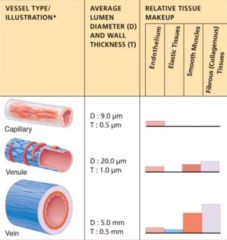
Vein tissue makeup
- mostly fibrous (Collagenous) tissue and smooth muscle

Elastic artery physical characteristics serve to
- Smooth out shock and even out flow
- They take pounding pulse of heartbeat and rebound back, resulting in consistent flow
- Does NOT Vasoconstrict
Muscular Artery characteristics
- Vasoconstrict to limit flow to inactive areas/tissues
- Responds to epinephrine
- Analogy of flushing toilet and person taking shower gets a rush of hot water
Arteriole characteristics
- Connect muscular arteries to capillary beds
- Vasoconstrict to further limit flow
- DO NOT cover great distances
Capillary Beds Purpose
- Serve as a passage of nutrients, gases, waste, hormones, etc.
- Arteries to veins

Precapillary Sphincters
Limit blood to capillary bed

Thoroughfare channels
Bypass capillary beds when capillary sphincter is closed

Pericytes
Help stabilize capillary walls and control permeability

Tissues without capillary beds
- Tendons/ligaments do not have good blood supply (Mostly why they take so long to heal)
- Cornea
3 Types of Capillary Wall Structure
Continuous, Fenestrated, and Sinusoidal
Continuous Capillary Wall
Very tight, transport of solutes
- Skin, muscle, brain

Fenestrated Capillary Wall
Fenestra with our without diaphragm
- pores
- Intestine, kidney, endocrine glands

Sinusoidal Capillary Wall
Solutes, fluid & cell transport, "loose and leaky"
- Large Gaps
- Liver, bone marrow, spleen
Veins have much larger relative ______________ vs. ______________ when compared to arteries
Internal diameter (lumen) vs. wall thickness
Valves purpose
Keep blood from flowing backwards

Vascular Anastomoses
brain, heart, abdominal organs, joints
Varicose veins and hemorrhoids both result from ______________.
Venous valve failure
Blood flow definition
Volume of blood through a defined area
- Defined area is vessel, organ, or system
Blood Pressure Definition
Force exerted on vessel wall by blood within
Resistance Definition
Opposition of flow: amount of friction encountered by blood
3 Resistance factors
Viscosity: inc viscosity, inc resistance
Blood Vessel length: inc length, inc resistance
Diameter: Inc Diameter, Dec resistance
2 types of blood flow
Laminar and turbulent
Laminar Blood Flow
- Streamlined
- Slower closest to wall, fastest in the center

Turbulent Flow
- Interrupted
- Runs into wall and bounces around due to rough surfaces
- This is why heart sounds when valve closes and why clots are an issue in people with vessel problems

Blood Flow Units
mL/min
Cardiac Output (CO) Definition
Blood flow through entire CVS
Blood Flow at rest is _____________ but ____________
Constant, but varies by need to individual organs
Poiseuille's Law
Blood flow is
- Inversely proportional to resistance, viscosity, vessel length
- Directly proportional to diameter and the change in pressure meaning the greater the difference, the faster the flow.
4 Mechanisms and 1 response of long term regulation of blood pressure
- Renin-angiotensin-aldosterone mechanism
- Vasopressin (ADH) mechanism
- Atrial natriuretic mechanism
- Fluid shift mechanism
- Stress-relaxation response
Stress-Relaxation Response
- Blood vessels dilate/constrict
- Tunica media adapts to change in blood volume
Why does BP Regulation matter
- Maintains blood through capillary beds
- Changes regional blood flow based on need
- Counteracts gravity
3 Factors of BP Regulation
Cardiac Output: Inc CO, Inc BP
Peripheral resistance inc, Inc BP
Blood Volume: inc BV, inc BP
Heart Rate (HR) control under normal situations
- Parasympathetic NS
- Cardio Inhibitory Center (CIC)
- Vagas Nerve X (M & S)
- Medulla
Stroke Volume (SV) control under normal conditions
via end-diastolic-volume (EDV)
HR Control under stressful conditions
- Sympathetic NS
- Cardioacclerator Center (CAC)
- Inc HR
SV Control under Stress
- Epinephrine/neural regulation increases
- Venous return increases
Short Term BP Controls
Neural controls and Vasomotor Center
Neural Controls (Short Term BP) Part 1/3
Specific demands
- When you stand up suddenly
- Recover pressure lost w/ hemorrhage
- Overcoming pooling in legs
Neural Controls (Short Term BP) Part 2/3
Maintenence of main arterial pressure via altering blood vessel diameter
Neural Controls (Short Term BP) Part 3/3
Operate via reflex arcs
- Receptor: Baroreceptor
- Integration center: Vasomotor Center
- Effector: Vascular smooth muscle
Location and Purpose of Vasomotor Center
- Sympathetic Neurons in the Medulla
- Regulate BV Diameter
Tone of the Vasomotor Center
Constant Low level of activity = Ready state
S-ANS Activity Increase results in
- Vasoconstriction
- Increased HR
- Increased BP
S-ANS Activity Decrease results in
P-ANS Resumes Control
- Decreased BP
Chemoreceptor Reflex Location
Aorta, Carotid
Chemoreceptor reflex measures
O2 and CO2
Chemoreceptor Reflex Stimuli and action
- Dec O2 and Inc CO2 Stimuli
- Activates vasomotor control
result of chemoreceptor reflex
Vasoconstriction -> Speed blood back to heart and lungs for oxygenation
- Coupled with Increased HR
2 Receptors of the VMC
Chemoreceptor and Baroreceptor
Baroreceptor reflex response to High BP
- Dec HR, Resistance, Contractility, Cardiac Output
Baroreceptor reflex response to low BP
- Inc HR, Resistance, Contractility, CO
Control Mechanism of Renal Long term BP Regulation
Blood Volume
Direct Pathway of Renal Long term BP Regulation
Overtime baroreceptor adapts to chronic high/low BP
- Results: High: Kidneys eliminate H2O, dec bld vol, dec BP
Low: Save water, inc bld vol, inc BP
Indirect Pathway of Renal Long Term BP Regulation
Low BP: Renin- Angiotensin mechanism
High BP: Beta-blockers (Vasodilators), Diuretics
Angiogenisis happens when
Short term autoregulation cannot meet tissue needs
- Common at High altitude
How does angiogenisis work
Increases #/size of vessels to region
2 Mechanisms the prevail when Skeletal muscle is at rest
Myogenic and general neural
During activity, Blood flow __________ to the metabolic activity of the _______. What controls override systemic controls?
Increases, Tissue
- Local Controls override systemic controls
Precapillary sphincters constrict when
- O2, nutrients & pH increase
- Metabolic byproducts & CO2 decrease
Precapillary Sphicters relax when
- O2, nutrients, and pH decrease
- Metabolic byproducts & CO2 increase
Blood Flow to the Brain is __________, as neurons are intolerant of _________.
Constant, Ischemia
Metabolic controls of the brain's BP vasodilate when
pH Decreases and CO2 Increases
Myogenic controls of the brain's BF do what when MAP decreases
Constrict Cerebral vessels
- Opposite when MAP increases
Atherosclerosis Definition and result
- Lipid deposit on vessel wall
- Turbulent flow, Increased resistance
Arteriosclerosis
- family of degenerative disorders
- Decreases elasticity of vessel wall
Systemic veins and venules make up _________ % of the CVS
60
Systemic arteries and arterioles make up ______% of the CVS
15
Pulmonary BV make up _______% of the CVS
12
The heart makes up ______% of the CVS
8
Capillaries make up ________% of the CVS
5
When standing, hydrostatic pressure caused by gravity _____________ BP below the heart and ____________ BP above the heart.
Increases, Decreases
Muscular movement ____________ Venous return
Improves
Extrinsic factors affecting BP
- Age
- Sex
- Weight
- Mood
- Race
- Posture
- Diet
- Physical Activity
Definition of Hypotension
Low BP, systolic less than 100 mm Hg
Orthostatic Hypotension Definition
temporary 'head rush' after suddenly standing
Chronic Hypotension definition
Result of poor nutrition
- Addison's disease or hypothyroid
Acute Hypotension is a sign of
Circulatory shock
Transient Hypertension is ___________, caused by __________
Normal; caused by fever, physical exertion or emotions
Chronic Hypertension can cause damage to
Vessels, baroreceptors, heart muscle, vascular organs
- Caused more commonly by heredity, stress, smoking
Circulatory Shock Definition
Blood volume low, cannot circulate normally
Result of circulatory shock
Inadequate blood flow to meet tissue needs
Hypovolemic shock
Large scale blood loss, vomit, diarrhea
Vascular Shock
extreme vasodilation
Cardiogenic shock
poor heart function
Obstructive shock
obstruction of blood flow
Anaphylactic shock
Massive histamine release (allergic rxn)
CNS Ischemic response
Elevation of BP in response to lack of BF to the Medulla Oblongata
Definition of and 2 Sources of lymph
- Water plus solutes
- Plasma and Cells
Difference between veins and lymphatic collecting vessels
- Collecting vessels have thinner walls and more internal valves
- Anastomose more frequently
Collecting lymphatic vessels travel with
superficial veins