lec 19 - B cell development
 Call Kai
 Learn
 Practice Test
 Spaced Repetition
 Match
 Flashcards
 Knowt Play
1/56

There's no tags or description
Looks like no tags are added yet.
57 Terms
Where are our B cells waiting to be activated?
in the lymphoid follicles of lymph nodes!


When activated, B cells differentiate into _______ cells which secrete protective antibodies.
plasma
T/F: Each B cell is specific for only one antigen.
true!
Where are B cells born?
in the bone marrow!

Just like T cells, B cell progenitors also come from the bone marrow.
Unlike T cells, B cells ….. as well.
Just like T cells, B cell progenitors also come from the bone marrow.
Unlike T cells, B cells mature in the bone marrow as well.
What does the “B” in B cells stand for? Why?
Hint: birds
bursa of fabricius!
B cells were first described in birds, but nobody thought they were all that important.
The Bursa of Fabricius is the source of B cells in chickens. Mammals grow B cells in the bone marrow though.

Rem. that BCRs ARE immunoglobins which ARE antibodies! Recall that making a unique antibody requires _ _ _ recombination.
VDJ recombination
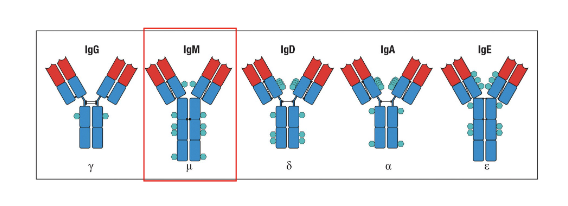
What is the default antibody produced by developing B cells?
IgM!
So VDJ recombination occurs to make a productive _____ antibody.
So VDJ recombination occurs to make a productive IgM antibody.

IgM is the default antibody produced by developing B cells, but actually naive B cells in the lymph nodes express both IgM and Ig__.
IgM is the default antibody produced by developing B cells, but actually naive B cells in the lymph nodes express both IgM and IgD.
Summary of B cell development:
…

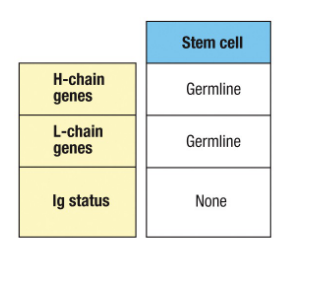
Stem cells have [germline/somatic] BCR sequences. Why?
Stem cells have germline BCR sequences cuz at this stage we want the fundamental B cell precursors which should all be identical. Only later will we undergo VDJ recombination for diversity.
At the early pro-B cell stage, which chain [light / heavy] is rearranged first?
the heavy chain! it undergoes DJ recombination on both chromosomes (mom and dad’s).

If something works, it is considered “____________”.
If something works, it is considered “productive”.
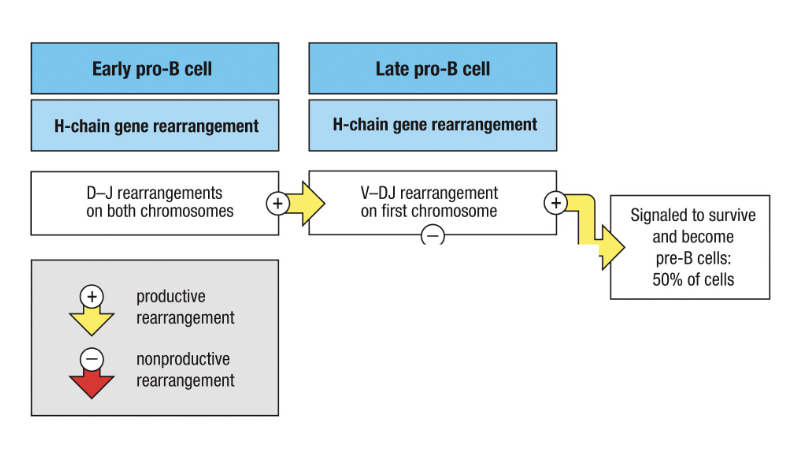
If the heavy chain DJ recombination is productive, then the cell can undergo V (of VDJ) recombination as a __________ stage B cell.
as a late pro-B stage cell.
Once the heavy chain has finished VDJ recombination (finished rearranging), it gets CHECKED. This is the first checkpoint.
…
Once the heavy chain has finished VDJ recombination (finished rearranging), it gets CHECKED. What are the B cells called at this point?
large pre-B cells!
Once the heavy chain has finished VDJ recombination (finished rearranging), it gets CHECKED. This is the first checkpoint.
What is checked at this point?
The functionality of the heavy chain! i.e., if it can bind to a light chain.
The rearranged heavy chain is tested with a surrogate light chai

If the large pre-B cell passes the first checkpoint, i.e., if the heavy chain can bind a surrogate light chain, then the cell….
…the cell survives! it sends a survival signal!
If the large pre-B cell passes the first checkpoint, i.e., if the heavy chain cannot bind a surrogate light chain, then the cell….
…the cell fails and dies by neglect

If the large pre-B cell passes the first checkpoint, i.e., if the heavy chain can bind a surrogate light chain, then the cell sends a survival signal.
What does the survival signal cause inside the cell?
That survival signal tells the cell to stop making RAG (the DNA-cutting enzyme) and destroys any RAG proteins left over.
The cell also tightly coils up the heavy chain DNA on its other chromosome so it cannot be edited.
These steps set the VDJ rearrangement on the second chromosome in stone!!! allelic exclusion
What do you mean by allelic exclusion… why is VDJ rearrangement on only ONE chromosome set in stone?
(rem. there are two alleles, one on mom’s chromosome and one on dad’s).
If the cell randomly picked your dad's heavy chain allele first to rearrange and it worked, it locks your mom's copy. If it picked your mom's copy first and it worked, it locks your dad's copy.
Thus across your entire body, roughly 50% of your B cells use the heavy chain chromosome from your mom, and 50% use the one from your dad.
Why doesn’t the B cell make two heavy chains?
cuz 2 productive heavy chains —> 2 antibodies —> not allowed!!
Rem. each B cell is specific for only ONE antigen.
ALLELIC EXCLUSION =
productive heavy chain production from the allele on one chromosome inhibits heavy chain production from the allele on the other chromosome.

Ok great, so we’ve succesffuly passed the first checkpoint (made a functional heavy chain). Now we proliferate this large Pre-B cell.
Then we need to rearrange the light chain.
…

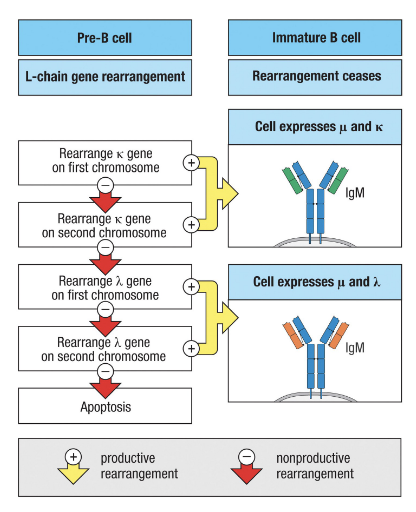
Recall that there are 2 light chains: kappa and lambda.
Pre-B cells start by rearranging their ______ light chains. As a result, most (~66%) B cells have a _____ light chain.
Pre-B cells start by rearranging their kappa light chains. As a result, most (~66%) B cells have a kappa light chain.
If the kappa chain fails (isn’t productive), then the lambda chain is attempted. If that fails —>
—> the cell dies by neglect!
T/F: Light chains don’t try many V/J combinations and easily give up.
false!!
Light chains will try multiple V/J combinations to maximize the likelihood of success.
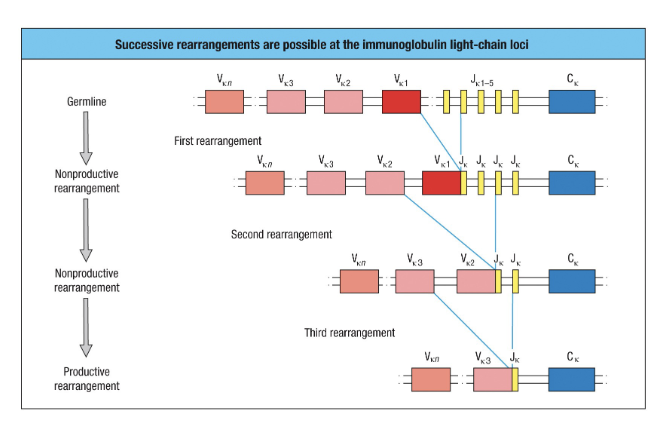
Most (__%) pre-B cells succeed.
Most (85%) pre-B cells succeed.
What is being checked in the second checkpoint?
whether the fully formed BCR works (is productive).
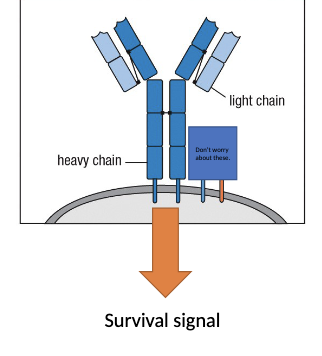
If the second checkpoint is passed (heavy chain-light chain work tg), then the BCR sends a survival signal into the cell.
What does the signal cause?
The survival signal tells the cell to stop making RAG (DNA-cutting enzyme) so that gene editing stops and destroys leftover RAGs.
The cell tightly coils up the light chain DNA so they can no longer be edited.
Locks the other parental chromosome / sets this chromosome allele in stone (allelic exclusion).
Also stops rearrangement of the other light chain (kappa or lambda) (isotypic exclusion).
Very similar to the first checkpoints signalling!
What does isotypic exclusion ensure?
that the B cell only produces one kind of light chain.
Where does negative selection of B cells happen?
in the bone marrow!
What do you mean negative selection happens in the bone marrow?
Recall neg selection = making sure we don’t bind to self-antigens
well the bone marrow stromal cells produce many self-antigens. so B cells encounter a lot of antigens in the blood plasma that permeates the bone marrow.


Only cells which fail to bind to self-antigens in the blood plasma in the bone marrow are allowed to make it out.
But how come many self-reactive B cells still do escape?
cuz not ALL self-antigens are found in the marrow.

Rather than simply dying by apoptosis, self-reactive B cells do what?
self-reactive B cells will rearrange a new light chain instead —> changes specificity

Rather than simply dying by apoptosis,
self-reactive B cells will rearrange a new light chain instead —> changes specificity.
What is this called?
RECEPTOR EDITING.
So while self-reactive B cells undergo receptor editing (rearrange their light chain to change specificity), what do lame self-reactive T cells do?
they just die instead!
If the B cell tries all the new light chain rearrangements possible and it still isn’t productive, what happens to the B cell?
it dies by apoptosis!
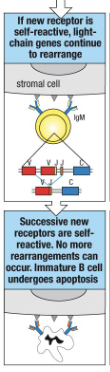
Self-reactive =
auto-reactive
Self-reactive B cells are put into ___________ (unresponsive quiet state).
Self-reactive B cells are put into anergy (unresponsive quiet state).
When a self-reactive B cell’s IgM receptor binds to self-antigens —> B cell enters anergic state.
In response to this self-antigen, the B cell lowers its Ig__ levels while keeping normal levels of IgD on its surface in a state of anergy. What is the fate of these anergic B cells?
Wha
IgM
The anergic B cell travels into the bloodstream, where it remains mostly unresponsive to antigens and has a short lifespan.
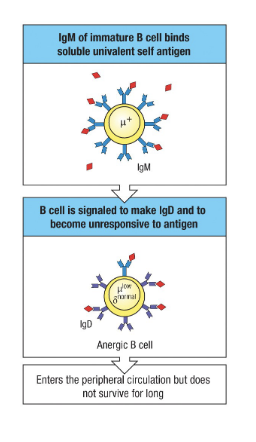
Why do anergic B cells downregulate IgM?
cuz lowering IgM receptors raises the B cells activation threshold. Making it much harder for them to bind to self antigens → harder to accidentally tirgger autoimmune attack.
Wait im confused… I thought B cells could only produce ONE antibody class. How can we display both IgD and IgM then?
well normally a B cell commits to just one heavy chain class.
but during late development statges, it displays both IgM and IgD receptors.
this is just temporary co-expression. however we’ll learn in future lectures that we CAN switch isotypes.
The transition of immature B cells —> mature B cells = _________ selection.
= positive selection

Recall that chemokines guide immature B cells into the lymph node via high endothelial venules (HEVs).
Once inside the lymph node, immature B cells must …. with each other for a limited # of spots inside the B-cell follicle.
must compete with each other!

How do these immature B cells compete for a spot in the B cell follicle of the lymph node??
Hint: survival protein called BAFF
Follicular dendritic cells inside the follicle release a survival protein called BAFF.
B cells that catch enuf BAFF with their BAFF receptors —> secure a spot —> survive to fully mature
B cells that don’t ““ —> die

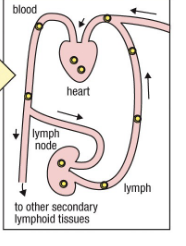
Once mature, these naive B cells constantly travel throughout the body and lymphoid organs to look for their matching antigen.
…
T/F: Majority of immature B cells die within 3-4 days, failing positive selection.
true!
What is the half-life of mature naive B cells?
hint: __ - 8 weeks
3 - 8 weeks
B cells live a very long time. Longer than…
longer than our entire lifespan!!!
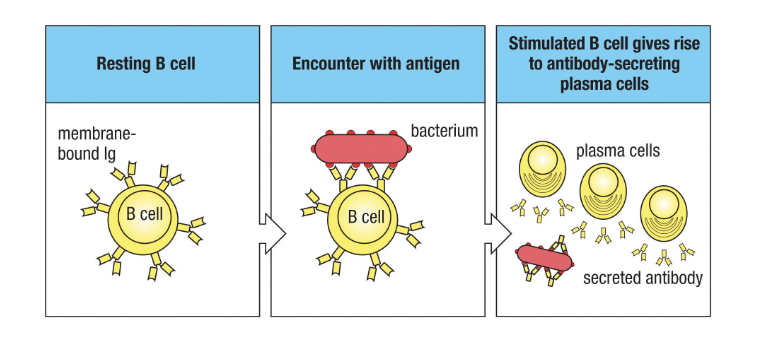
How do B cells protect us?
via antibodies!
What are the 2 types of B cells?
B1 cells
B2 cells
What are the special things about B1?
B1 cells:
reside mainly in body cavities
self-renew locally (instead of coming from bone marrow everytime)
restricted V-region repertoire (less diverse recognition)
secrete lots of IgM
don’t need help from T cells
thus they require a massive turn-on signal (like long repetitive antigens on bacteria that bind to numerous receptors or TLRs)
don’t undergo somatic hypermutation
produce barely any memory cells

B1 cells require a massive turn-on signal (like long repetitive antigens on bacteria that bind to ….)
…numerous receptors or TLRs)

What are the special things about B2?
Unlike B1, B2 cells have a diverse V-region repertoire (allows for diverse protection) and undergo somatic hypermutation
They patrol secondary lymphoid organs and are continuously replaced by new ones from the bone marrow
They are dormant until they actually encounter their antigen.
They require T cell help (from TFH cells)
Activated B2 cells generate memory B cells

T/F: B2 cells are the majority of protection against pathogens. They are the basis of vaccination.
true!