Exam 1 (Prologue, Ch 1, Ch 2, Ch 5)
 Call Kai
 Learn
Learn Practice Test
 Spaced Repetition
 Match
Match Flashcards
 Knowt Play
1/90

There's no tags or description
Looks like no tags are added yet.
Name | Mastery | Learn | Test | Matching | Spaced | Call with Kai | Chat |
|---|
No analytics yet
Send a link to your students to track their progress
91 Terms
Three main schools of psychology
Structuralism
Functionalism
Behaviorism
Wundt's school of psychology
Structuralism
James' school of psychology
Functionalism
Watson's school of psychology
Behaviorism
Structuralism
Used introspection to reveal the structure of the human mind
Functionalism
explored how mental and behavioral processes function - how they enable an organism to adapt, survive, and flourish
Behaviorism
psychology as an objective science that studies behavior without reference to mental processes
Psychology evolved from ...
Philosophy and Physiology
Basic Assumptions of Science
evolution
naturalism
materialism
relativism
determinism
reductionism
Biblical Presuppositions
we were created
we have a soul
we are sinful
we are sanctified
Contemporary Perspectives
neuroscience
evolutionary
behavior genetics/behavior
psychodynamics
cognitive
social/cultural
Who are Psychologists?
5 years avg. MA/PHD, 3 years for Marriage and Family
Psychiatrists earn MD (they are doctors)
Empirical
based on, concerned with, or verifiable by observation or experience rather than theory or pure logic
experience is the sole source of knowledge
Types of Description
naturalistic observation
case study
survey
Naturalistic Observation
observing and recording behavior in naturally occurring situations w/o trying to manipulate or control the situation
describes behavior, doesn't explain it
Case Study
examining one individual or group in depth in hope of revealing things true to all
Survey
looks @ many cases in less depth, uses random sampling
Random Sample
a sample that fairly represents all those in a group being studied because each member has an equal chance in answering
Correlation
measure of extent to which 2 factors vary together, and thus of how well either factors predict the other

Smaller shoe size --> Smaller vocabulary correlation
the smaller the shoe size, the younger you are, thus the smaller vocabulary
AGE needs to be held constant
Correlation Coefficient
a statistical index of the relationships between two things (-1.00 to 1.00)

Regression Towards the Mean
the tendency for extreme or unusual scores or events to fall back (regress) toward the avg.
Correlation & Causation
correlation does not prove causation, correlation indicates the possibility of a cause-effect relationship but does not prove such
Experimentation
a research method in which an investigator manipulates one or more factors (independent variables) to observe the effect on some behavior or mental process (dependent variable)
by random assignment of participants, the experimenter aims to control other relevant factors
Experimental Group
people exposed to the treatment (to one version of the independent variable)
Control Group
people who are not exposed to the treatment, contrasts with the experimental group and serves as a comparison for evaluation the effect of the treatment
Random Assignment
assigning participants to experimental and control groups by chance, thus minimizing preexisting differences between the different groups
Independent Variable
the factor in an experiment that is being manipulated, the variable whose effect is being studied
Dependent Variable
the outcome in an experiment that is being measured, the
variable that may change when the independent variable is manipulated
Still face mother and baby experiment (IV and DV)
IV- mom's expression
DV- baby's reaction
Confounding Variable
in an experiment, a factor other than the independent variable that might produce an effect
Theory
an explanation using an integrated set of principles that organizes observations and predicts behaviors or events
Hypotheses
a testable prediction, often implied by a theory
Operational Definitions
carefully worded statement of the exact procedures (operations) used in a research study
Replication
repeating the essence of a research study, usually with different participants in different situations, to see whether the basic finding extends to other participants and circumstances
Nervous System
body's electrochemical communication network
consists of all the nerve cells of the peripheral and central nervous system
Functional divisions of the nervous system

Central Nervous System (CNS)
the brain and the spinal cord
(nerves encased in bone)

Peripheral Nervous System (PNS)
the sensory and motor neurons that connect the central nervous system (CNS) to the rest of the body
Nerves
bundled axons that form neural cables connecting the central nervous system with muscles, glands, and sense organs
Sensory (Afferent) Neurons
neurons that carry incoming info from the sensory receptors to the brain and spinal cord (to the CNS)

Motor (Efferent) Neurons
neurons that carry outgoing information from the brain and spinal cord (from the CNS) to the muscles and glands

Interneurons
neurons within CNS
communicate internally and process information between the sensory inputs and motor outputs
Somatic Nervous System
the division of the peripheral nervous system that controls the body's skeletal muscles (aka skeletal nervous system)
Autonomic Nervous System
the part of the peripheral nervous system that controls the glands and the muscles of the internal organs (such as heart)
its sympathetic division arouses
its parasympathetic division calms
Simple Reflex
an afferent neuron carries the message that a sensory receoptor has been stimulated to an interneuron in the spinal cord. The interneuron responds by activating motor neurons that will enable the appropriate response.
Parts of a Neuron
cell body
dendrite
axon
myelin sheath
Dendrite
the bushy, branching extensions of a neuron that receive messages and conduct impulses toward the cell body
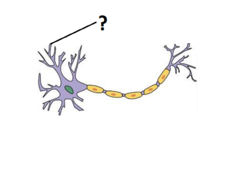
Axon
the route the message travels

Myelin Sheath
a layer of fatty cells that covers many axons and helps speed neural impulses

All-or-nothing Response
neurons are like guns, they either fire or they don't
Nerve cells never physically touch!
Inhibitory vs. Excitatory
Inhibitory - tells the next cell NOT to fire Excitatory - tells the next cell TO fire
Cell Body
the cells's life support center
functions as the "adding machine"; adds up + and - until the threshhold is reached

Synaptic Gap
aka synaptic cleft
where the axon terminal of one neuron is separated from the receiving neuron (gap is less than a millionth of an inch wide
river analogy; the +/- charged ions in the river; etc

Neurotransmitters
chemical messengers that cross the synaptic gaps between neurons
when released by the sending neuron, neurotransmitters travel across the snaps and bind to receptor sites on the receiving neuron, thereby influencing where that neuron will generate a neural impulse

Types of Neurotransmitters
Acetylcholine (ACh)
Dopamine
Serotonin
Norepinephrine
GABA (gamma-aminobutyric acid)
Glutamate
Acetylcholine (ACh)
enables the muscle action, learning, and memory
causes the contraction of muscle fibers whenstimulated by motor neurons. It is found at the junction between motor neurons and muscle fibers
Alzheimer's disease- ACh producing neurons deteriorate
Dopamine
influences movement, learning, attention, and emotion
too little >> may lead to Parkinson's Disease
too much >> may lead to Schizophrenia
Serotonin
affects mood, hunger, sleep, and arousal
not enough >> depression
drugs that raise serotonin levels are used to treat depression
Norepinephrine
helps control alertness and arousal
not enough >> can depress mood
GABA (gamma-aminobutyric acid)
a major inhibitory neurotransmitter
not enough GABA >> seizures, tremors, insomnia
used to control epeleptic seizure; tranquilizers use GABA
Glutamate
a major excitatory neurotransmitter, involved in memory
too much >> overstimulate the brain, producing migraines or seizures
Neuromodulators
make "keys" work better.
Endorphins
"morphine within"
natural, opiate-like neurotransmitters linked to pain control and to pleasure
Reuptake
a neurotransmitter's reabsorption by the sending neuron
keys get sucked back up by the vacuum into the garage
How cocaine affects the nervous system
cocaine increases levels of the natural chemical messenger dopamine in brain circuits controlling pleasure and movement
cocaine prevents dopamine from recycling, causing excessive amounts to build up between nerve cells. (blocks reuptake system) This flood of dopamine ultimately disrupts normal brain communication and causes cocaine's high
Split Brain
cutting the corpus callosum (wide band of axon fibers connecting 2 hemispheres and carrying messages between them)
personality and intellect hardly affected
cut to control seizures

Agonists
molecule that increases a neurotransmitter's action
may increase the production or release of neurotransmitters or block reuptake in the synapse or they are similar enough to neurotransmitter to bind to the receptor and mimic the effects
Antagonists
molecule that inhibits or blocks a neurotransmitter's action (blocking production or release)
antagonist molecules are enough like the natural neurotransmitter to occupy its receptor site and block its effect, but not similar enough to activate the receptor
Nature-Nurture Issue
longstanding controversy over the relative contributions that genes and experience make to the development of psychological traits and behaviors
today's science sees traits and behaviors arising from the interaction of nature and nurture
genetic vs. experience
nature: genetic
nurture: prenatal chemical, postnatal chemical, general experimental, individual experimental, traumatic factors
Prenatal Stages of Development
zygote
embryo
fetus
Zygote
0-2 weeks
the fertilized egg, 2 week cycle of rapid cell division and develops into an embryo
Embryo
2-9 weeks
the developing human organism from 2 weeks through the second month
Fetus
9 weeks - birth
the developing human organism from 9 weeks to birth
Teratogens
"monster maker"
agents, such as chemicals and viruses, that can cross the placental barrier and reach the embryo or fetus during prenatal development and cause harm
ex. X-rays, drugs & alcohol, measles
Rooting Reflex
tendency for a newborn to open mouth and search for nipple when touched on cheek
Newborn Preferences
newborns will stare longer @ things that confuse them
will prefer mother over strangers (breast feeding and comfort)
Newborn Reflexes
sucking, tonguing, swallowing, and breathing
Newborn Social Development
social interchanges- interactions with reciprocal influences (parents mimicking baby sounds, basic beginning of conversation)
physical contact & deprivation- lack of physical touch can lead to the lack of social devolopment
Harlow's Studies
monkey baby, wire mother with food, and terry cloth mother
baby will go to wire mother for food, but will hang on to try cloth mother after
when scared monkey baby will run to terry cloth mother
Jean Paiget
1896-1980
studied how knowledge is acquired, focused on children's errors in cognition
developed 4 major stages of cognitive development: sensorimotor, pre-operational, concrete operational, and formal operational
Sensorimotor Stage
birth-2 years
infants know the world mostly in terms of their sensory impressions and motor activities
young infants lack object permanence: awareness that things continue to exist even when not perceived
Preoperational Stage
2-6/7 years
learns to use language but does not yet comprehend the mental operations of logic
lack the concept of conservation: principle that properties stay the same despite changes in the forms of it (same water amts. in diff cups)
children are egocentric: difficulty taking another's point of view
start to form theory of mind: ideas about their own and other's feelings, perceptions, and thoughts, and behaviors these might predict
Concrete Operational Stage
7-11 years
children gain the mental operations that enable them to think logically about concrete events
Formal Operational Stage
12 years-adulthood
begin to think logically about abstract concepts
Cognition
all mental activities associated with thinking, knowing, remembering, and communicating
Schemas
cognitive structures, concept or framework that organizes and interprets information
ways of looking at the world that organize our past experiences and provide a framework for understanding our future experiences
Assimilation
interpreting our new experiences in terms of our existing schemas
Accommodation
adapting our current understandings (schemas) to incorporate new information and the particulars of new experiences
Kohlberg's Stages of Moral Development
preconventional: self interest, obey rules to avoid punishment or gain concrete rewards
conventional: uphold laws and rules to gain social approval or maintain social order
postconventional: actions reflect belief in basic rights and self defined ethical principles

Erikson's Stages of Psychosocial Development
infancy
toddlerhood
preschool
elementary school
adolescence
young adulthood
middle adulthood
late adulthood
