Reactions of Organic Chemistry
 Call Kai
 Learn
 Practice Test
 Spaced Repetition
 Match
 Flashcards
 Knowt Play
1/25

There's no tags or description
Looks like no tags are added yet.
26 Terms
What are the 8 common chemical reactions in organic chemistry?
COMBUSTION
ADDITION
SUBSTITUTION
ELIMINATION
OXIDATION
REDUCTION
CONDENSATION
HYDROLYSIS
What are Combustion reactions?
All hydrocarbons burn in air to produce large amounts of LIGHT and HEAT
In the presence of excess oxygen, the hydrocarbon will undergo a COMPLETE COMBUSTION
The products of a complete combustion are CARBON DIOXIDE and WATER

What are Addition reactions?
A reaction in which the atoms from one molecule are added to another molecule to form a single molecule
Common for ALKENES and ALKYNES
Atoms are ADDED to a double or triple bond
One bond of the multiple bond breaks so that TWO new bonds form
TWO compounds react to form ONE major product

What are Substitution reactions?
A reaction where a HYDROGEN atom or a FUNCTIONAL GROUP is replaced by a different functional group
TWO compounds react to form two DIFFERENT products

What are Elimination reactions?
A reaction where atoms are removed from a molecule to form a DOUBLE bond
This reactions is the REVERSE of the addition reaction
ONE reactant usually breaks up to give TWO products

What are Oxidation Reactions?
A reaction where a CARBON atom forms MORE bonds to OXYGEN or LESS bonds to HYDROGEN
Involves the formation of double C=O bonds
Occurs when an organic compound reacts with an OXIDIZING AGENT [O]

What are Reduction reactions?
A reaction where a CARBON atom forms FEWER bonds to OXYGEN or MORE bonds to HYDROGEN
A C=O bond or a C=C bond is reduced to a SINGLE bond
Reduction occurs when the organic compound reacts with a REDUCING AGENT [H]

What are Condensation reactions?
A reaction where two organic molecules combine to form a SINGLE organic molecule
Water is usually produced during the reaction

What are Hydrolysis reactions?
A reaction where water is added to a bond to split and organic molecule in TWO
This reaction is the REVERSE of a condensation reaction

What types of reactions do Alkenes and Alkynes undergo?
HYDROGENATION: the addition of hydrogen atoms
HALOGENATION: the addition of a halide (Cl, Br, F)
HYDRATION: the addition of water

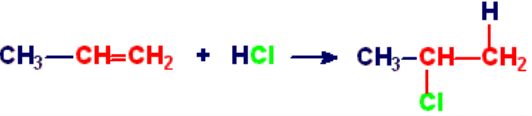
What is Markovnikov’s Rule?
“When a HYDROGEN, HALIDE or WATER molecule reacts with an alkene, the hydrogen atom will generally bond to the carbon atom in the multiple bond that has the MOST hydrogen atoms already bonded to it.”
What types of Reactions do Aromatic Compounds undergo?
Undergo SUBSTITUTION reactions
A hydrogen atom or a functional group that is attached to the benzene ring may be replaced by a DIFFERENT functional group

What types of reactions do Alcohols undergo?
Substitution
Elimination
Oxidation
What is the Substitution reaction of Alcohols?
When a halogen acid (HCl, or HBr) reacts with an alcohol the halogen atom is substituted for the OH group of the alcohol

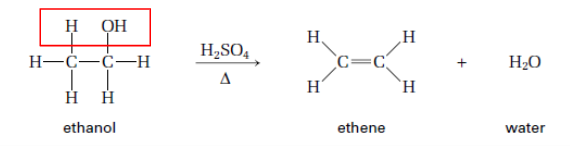
What is the Elimination reaction of Alcohols?
When an alcohol is heated in the presence of a strong acid, the OH group and one H atom leave the compound.
Water is produced. Also called a DEHYDRATION reaction.
What is the Oxidation reaction of Alcohols?
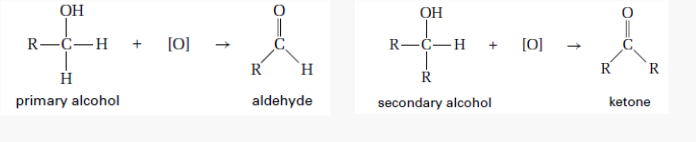
In the presence of an oxidizing agent, the alcohol is oxidized to form an aldehyde or a ketone.
A primary alcohol with form an aldehyde and a secondary alcohol will form a ketone.
Tertiary alcohols cannot be oxidized.
What types of reactions do Aldehydes undergo?
Oxidation
Reduction
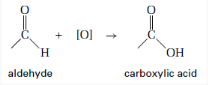
What is the Oxidation reaction of Aldehydes?
When an aldehyde is in the presence
of an oxidizing agent, it is oxidized to form a carboxylic acid
The hydrogen atom bound to the C=O is replaced by an OH group
What is the Reduction reaction of Aldehydes?
When an aldehyde is in the presence of a reducing agent, it is reduced to a primary alcohol

What types of reactions do Ketones undergo?
Reduction
What is the Reduction reaction of Ketones?
When a ketone is in the presence of a reducing agent, it is reduced to a secondary alcohol

What types of reactions do Carboxylic Acids undergo?
Neutralization
Esterification
What is the Neutralization reaction of Carboxylic Acids?
carboxylic acids react with BASES to produce a SALT and WATER

What is the Esterification reaction of Carboxylic Acids?
a CONDENSATION reaction where a carboxylic acid reacts with an alcohol to form an ESTER

What types of reactions do Esters undergo?
When an ester is treated with an acid or a base the ester splits into a carboxylic acid and an alcohol
This is the reverse of an esterification
This reaction is called HYDROLYSIS
These reactions usually involve heat

What types of reactions do Amides undergo?
The HYDROLYSIS of an amide produces a carboxylic acid and an amine
