infant and child development exam 2
 Call Kai
 Learn
Learn Practice Test
 Spaced Repetition
 Match
Match Flashcards
 Knowt Play
1/148

There's no tags or description
Looks like no tags are added yet.
Name | Mastery | Learn | Test | Matching | Spaced | Call with Kai | Chat |
|---|
No analytics yet
Send a link to your students to track their progress
149 Terms
Paleolithic (Old Stone Age) Art
ca. 40,000-9,000 BCE
What subjects dominated Paleolithic art?
Women were far more common subjects than men, but animals, not humans, dominated
Paleolithic art ranges from...
tiny portable figurines and sometimes over-life-size, carved and painted representations of animals.
Paleolithic artists regularly depicted animals in...
profile in order to present a complete picture of each beast, including its head, body, tail, and all four legs. This format
persisted for millennia.
Neolithic (New Stone Age) Art
ca. 8000-2300 BCE
The Neolithic Age revolutionized human life with the beginning of agriculture and the...
formation of the first settled communities. (extensive town with numerous shrines, fortified stone circuit walls)
In Neolithic painting, coherent narratives became common, and artists began to represent...
human figures as composites of frontal and profile views - another formula that would remain universal for a very long time.
Human with feline (lion?) head, from Hohlenstein-Stndel, Germany, ca. 40,000-35,000 BCE; Woolly mammoth ivory, 11¾" high
One of the world's oldest preserved sculptures

Nude woman (Venus of Willendorf), from Willendorf, Austria, ca. 28,000-25,000 BCE. Limestone, approx. 4 1/4" high. Naturhistorisches Museum, Vienna.

Two bison, reliefs in the cave at Le Tue d'Audoubert, France, ca. 15,000-10,000 BCE. Clay, right bison 2'7/8" long.
The sculptor built using a stone spatula-like smoothing tool and fingers to shape the details.

Bison licking its flank, fragmentary spear-thrower, from La Madeleine, France, ca. 12,000 BCE. Reindeer horn, 4 1/8" long
This fragment of a spear-thrower was carved from a reindeer antler. The sculptor turned the bison's head a full 180 degrees to maintain the profile view and incised the details with a stone burin.

Bison, detail of a painted ceiling in the Altamira cave, Santander, Spain, ca. 12,000-11,000 BCE. Each bison approx. 5' 2 ½" long.
Paleolithic painters used stone lamps to provide light in the dark caves. They made brushes from reeds and twigs or used reed or bone blowpipes to spray ground ocher pigments onto out-of-reach surfaces.

Spotted horses and negative hand imprints, wall painting in the cave at Pech-Merle, France, ca. 23,000- 22,000 BCE, 11'2" long.

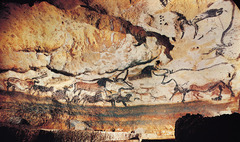
Left wall of the Hall of the Bulls in the cave at Lascaux, France, ca.16,000-14,000 BCE. Largest bull 11' 6" long.
inconsistent in size and move in different directions; colored silhouettes and outline drawings; probably painted at different times by different painters; Prehistoric painters consistently represented animals in strict profile, the only view showing the head, body, tail, and all four legs; both horns are included to give a complete picture of the bull
Rhinoceros, wounded man, and disemboweled bison, painting in the well of the cave at Lascaux, France, ca. 16,000-14,000 BCE. Bison 3'4½" long; paintings of two animals and a bird-faced (masked?) man deep in a Lascaux well shaft depict a hunting scene
constitute the earliest example of narrative art ever discovered

Great stone tower built into the settlement wall, Jericho, ca. 8000- 7000 BCE.

Human skull with restored features, from Jericho, ca. 7200- 6700 BCE. Features modeled in plaster, painted, and inlaid with seashells. Lifesize.
The Neolithic farmers of Jericho removed the skulls of their dead before burial, modeled them with plaster, and inlaid the eyes to create lifelike "portraits" of their ancestors, whom they may have worshiped.

Human figure, from Ain Ghazal, Jordan, ca. 6750- 6250 BCE. Plaster, painted and inlaid with bitumen, 3' 5 3/8" high. Musée du Louvre, Paris.
plaster statuettes (some with two heads and with details added in paint or inlaid with bitumen) found at Ain Ghazal are the earliest large-scale sculptures known

Deer hunt, detail of a wall painting from Level III, Çatal Höyük, Turkey, ca. 5750 BCE. Museum of Anatolian Civilization, Ankara.

megaliths
massive rough-hewn stones

dolmens
stones set vertically with covering slab

menhirs
single stones raised vertically

cromlech
stones arranged vertically in a circle

Corbeled dome of the main chamber in the passage grave, Newgrange, Ireland, ca. 3200-2500 BCE.
Newgrange passage grave is an early example of corbeled vaulting,. The huge stones (megaliths) of the dome of the main burial chamber beneath the tumulus are held in place by their own weight

Newgrange passage grave is an early example of corbeled vaulting,. The huge stones (megaliths) of the dome of the main burial chamber beneath the tumulus are held in place by their own weight
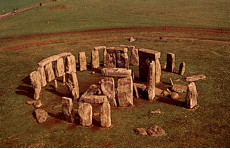
Stonehenge's circles of trilithons probably functioned as an astronomical observatory and solar calendar. The sun rises over its "heel stone" at the summer solstice. Some of the megaliths weigh 50 tons.
MESOPOTAMIA AND PERSIA Sumerian Art - ca. 3500-2332 BCE
Sumerians founded the world's first city-states in the valley between the Tigris and Euphrates Rivers and Invented writing in the fourth millennium BCE; first to build communal religious shrines on towering platforms
MESOPOTAMIA AND PERSIA Akkadlan Art - ca. 2332-2150 BCE
Akkadians were the first Mesopotamian rulers to call themselves kings of the world and to assume divine attributes; may have been the first to cast hollow life-size metal sculptures and to place figures at different levels in a landscape setting
MESOPOTAMIA AND PERSIA Neo-Sumerian and Babylonian Art - ca. 2150-1600 BCE
Sumerians rose again to power and constructed one of Mesopotamia's largest tiered temple platforms; Gudea of Lagash (r. ca. 2100 BCE) built numerous temples and placed portraits of himself in them as votive offerings to the gods; Babylon's greatest king, Hammurabi (r. 1792-1750 BCE), formulated wideranging laws for the empire he ruled; among the first to experiment with foreshortening
MESOPOTAMIA AND PERSIA Assyrian and Neo-Babylonlan Art - ca. 900-539 BCE
palaces were fortified citadels with gates guarded by monstrous lamassu; Paintings and reliefs depicting official ceremonies and the king battling enemies and hunting lions decorated the walls of the ceremonial halls; The Ishtar Gate, with its colorful glazed brick reliefs, gives an idea of Babylon's magnificence under Nebuchadnezzar II (r. 605-562 BCE)
MESOPOTAMIA AND PERSIA Achaemenid and Sassanian Art - ca. 559-330 BCE and 224-636 CE
DariusI (r. 522-486 BCE) and Xerxes (r. 486-465 BCE) built a huge palace complex with an audience hall that could accommodate 10,000 guests; Painted reliefs of subject nations bringing tribute adorned the terraces
Cuneiform tablet: administrative account of barley distribution with cylinder seal impression of a male figure, hunting dogs, and boars; clay; 2.17 x 2.36 x 1.63 in. (5.5 x 6 x 4.15 cm); ca. 3100-2900 BCE

Cuneiform tablet with numbers of goats and sheep; clay; ca. 2350 BCE; Sumerian, from Lagash-Telloh; Paris, Louvre

Banquet scene, cylinder seal (right) and its modern impression (left), from the tomb of Pu-abi (tomb 800), Royal Cemetery, Ur (modern Tell Muqayyar), Iraq, ca. 2600-2400 BCE. Lapis lazuli, 1 7/8" high, 1" diameter

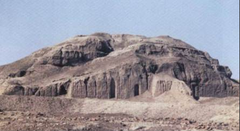
White Temple and ziggurat, Uruk (modern Warka), Iraq, ca. 3200-3000 BCE.
Using only mud bricks, the Sumerians erected towering temple platforms several centuries before the Egyptians built stone pyramids.
Female head (Inanna?), from Inanna temple complex, Uruk (modern Warka), Iraq, ca. 3200-3000 BCE. Marble, 8" high
Sumerians imported the marble for this head at great cost. It may represent the goddess Inanna and originally had inlaid colored shell or stone eyes and brows, and a wig, probably of gold leaf

Presentation of offerings to Inanna (Warka Vase), from the Inanna temple complex, Uruk (modern Warka), Iraq, ca. 3200-3000 BCE. Alabaster, 3' 1/4" high
first great work of narrative relief sculpture known

War side of the Standard of Ur, from tomb 779, Royal Cemetery, Ur (modern Tell Muqayyar), Iraq, ca. 2600- 2400 BCE. Wood, lapis lazuli, shell, and red limestone, 8"x 1'7"
mosaic-like technique, this Sumerian artist depicted a battlefield victory in three registers; narrative reads from bottom to top, and the size of the figures varies with their importance in society;

Peace side of the Standard of Ur, from tomb 779, Royal Cemetery, Ur (modern Tell Muqayyar), Iraq, ca. 2600-2400 BCE. Wood, lapis lazuli, shell, and red limestone, 8"x1'7"
entertainers at this banquet of Sumerian nobility include a musician playing a bull-headed harp of a type found in royal graves at Ur. The long haired, bare-chested singer is a court eunuch

Bull -headed harp with inlaid sound box, from the tomb of Pu -abi (tomb 800), Royal Cemetery, Ur (modern Tell Muqayyar), Iraq, ca. 2600 -2400 BCE. Wood, gold, lapis lazuli, red limestone, and shell, 3' 8 1/8" high
bearded bull's head fashioned of gold leaf and lapis lazuli over a wood core adorns this harp from the tomb of Pu - abi, perhaps the queen of Ur. The inlaid sound box features four narrative scenes

Sound box of the bull -headed harp from tomb 789 ("King's Grave"), Royal Cemetery, Ur (modern Tell Muqayyar), Iraq, ca. 2600 -2400 BCE. Wood, lapis lazuli, and shell, 1' 7" high
four inlaid panels on the sound box of the harp found in the King's Grave at Ur represent a Gilgamesh -like hero between man -bulls, and animals acting out scenes of uncertain significance

Head of an Akkadian ruler, from Nineveh (modern Kuyunjik), Iraq, ca. 2250 -2200 BCE. Copper, 1' 2 3/8" high
sculptor of this oldest extant life -size hollow -cast head captured the distinctive features of the ruler while also displaying a keen sense of abstract pattern

Victory stele of Naram-Sin, set up at Sippar, Iraq, found at Susa, Iran, 2254-2218 BCE. Pink sandstone, 6' 7" high
To commemorate his conquest of the Lullubi, Naram Sin set up this stele showing him leading his army up a mountain. The sculptor staggered the figures, abandoning the traditional register format.

Ziggurat, Ur (modern Tell Muqayyar), Iraq, ca. 2100 BCE. 190' x 130' (base 50' high)
has three (restored) ramp like stairways of a hundred steps each that originally ended at a gateway to a brick temple, which does not survive

Gudea seated, holding the plan of a temple, from Girsu (modern Telloh), Iraq, ca. 2100 DCE. Diorite, 2'5" high
Gudea built or rebuilt many temples and placed statues of himself in them; inscription on this seated portrait states that Gudea has on his lap a plan of the new temple he erected to Ningirsu

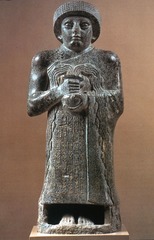
Gudea standing, holding an overflowing water jar, from the Temple of Geshtinanna, Girsu (modern Telloh), Iraq, ca. 2100 BCE. Calcite, 2' 3/8" high
overflowing water jar Gudea holds symbolizes the prosperity he brings to the people of Lagash; Mesopotamian art, normally only gods and goddesses are the sources of lifegiving water
Stele with laws of Hammurabi, set up at Babylon, Iraq, found at Susa, Iran, ca. 1780 BCE. Basalt, 7' 4" high
crowning the stele recording Hammurabi's laws is a representation of the flame-shouldered sun god Shamash extending to the Babylonian king the symbols of his authority to govern and judge

Lamassu (man-headed winged bull), from the citadel of Sargon II, Dur Sharrukin (modern Khorsabad), Iraq, ca. 721-705 BCE. Limestone, 13' 10" high
ancient sculptors insisted on complete views of animals; this four-legged composite monster that guarded an Assyrian palace has five legs- two when seen from the front and four in profile view

Assyrian archers pursuing enemies, relief from the northwest palace of Ashurnasirpal II, Kalhu (modern Nimrud), Iraq, ca. 875-860 BCE. Gypsum, 2' 10 5/8" high
extensive reliefs exalting the king and recounting his great deeds have been found in several Assyrian palaces; one depicts Ashurnasirpal II's archers driving the enemy into the Euphrates River

Ashurbanipal hunting lions, relief from the north palace of Ashurbanipal, Nineveh (modern Kuyunjik), Iraq, ca. 645-640 BCE. Gypsum, 5' 4" high
ceremonial and battle scenes, the hunt was a common subject of Assyrian palace reliefs; Assyrians viewed hunting and killing lions as manly royal virtues on a par with victory in warfare

Ishtar Gate (restored), Babylon, Iraq, ca. 575 BCE

Persepolis (looking west with the apadana in the background), Iran, ca. 521-465 BCE
heavily fortified complex of Persian royal buildings on a high plateau at Persepolis included a royal audience hall, or apadana, with 36 colossal columns topped by animal protomes

three columns with animal protomes, from the apadana of the palace, Persepolis, Iran, ca. 521-465 BCE
64-foot coLumns of the Persepolis apadana drew on Mesopotamian, Greek, and Egyptian models but are unique in form; back-to-back protomes of the capitals supported gigantic cedar beams

Persians and Medes, detail of the processional frieze on the east side of the terrace of the apadana of the palace, Persepolis, Iran, ca. 521-465 BCE, limestone, 8' 4" high
reliefs decorating the walls of the terrace and staircases leading up to the Persepolis apadana included depictions of representatives of 23 nations bringing tribute to the Persian king

ANCIENT EGYPT Predynastic and Early Dynastic Periods - ca. 3500-2575 BCE
earliest labeled work of narrative art, the palette of King Narmer, probably commemorates the event; predynastic works palette established the basic principles of most Egyptian representational art for 3,000 years
Imhotep ANCIENT EGYPT
the first artist in history whose name is known, was the earliest master of monumental stone architecture. He designed the funerary complex and stepped pyramid of King Djoser (r. 2630 - 2611 BCE) at Saqqara
ANCIENT EGYPT Old Kingdom - ca. 2575-2134 BCE
first golden age of Egyptian art and architecture, the time when three kings of the Fourth Dynasty erected the pyramids at Gizeh, the oldest of the Seven Wonders of the ancient world; pyramids were emblems of the sun on whose rays the god-kings ascended to the heavens when they died; sculptors created seated and standing statuary types; all movement was suppressed in order to express the eternal nature of divine kingship; dominate Egyptian art for 2,000 years
ANCIENT EGYPT Middle Kingdom - ca. 2040-1640 BCE
major artistic innovation of this period was a new kind of royal portrait with heightened emotional content; rock-cut tombs in which sculptors hewed both the facade and interior chambers out of the living rock replaced the mastabas as the standard Egyptian burial monument
ANCIENT EGYPT New Kingdom - ca. 1550-1070 BCE
most significant architectural innovation of this period was the axially planned pylon temple incorporating an immense gateway, columnar courtyards, and a hypostyle hall with clerestory lighting; pharaohs erected gigantic temples in honor of their patron gods and, after their deaths, for their own worship;
EGYPT FROM NARMER TO CLEOPATRA First Millennium - BCE 1000-30 BCE
traditional forms of Egyptian art and architecture lived on even under foreign rule - for example, in the portrayal of the pharaoh as a sphinx
Palette of King Narmer (left, back; right, front), from Hierakonpolis, Egypt, Predynastic, ca. 3000-2920 BCE. Slate, 2' 1" high
earliest surviving labeled work of historical art; back, the king, the largest figure in the composition, wears the crown of Upper Egypt and slays a captured enemy as his attendant looks on; front, Narmer, now wearing the crown of Lower Egypt, reviews beheaded enemy bodies. At the center of the palette, the intertwined animal necks may symbolize the unification of the two kingdoms

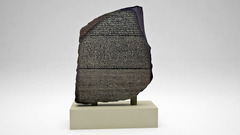
Rosetta stone, dated 196 BC (originally 6' high) Discovered 1799
Same text (copy of a decree) written in Greek, Demotic (late Egyptian) and formal hieroglyphic
Stele of Irtysen, limestone, cm 117 x 56, ca. 2033-1982 BCE. Paris, Louvre, C 14

Judgment of Hu-Nefer, detail of an illustrated Book of the Dead, from the tomb of Hunefer, Thebes, Egypt, 19th Dynasty, ca. 1290-1275 BCE; painted papyrus scroll, 1' 3 ½" high; full scroll 18' ½" long. British Museum, London; scene reads from left to right
Hunefer's heart, represented as a pot, is being weighed against a feather, the symbol of Maat, the established order of things, in this context meaning 'what is right'. If the heart did not balance with the feather, then the dead person was condemned to non-existence, and consumption by the ferocious "devourer," the strange beast shown here which is part-crocodile, part-lion, and part-hippopotamus; Hunefer's is shown to the right, brought into the presence of Osiris by his son Horus, having become "true of voice" or "justified

Imhotep, stepped pyramid and mortuary precinct of Djoser, Saqqara, Egypt, Third Dynasty, ca. 2630-2611 BCE (approx. 200' high; base 413' x 344').
Imhotep, the first artist whose name is recorded, built the first pyramid during the Third Dynasty for King Djoser; god-king's pyramid resembles a series of stacked mastabas of diminishing size

the Fourth Dynasty pyramids (looking north), Gizeh, Egypt. From bottom: Pyramids of Menkaure, ca. 2490 -2472 BCE; Khafre, ca. 2520 -2494 BCE; and Khufu, ca. 2551 -2528 BCE
three pyramids of Gizeh took the shape of the ben -ben, the emblem of the sun god, Re. The sun's rays were the ramp the Egyptian kings used to ascend to the heavens after their death and rebirth

Great Pyramids, Gizeh, Egypt, Dynasty IV. From left: Pyramids of Menkaure, ca. 2490-2472 BCE; Khafre, ca. 2520-2494 BCE; and Khufu, ca. 2551-2528 BCE

Great Sphinx (with Pyramid of Khafre in the background at left), Gizeh, Egypt, Fourth Dynasty, ca. 2520-2494 BCE. Sandstone, 65' x 240'

canon of proportions
a set of ideal mathematical ratios in art based on measurements of the human body

Khafre, from Gizeh, Egypt, Dynasty IV, ca. 2520-2494 BCE. Diorite (or anorthosite gneiss), approx. 5' 6" high
portrait from his pyramid complex depicts Khafre as an enthroned divine ruler with a perfect body; formality of the pose creates an aura of eternal stillness, appropriate for the timeless afterlife

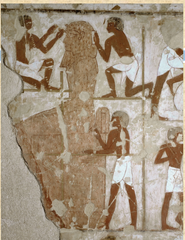
Sculptors at work, detail of the south wall of the main hall of the funerary chapel of Rekhmire, Thebes, Egypt, 18th Dynasty, ca. 1425 BCE
Menkaure and Khamerernebty(?), from Gizeh, Egypt, Fourth Dynasty, ca. 2490-2472 BCE. Graywacke, 4' 6 1/2" high
displays the conventional postures used for Old Kingdom royal statues; the formalized embrace denotes the close association of the two figures

Pair statue of Ptahkhenuwy and his wife Old Kingdom, Dynasty 5, 2465-2323 B.C. Height 2 feet 35/8 inches (70.1 cm)

Seated scribe, from Saqqara, Egypt, Fourth Dynasty, ca. 2500 BCE. Painted limestone, 1' 9" high
idealism that characterizes the portraiture of the Egyptian god -kings did not extend to the portrayal of non elite individuals; sculptor portrayed this seated scribe with clear signs of aging

Fragmentary head of Senusret III, 12th Dynasty, ca. 1860 BCE. Red quartzite, 6 1/2" high
face of Senwosret III is one of the most individual and recognizable in all of Egyptian art; deep -set, heavy -lidded eyes, the thin lips, and the series of diagonal furrows marking the rather hollow cheeks give representations of this king a brooding expression not usually found on the faces of Egyptian kings, who are generally portrayed with a more youthful countenance; expression here is somewhat softened, suggesting the face of a living, aging man

Mortuary temple of Hatshepsut, Deir el-Bahri, Egypt, 18th Dynasty, ca. 1473-1458 BCE

temple of Amen-Re (looking north), Karnak, Egypt, major construction, 15th-13th centuries BCE.
vast Karnak temple complex contains a pylon temple with a bilaterally symmetrical axial plan and an artificial lake associated with the primeval waters of the Egyptian creation myth

Columns and clerestory of the hypostyle hall of the temple of Amen -Re, Karnak, Egypt, 19th Dynasty, ca. 1290 -1224 BCE
columns crowd the hypostyle hall of the Amen -Re temple; tallest are 66 feet high and have capitals that are 22 feet in diameter; columns support a roof of stone slabs carried on lintels

Model of the hypostyle hall, temple of Amen-Re, Karnak, Egypt, 19th Dynasty, ca. 1290-1224 BCE
two central rows of columns of Karnak's hypostyle hall are taller that the rest; raising the roof's central section created a clerestory that admitted light through windows with stone grilles

Akhenaton, colossal statue from the temple of Aton, Karnak, Egypt, 18th Dynasty, ca. 1353-1335 BCE. Sandstone, 13' high
akhenaton initiated both religious and artistic revolutions; this androgynous figure is a deliberate reaction against tradition; attempt to portray the pharaoh as Aton, the sexless sun disk

THUTMOSE, Nefertiti, from Tell el-Amarna, Egypt, Dynasty XVIII, ca. 1353-1335 BCE. Painted limestone, approx. 1' 8" high
found in the sculptor's workshop, Thutmose's bust of Nefertiti portrays Akhenaton's influential wife as an elegant beauty with a thoughtful expression and a long, delicately curved neck

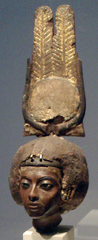
Portrait of Tiye, from Ghurab, Egypt, 18th Dynasty, ca. 1353 - 1335 BCE. Yew wood, gold, silver, alabaster, faience, and lapis lazuli, 8 7/8" high
portrait of Akhenaton's mother is carved of dark yew wood, possibly to match the queen's complexion; during her son's reign, the tall gold crown with the sun disk and cow horns was added
Akhenaton, Nefertiti, and three daughters, from Amarna, Egypt, 18th Dynasty, ca. 1353-1335 BCE. Limestone, 1' 1/4" high.
this sunken relief, the Amarna artist provided a rare intimate look a the royal family in a domestic setting; Akhenaton, Nefertiti, and three of their daughters bask in the life-giving rays of Aton, the sun disk

Innermost coffin of Tutankhamen, from his tomb at Thebes, Egypt, 18th Dynasty, ca. 1323 BCE. Gold with inlay of enamel and semiprecious stones, 6' 1" long
treasures in Tutankhamen's tomb include this mummy mask portraying the teenaged pharaoh with idealized features and wearing the traditional false beard and uraeus cobra headdress

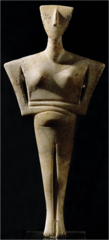
Figurine of a woman, from Syros (Cyclades), Greece, ca. 2500 -2300 BCE. Marble, 1' 6" high
sculptor rendered the female body schematically as a series of triangles; most Cycladic statuettes depict nude women
Male lyre player, from Keros (Cyclades), Greece, ca. 2600 -2300 BCE. Marble, 9" high
seated musician may be playing for the deceased in the afterlife; statuette displays simple geometric shapes and flat planes

Palace of Knossos, Crete, ca. 1700-1370 B.C.E.
first instance of a highly developed, urban culture in the Western hemisphere; sprawling structure with throne rooms, reception halls, drainage system, and extensive storage facilities for wine, grain, oil, honey, etc.; use of columns with bulbous capitals n Numerous true fresco paintings decorated the palace

Bull-leaping, from the palace at Knossos (Crete), Greece, ca. 1500 BCE. Fresco, 2' 8" high, including border
ceremonial scenes, such as this one of bull leaping; women have fair skin and the man has dark skin, a common convention in ancient painting

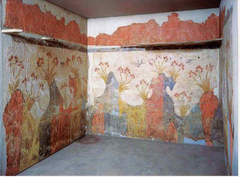
Landscape with swallows (Spring Fresco), from Room Delta 2, Akrotiri, Thera (Cyclades), Greece, ca. 1650-1625 BCE. Fresco, 7' 6" high
Aegean muralists painted in wet fresco, which required rapid execution; in this wraparound landscape, the painter used vivid colors and undulating lines to capture the essence of nature
Harvester Vase, from Hagia Triada (Crete), Greece, ca. 1500 BCE. Steatite, originally with gold leaf, greatest diameter 5".
relief sculptor of the singing harvesters on this small stone vase was one of the first artists in history to represent the underlying muscular and skeletal structure of the human body

Marine Style octopus jar, from Palaikastro (Crete), Greece, ca. 1500 BCE. Approx. 11" high
Marine Style vases have dark figures on a light ground; on this octopus flask, the tentacles of the sea creature reach out over the curving surface of the vessel to fill the shape perfectly

the citadel (looking east) at Tiryns, Greece, ca. 1400-1200 BCE.
in the Iliad, Homer called the fortified citadel of Tiryns the city "of the great walls."; its huge, roughly cut stone blocks are examples of Cyclopean masonry, named after the mythical one-eyed giants

Corbel -vaulted gallery in the circuit wall of the citadel, Tiryns, Greece, ca. 1400 -1200 BCE
long gallery within the circuit walls of Tiryns, the Mycenaeans piled irregular Cyclopean blocks in horizontal courses and then cantilevered them until the two walls met in a corbeled arch

Grave Circle A, ca. 1600 BCE, and of the wall circuit, ca. 1300-1250 BCE, Mycenae, Greece.

Lion Gate (looking east), Mycenae, Greece, ca. 1300-1250 BCE. Limestone, relief panel, 9' 6" high.
largest sculpture in the prehistoric Aegean is the relief of confronting lions that fills the relieving triangle of Mycenae's main gate; the gate itself consists of two great monoliths and a huge lintel

Exterior of the Treasury of Atreus (looking west), Mycenae, Greece, ca. 1300- 1250 BCE
best- preserved Mycenaean tholos tomb is named after Homer's King Atreus; earthen mound covers the burial chamber, reached through a doorway at the end of a long passageway

Vault of the tholos of the Treasury of Atreus, Mycenae, Greece, ca. 1300- 1250 BCE. Approx. 43' high (and about 48' wide)
beehive-shaped tholos of the Treasury of Atreus consists of corbeled courses of stone blocks laid on a circular base; 43-foot-high dome was the largest in the world for almost 1,500 years

Funerary mask, from Grave Circle A, Mycenae, Greece, ca. 1600-1500 BCE. Beaten gold, 1' high.
beaten-gold (repoussé) mask of a bearded man comes from a royal shaft grave; it is one of the first attempts at life-size sculpture in Greece

Dipylon Painter, Geometric amphora with mourning scene, from the Dipylon cemetery, Athens, Greece, ca. 750 BCE. 5' 1" high.

Krater
Vessel form used for mixing wine and water
Greek Pottery
Designation derives from the type of decoration found on pottery from this period: multiple bands of figures forming a funerary procession; geometric, simplified rendering of figures