Week 6: Informed consent in research
0.0(0)
Studied by 0 people Call Kai
 Learn
Learn Practice Test
 Spaced Repetition
 Match
Match Flashcards
 Knowt Play
Card Sorting
1/20

Earn XP
Description and Tags
Last updated 12:10 PM on 10/11/26
Name | Mastery | Learn | Test | Matching | Spaced | Call with Kai | Chat |
|---|
No analytics yet
Send a link to your students to track their progress
21 Terms
1
New cards
why conduct research?
Research involving humans is premised on a fundamental moral commitment to advancing human welfare, knowledge, and understanding, and to examining cultural dynamics.
2
New cards
3 reasons why we need research ethics
1\.) Correct past problems and abuses
\
2\.) Prevent new problems and abuses
\
3\.) Law is not enough
\
2\.) Prevent new problems and abuses
\
3\.) Law is not enough
3
New cards
What 2 major atrocities in the 20th century led to codification of research ethics
1. Nazi science
2. Tuskagee Institute (Alabama)
4
New cards
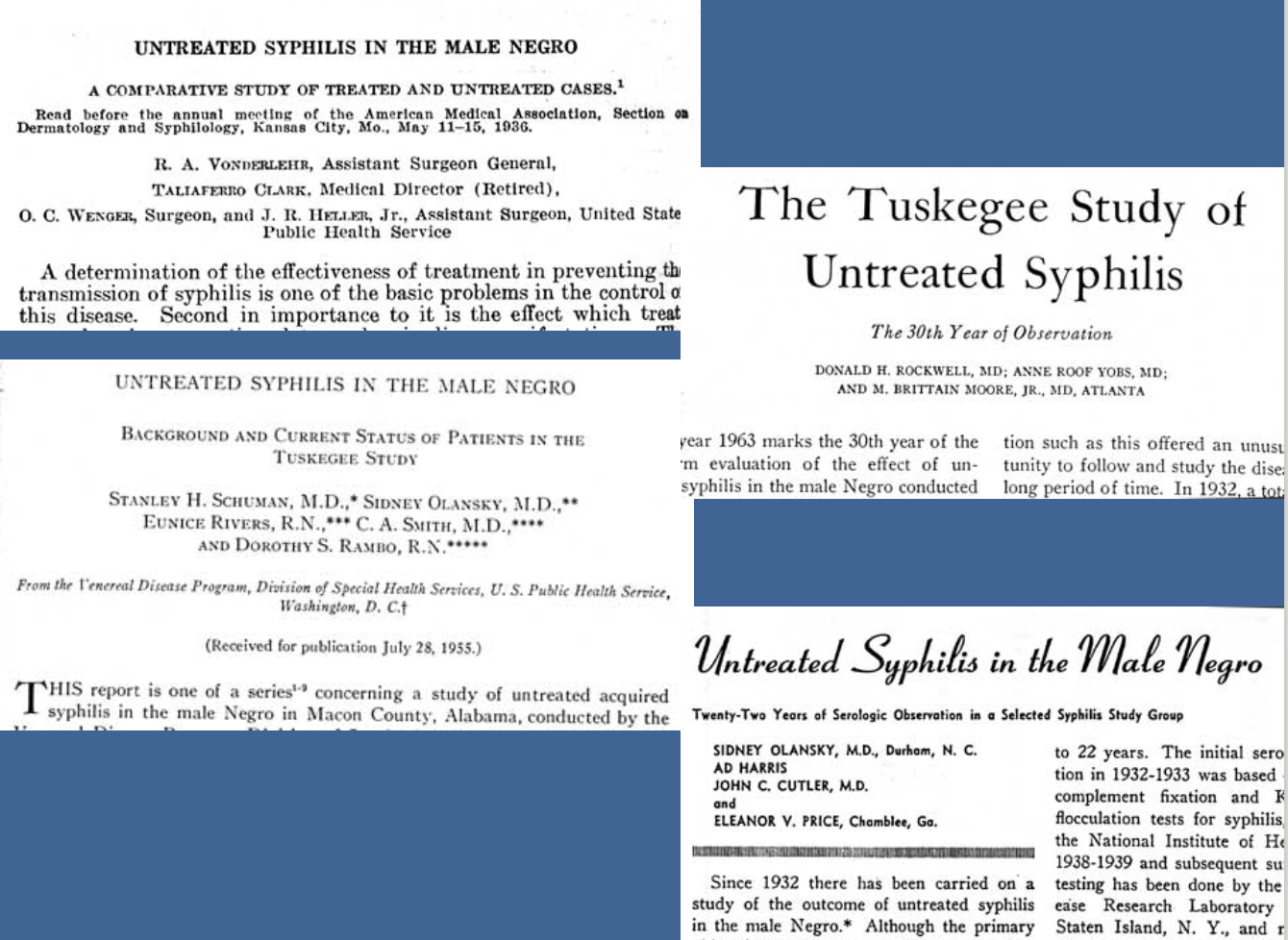
Tuskagee Institute (1932-1972)
Dr. T. Clark
Tuskagee Institute, Macon County, Alabama
* 1931 USPHS Survey Results
* 399 untreated syphilitic African Americans
* "Study in Nature"
* Observe natural history of disease
Tuskagee Institute, Macon County, Alabama
* 1931 USPHS Survey Results
* 399 untreated syphilitic African Americans
* "Study in Nature"
* Observe natural history of disease
5
New cards
opportunity?
An unusual opportunity to study the untreated syphilitic patient from the beginning of the disease to the death of the infected person
6
New cards
Nuremberg code 1947
War trials of Nuremberg
“The voluntary consent of the human subject is absolutely essential
\
Nuremberg code 1947 Article 1
“The voluntary consent of the human subject is absolutely essential
\
Nuremberg code 1947 Article 1
7
New cards
Declaration of Helsinki 1964 (World Medical Association)
\*Physician and Treatment Focus
\
\
**Therapy and Research**
\
Distinction between research where aim is:
1. diagnostic or therapeutic for the patient
2. purely scientific without implying therapeutic value to the person subjected to the research
\
\
**Therapy and Research**
\
Distinction between research where aim is:
1. diagnostic or therapeutic for the patient
2. purely scientific without implying therapeutic value to the person subjected to the research
8
New cards
Right to standard of care (declaration of Helsinki amended in 1996)
Every patient including those of a control group, should be assured of the best proven diagnostic and therapeutic method
\
Declaration of Helsinki 1996 II, 3.
\
Declaration of Helsinki 1996 II, 3.
9
New cards
TPS (Tri-council policy statement) AKA Tri-council code
This joint policy expresses the continuing commitment of the three Councils to the people of Canada, to promote the ethical conduct of research involving human subjects.
\
\
\- abiding by the Tri-Council Code is a condition for public funding of research (and many universities have similar rules for private funding for its researchers).
\
\
\- abiding by the Tri-Council Code is a condition for public funding of research (and many universities have similar rules for private funding for its researchers).
10
New cards
4 basic principles of the Tri-council code 1997
1\.) Respect for Persons
\
2\.) Non-Maleficence
\
3\.) Beneficence
\
4\.) Justice
\
2\.) Non-Maleficence
\
3\.) Beneficence
\
4\.) Justice
11
New cards
9 guiding ethical principles
1\.) Human Dignity
2\.) Free and Informed Consent
3\.) Vulnerable Persons
4\.) Privacy and Confidentiality
5\.) Justice and Inclusiveness
6\.) Balancing Harms and Benefits
7\.) Non-Maleficence
8\.) Minimizing Harm
9\.) Maximizing Benefits
2\.) Free and Informed Consent
3\.) Vulnerable Persons
4\.) Privacy and Confidentiality
5\.) Justice and Inclusiveness
6\.) Balancing Harms and Benefits
7\.) Non-Maleficence
8\.) Minimizing Harm
9\.) Maximizing Benefits
12
New cards
consent as a patient
* As a patient, your consent must be respected.
* As a research subject, your consent must be scrutinized – and can (*and in the right cases must*) be rejected.
* As a research subject, your consent must be scrutinized – and can (*and in the right cases must*) be rejected.
13
New cards
what is the difference between the 2 informed consents?
it is based in rights:
* you have the right to medical care
* you don’t have the right to be a research subject
\
(*it’s your free choice, but not guaranteed to you as an inalienable right*).
* you have the right to medical care
* you don’t have the right to be a research subject
\
(*it’s your free choice, but not guaranteed to you as an inalienable right*).
14
New cards
Volunteering in a lab to be a research subject
When you appear in a lab to be a research subject, the researcher’s obligation is to determine if there is any coercion at work in your decision.
* the researcher is obligated To examine your consent for hidden reasons
* If one becomes apparent, the researcher should refuse you.
* Your consent to experimentation is not the same as it is for medical treatment.
* the researcher is obligated To examine your consent for hidden reasons
* If one becomes apparent, the researcher should refuse you.
* Your consent to experimentation is not the same as it is for medical treatment.
15
New cards
example 1: experiments on inmates
inmates used to volunteer for super random trials why?
* to seem cooperative
* they don’t really care what happens
* if the intervention relates to the crime
* to seem cooperative
* they don’t really care what happens
* if the intervention relates to the crime
16
New cards
example 2: HIV
* lots of people were spending lots of money to try and cure HIV
* they go to places were transmission rate was super high
* these places happened to be were research guidelines were not very strict
* eg. pimp forcing his sex workers to get vaccine (becomes involuntary)
* dilemma:
* cure HIV or free the sex workers
* they go to places were transmission rate was super high
* these places happened to be were research guidelines were not very strict
* eg. pimp forcing his sex workers to get vaccine (becomes involuntary)
* dilemma:
* cure HIV or free the sex workers
17
New cards
coercion
expectation of favour - reference for parole, example of good behaviour, coincides with treatment
18
New cards
Vulnerable populations
groups who have structural/systemic vulnerability to the powerful who may want to research using them.
* more susceptible to coercion
* more susceptible to coercion
19
New cards
characteristics of vulnerable populations
1. Institutionalized disparity of power
\
2. An inability to respect their own best interests
\
3. If the population have to consider punishment of rewards before participating
\
4. Susceptibility to power
20
New cards
Coercion vs. Inducement
Coercion = forcibly, against your will
* threat of force is almost always not allowed in research participation/recruitment
\
Inducement = reward, ultimately your choice
* are allowed, so long as their not “undue”
\
\
* threat of force is almost always not allowed in research participation/recruitment
\
Inducement = reward, ultimately your choice
* are allowed, so long as their not “undue”
\
\
21
New cards
voluntariness
* Can be addressed in the case of coercion or inducement:
\
“would I do this, if I wasn’t going to have this bad thing/harm happen?”
\
“would you participate in the research if it turned out that the inducement was *“out?”*
\
“would I do this, if I wasn’t going to have this bad thing/harm happen?”
\
“would you participate in the research if it turned out that the inducement was *“out?”*