Section B
 Call Kai
 Learn
 Practice Test
 Spaced Repetition
 Match
 Flashcards
 Knowt Play
1/29

There's no tags or description
Looks like no tags are added yet.
30 Terms
What is an ecosystem?
A community of biotic (living things) and abiotic (non-living things) parts that interact with eachother.
What is a producer, consumer, and decomposer?
Producer - an organism that carries out photosynthesis for energy
Consumer - an organism that eats other organisms for energy
Decomposer - an organism (e.g. bacteria / fungi) that breaks down dead material
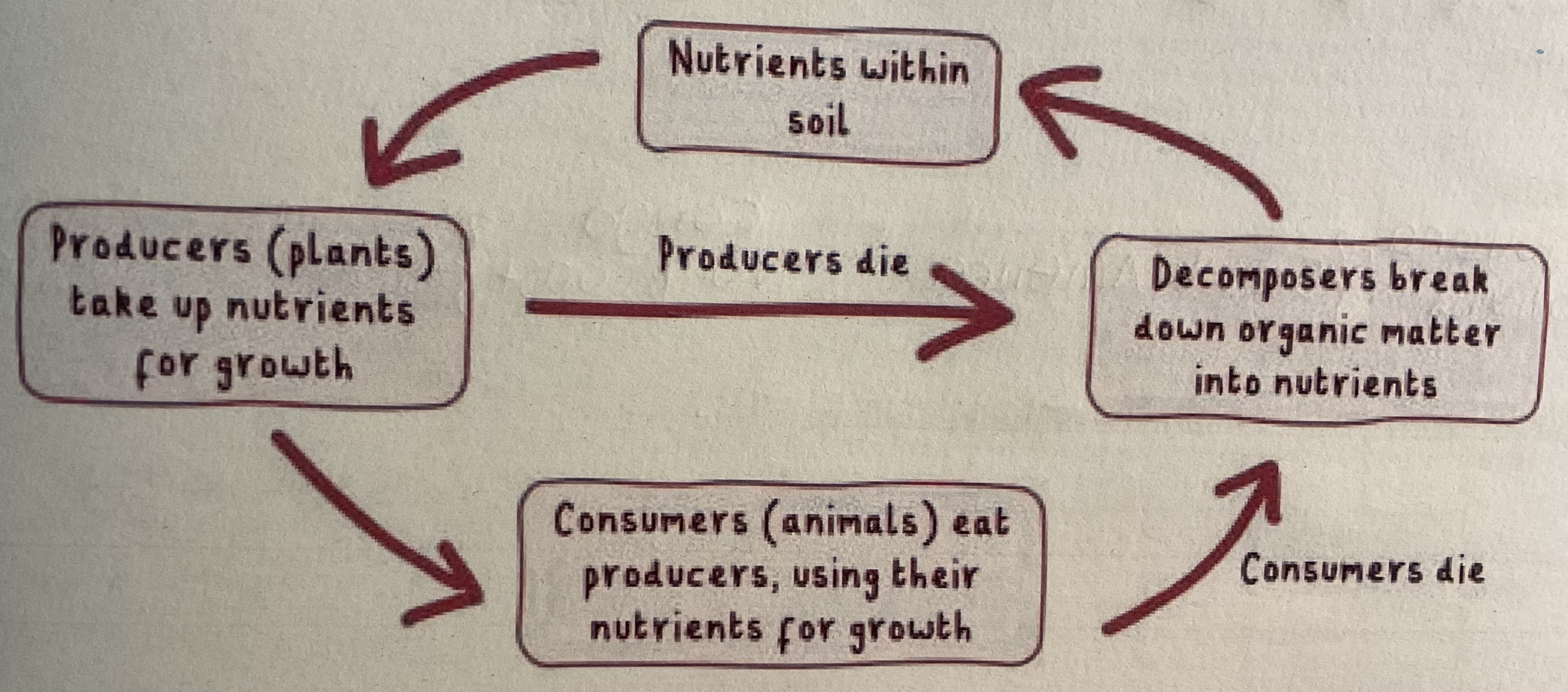
What is the nutrient cycle?
Dead material is decomposed which releases nutrients into the soil, producers take up nutrients for growth, consumers eat producers, consumers die
What is an example of a small-scale ecosystem?
Egerton Park pond (South East England)
Producers: algae and microscopic plants
Consumers: pond snails, frogs, mayfly, dragonfly, fish, and herons
Decomposers: rat-tailed maggots
Change to balance: in 2017, lots of algae bloomed causing oxygen levels to crash, resulting in many young bass + eels dying
What is a biome?
Very large area on Earth with fauna (animals) and flora (plants) that have adapted to their environment
What are six main global biomes?
Tundra
Savanna grassland
Deciduous forest
Coniferous forest
Tropical rainforest
Hot desert
What are main characteristics of tundra?
High latitudes in Northern Europe, Alaska and northern Canada
Very cold winters, brief summers and little rainfall
Only vegetation is mosses, grasses and low shrubs
What are main characteristics of savanna grassland?
Found between the tropics
Distinct dry and wet seasons, but low rainfall still
Most of the vegetation is grasses and few trees
What are main characteristics of deciduous forest?
Found in the mid latitudes
Warm summers and mild winters with rainfall year-round
Deciduous trees lose their leaves in winter to cope with colder weather
What are main characteristics of coniferous forest?
Found in high northern latitudes
Severe winters and hot summers
Evergreen trees to survive freezing winters
What is the climate of the TRF? What about the rainfall?
Little seasonal variation. It’s hot because it is within 23.5º of the equator. There is conventional rainfall - warm air rises as the sun heats the ground, which cools as it rises and forms large cumulonimbus clouds. These result in heavy rain.
What is the soil in the TRF like?
Infertile as lots of leaching, washing away nutrients. Leaf litter provides nutrients however hot, damp conditions means fast decay.
What plants live in the TRF and what adaptations do they have?
Most trees are evergreen due to the continual growing season and have buttress roots to support them. Plants have drip-tips to allow heavy rain to run off the leaves, preventing algae. Many trees have smooth, thin bark so water can run off. Lianas climb to reach sunlight.
EXAMPLES: orchids, bamboo, mahogany / banana trees
What animals live in the TRF and what adaptations do they have?
Rainforests contain 50% of the Earth’s species. Many animals live in the canopy, with strong limbs to swing from tree to tree. Some animals have flaps of skin to fly between trees (e.g. flying squirrels). Some animals camouflage to hide from predators. Most birds have short, pointy wings to easily move between dense tree branches.
EXAMPLES: gorillas, jaguars, anacondas, tree frogs, sloths
What are the four layers of the rainforest?
Emergent (top)
Canopy
Under canopy
Shrub layer (bottom)
What are the six main causes of deforestation?
Population pressure: as population increases, trees are cleared to make land for new settlements
Mineral extraction: minerals (e.g. gold and iron) are mined and sold for money
Energy development: building HEP dams floods large areas of forest
Commercial logging: trees felled to make money
Commercial farming: cattle grazing, and huge palm / soya plantations
Subsistence farming: farmers clear land to grow food for themselves + families
How is the rate of deforestation changing?
It’s very high but globally the rate is slowing; however there are hotspots of increase (e.g. Nigeria).
Case study: deforestation in the Amazon
The Amazon the largest TRF in the world but since 1978 has over lost over 750000km² to deforestation
MAIN CAUSES
About 70% by cattle ranching / commercial farming
20-25% by subsistence farming
Population growth also putting pressure on the Amazon rainforest, especially in Brazil
MAIN IMPACTS
Environmental: the Amazon stores around 100 billion tonnes of carbon and deforestation releases this, causing global warming. Brazil is losing 55 million tonnes of topsoil yearly due to soil erosion caused by soy farming.
Economic: in 2008, Brazil made $7 billion from trading cattle. The mining industry creates jobs for people. Logging contributes to a huge amount of Brazil’s economy.
Why does the tropical rainforest need protecting?
25% of all medicines come from rainforests
Many products (e.g. rubber, coffee, chocolate) sourced here
They are carbon sinks (absorb large amounts of carbon dioxide which regulates the global climate)
How can rainforests be sustainably managed?
Selective Logging: only some trees (e.g. older ones) are felled, keeping the overall forest structure and allowing for regeneration
Replanting: new (same type of) trees are planted to replace the ones that are cut down
Ecotourism: only a small amounts of visitors can tour at one time with strict rules in place. Tourism gives locals legal jobs.
International Hardwood Agreements: in place to reduce illegal logging of hardwood (mahogany, teak, etc) for furniture
Education: educating locals about the impacts of logging and giving alternative ways for them to make money
Reducing Debt: LICs don’t have to log, farm and mine to pay back debt
Conservation: countries pay into protected national parks and nature reserves in rainforests
Where are hot deserts found? Explain he Hadley Cell.
15-35º North and South of the equator
At equator, hot air rises. Cold air sinks and warms so no clouds. Hadley Cell circulates air in deserts (high pressure) back to equator (low pressure)
What is the climate like in hot deserts?
Less than 250mm rainfall / year - and all within a few months
Diurnal temperature range:
Day - sand warms quickly as no clouds to reduce sun’s power, up to 50ºC
Night - sand cools quickly due to no clouds to trap heat, can be 5ºC
What is the soil like in hot deserts?
Shallow, thin, rocky
Very dry due to lack of rainfall + plant material
Little leaf litter (due to difficult plant growth conditions) so poor nutrients / fertility
How have plants adapted to the hot desert?
Cacti / succulents - fleshy stems store water, waxy cuticle prevents evaporation, shallow wide roots quickly absorb rainfall
Acacia trees - deep roots to find water, thorny bark to protect from herbivores, leaves close during day to prevent evaporation
How have animals adapted to the hot desert?
Sidewinder snake - active in cooler night, camouflages into sand, buries itself in soil to stay cool in day
Fennec fox - large ears release heat, thick fur on paws protect from hot sand, nocturnal as cooler during night
Camels - humps of fat to be converted into energy if needed, long eyelashes to keep dirt out, heat resistant feet
What are the opportunities for development in the Thar Desert?
Energy - big coal stores, India’s largest wind farm, 40km solar park providing energy for all of Rajasthan
Farming - lots of subsistence farming, Indira Gandhi Canal provides irrigation for 3500km of commercial farmland
Tourism - desert safaris becoming more popular, annual Desert Festival in Winter brings in income for locals who provide accommodation, guides, food, etc
Mineral extraction - kaolin to whiten paper, phosphorite for fertiliser, gypsum for plaster, valuable rocks, etc transported around the world
What are the challenges for development in the Thar Desert?
Extreme temperatures - up to 50ºC during day, can cause health issues for those working outside, hot season too hot for tourists
Water supply - increased demand, rainfall between 120-240mm, difficult to provide water for everyone, most rivers only flow after rainfall
Inaccessibility - Thar Desert 200000km², limited road network, high temperatures melt tarmac, overcrowded buses or camels often only way into desert
What is desertification?
The process by which land becomes drier and degraded. The Thar Desert edges (fringes) are spreading. It can lead to to less fertile land and food shortages.
What causes desertification?
Rising temperatures + low rainfall - water evaporates form the land making to soils drier, leading to plants death (so their roots no longer hold the soil together - soil erosion)
Removal of firewood - many people rely on wood for cooking fuel; removes forest cover so soil exposed
Overgrazing - too much livestock eat the plants + trample plants, leading to more soil erosion (see above)
Over-cultivation - nutrients get used up by planting in the same area, increases soil erosion (see above)
How can desertification be reduced?
Water management - growing crops that don’t need much water, planting pits reduces water run-off
Planting acacia trees - protect soil from wind erosion, trees stabilise the soil, provide shade to reduce evaporation
Soil management - leaving land to rest in between grazing / planting, compost used, stone lines trap soil instead of it being washed away
Appropriate technology - in terms of APPS (affordability, people, place, sustainability)