NROSCI: Neurophysiology
 Call Kai
 Learn
Learn Practice Test
 Spaced Repetition
 Match
Match Flashcards
 Knowt Play
1/23

There's no tags or description
Looks like no tags are added yet.
24 Terms
Ions
Cations - positively charged ions (Na+, K+, Ca2+), Anions - negatively charged ions (Cl-, A-)
Channels
Ungated channels allow the passage of ions
Voltage-gated ion channels: open or closed only at specific membrane voltages
Ligand-gated channels: open or closed when a ligand is bound, include neurotransmitter gated channels
Pumps
Actively transport a substance across the membrane
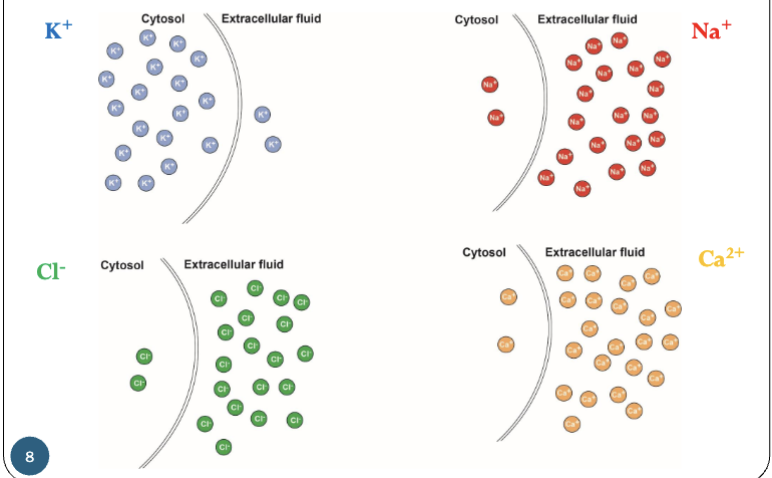
External and internal concentrations for K+, Na+, Ca2+ and Cl- ions
Only K+ is higher concentration in internal cell
Gradients
Concentration gradient - diffuses from an area of higher concentration to lower concentration
Electrical Gradient - difference in charge between two regions that allows a flow of ions between the regions (opposite charges attract, similar charges repel)
Electrochemical gradient - when they work together

How do movements of K+ ions create charge separation at the membrane?
Neuronal membrane is permeable to K+ ions but not intracellular anions. As K+ ions diffuse out of the neuron, impermeant anions accumulate near the inner surface of the membrane, while K+ ions accumulate near the outer surface. This separation of charge across the neuronal membrane produces membrane potential.
Resting Membrane Potential
The difference in electrical potential between the inside and outside of a cell in the absence of stimulation (-70 mV)
What do membrane depolarization and hyperpolarization mean? How do these terms relate to
EPSPs and IPSPs?
Depolarization: decrease in the difference in electrical potential across the membrane (potential becomes more positive)
Hyperpolarization: increase in the difference in electrical potential across the membrane (potential becomes more negative)

What is action potential? How is it generated? What is the action potential threshold?
A rapid sequence of changes in the voltage across a membrane. A brief, all-or-nothing response generated at the axon hillock that has a large amplitude through which information is encoded through the frequency of the action potentials. The threshold potential is the voltage across the membrane at which an action potential is triggered – about -50 mV
What’s the special role of the axon hillock?
The axon hillock is the junction of the cell body and the axon that has lots of voltage-sensitive
channels. It is where postsynaptic potentials are summed and where action potentials are integrated.

What is the role of Na+ and K+ voltage-gated channels in generation of action potential?
There are 3 phases of the action potential:
Depolarization: voltage gated Na+ channels in the membrane open, which allows for a massive influx of Na+
Repolarization: voltage gated K+ ions are less sensitive to depolarization, so they open after Na+ ion channels, and their opening allows for a massive efflux of K+ ions which repolarizes the membrane (Na+ channels begin closing)
Hyperpolarization: K+ ion efflux still occurring and Na+ channels are closed, bringing the membrane potential below the threshold potential

How does tetrodotoxin work? Why is it so lethal?
Blocks voltage-gated Na+ channels, pufferfish toxin
What happens after action potential is generated at the axon hillock?
AP is generated at the axon hillock and propagates as a wave along the axon, with the size and shape of the AP remaining constant along the axon (all-or-none law). The inward currents spread out along the axon during an action potential, depolarizing adjacent sections of the membrane.
What is saltatory conduction? What is the role of myelin sheaths? What is the role of the “nodes of Ranvier”?
Saltatory conduction is the propagation of an action potential from one node of Ranvier to another through myelinated axons. The nodes of Ranvier are parts of an axon that are not covered by myelin where action potentials are generated.
What happens when action potential reaches the axon terminal?
When an action potential reaches the axon terminal, it triggers the release of chemical messengers called neurotransmitters to communicate with the next cell.
How does synapse work? What are the 4 steps?
A synapse is where neurons communicate with each other, usually chemically through messenger molecules called neurotransmitters. Communication is only in one direction, from the presynaptic cell to the postsynaptic cell.
The 4 steps:
1. Neurotransmitters are synthesized in the axon terminal using building blocks from food that transporters pump into the cell, and/or in the cell body from DNA in the nucleus before being transported on microtubules to the axon terminal.
2. Neurotransmitters are released from vesicles at the terminal in response to an influx of calcium (Ca2+) caused by the opening of voltage-gated Ca2+ channels during the action potential
3. The released neurotransmitter diffuses across the synaptic cleft and binds to receptors on the postsynaptic cell, which results in the opening of the transmitter-gated ion channels → the neurotransmitter opens the channel when it binds to the receptor(s) on the channel, but it is ions (not the transmitter itself) that flow through the channel into the postsynaptic cell.
4. Neurotransmitter deactivation can occur in 4 different ways: diffusion away from the cleft, degradation by enzymes in the cleft, reuptake into the presynaptic neuron to be reused, or uptake by nearby glial cells

What is the role of presynaptic voltage-gated Ca2+ channels in neurotransmitter release?
Neurotransmitters are released from vesicles at the terminal in response to an influx of calcium (Ca2+)
caused by the opening of voltage gated Ca2+ channels during the action potential.
Can neurotransmitters cross the postsynaptic membrane?
No, neurotransmitters do not cross the postsynaptic membrane. The presynaptic neuron releases neurotransmitters into the synaptic cleft (the small gap between neurons and binds to receptors on the postsynaptic cell, which results in the opening of the transmitter-gated ion channels → the neurotransmitter opens the channel when it binds to the receptor(s) on the channel, but it is ions (not the transmitter itself) that flow through the channel into the postsynaptic cell.
What happens when a neurotransmitter binds to postsynaptic receptors? What is EPSP and IPSP?
It results in the opening of the transmitter-gated ion channels → the neurotransmitter opens the channel when it binds to the receptor(s) on the channel, but it is ions (not the transmitter itself) that flow through the channel into the postsynaptic cell.
Ion flow through the channels results in a subthreshold response on the postsynaptic membrane, either depolarization through an excitatory postsynaptic potential (EPSP) or hyperpolarization through an inhibitory postsynaptic potential (IPSP)
What is EPSP and IPSP?
Excitatory neurons form excitatory synapses on other neurons and produce an EPSP, which makes the neuron more likely to produce an action potential
Inhibitory neurons form inhibitory synapses on other neurons and produce an IPSP, which makes the neuron less likely to produce an action potential
What is the difference between ionotropic and metabotropic receptors?
Ionotropic receptors which are directly linked to ion channels (transmitter gated ion channels)
Metabotropic receptors (G protein-coupled receptors) work by activating G proteins and act more slowly with a longer response
Describe 4 different ways of neurotransmitter deactivation.
diffusion away from the cleft, degradation by enzymes in the cleft, reuptake into the presynaptic neuron to be reused, or uptake by nearby glial cells
Where are multiple EPSPs and IPSPs integrated (summed) in a neuron?
At the axon hillock
How does an inhibitory neuron send and deliver its inhibitory message to another neuron? Does it need to generate an action potential?
An inhibitory neuron sends its message by releasing inhibitory neurotransmiters (such as GABA or glycine) that make the receiving neuron more negative and less likely to fire an electrical signal.
Yes, it generally needs to generate an action potential to release these chemicals in a typical chemical synapse.