Lec 5- Communication - neurons and action potenital
 Call Kai
 Learn
 Practice Test
 Spaced Repetition
 Match
 Flashcards
 Knowt Play
1/36

There's no tags or description
Looks like no tags are added yet.
37 Terms
What do you do with osmolarity when a solution contains multiple solutes?
Add the osmolarities of all the solutes together to find the total osmolarity.
Remember membrane proteins have 4 main functions
transport (channels, carriers)
cell communication (receptors and messangers)
cell reactions (enzymes)
cell structure and shape
A solution contains 0.10 M NaCl and 0.20 M glucose. What is the total osmolarity of the solution?
NaCl dissociates into two so 0.20Osm/L
Glucose does not so 0.20Osm/L
0.2+0.2= 0.4Osm/L or 400mOsm/L
Solution A contains 0.15 M NaCl.
Solution B contains 0.20 M glucose.
Which solution has the higher water concentration?
0.15×2=0.30Osm/L NaCl
0.20Osm/L Glucose
Glucose has a smaller osmolarity so it has the higher water concentration.
Local communicationx examples between cells
gap junctions
autocrine and paracrine signalling
Gap Junction
A direct channel between neighboring cells that allows ions and small molecules to pass from one cell to another.

Two cells directly communicate directly through a tunnel called a connexon (not an ion channel!) its a transmembrane protein that connects to a transmembrane protein in the cell it wants to communicate with. Things pass from the ICF in oen cell to the next.
critical in the heart
Connexon
A transmembrane channel structure that connects with a connexon on another cell to form a gap junction.
What is autocrine signaling?
A cell releases a chemical messenger that binds to receptors on the same cell and affects that cell.
ex) Some ovarian cells can release signals that act back on themselves.

What is paracrine signaling?
A cell releases a chemical messenger that diffuses through the extracellular fluid and acts on a nearby cell.
not hormones - rather chemical messangers!

2 types of long distance communication
The nervous system → brain sends signals to lift your leg by neurotransmitters.
Endocrine system → hormone stravel in blood long distance
What is resting membrane potential (RMP)?
The voltage difference between the intracellular fluid (ICF) and extracellular fluid (ECF) when the cell is at rest. difference is due to the distribution of ions.
typical neuron has -70mV
What does a resting membrane potential of −70 mV mean?
The inside of the neuron is about 70 mV more negative than the outside.
Do all cells have a resting membrane potential?
Yes, but the actual voltage can differ between cell types.
What is the main ion movement that helps create the resting membrane potential in neurons?
Potassium (K⁺) leaking out of the cell through potassium leak channels. - meaning the ICF is becoming less positive and becomes more negative.

leak channels tend to be open for potassium to leak out during rest in neurons to keep the inside of the cell negative. - There is typically some sodium leakage in neurons too but not enough to offset the amount of potassium leaving.
after all the leakage we use the sodium potassium pump to load the potassium back in kick the sodium out.
excitable cells
Cells that can rapidly change their resting membrane potential to create electrical signals.
they are no longer at rest.
examples include neurons and muscle cells.
How can a neuron rapidly change its membrane potential?
By changing which ion channels are open, which changes membrane permeability to specific ions.
if a chloride channel opened the cell would be very negative.
What are gated ion channels?
Ion channels that are usually closed but open in response to a specific stimulus. The membrane then becomes more permeable to that ion, allowing it to move through the channel by channel-mediated diffusion.
What are the three main types of gated ion channels?
Mechanically gated
Chemically gated
Voltage gated channels.
they each open in response to different stimuli - the stimulus is in the name of each channel how it opens.
Mechanically Gated Channel
stretch the plasma membrane it literally opens the gate of the ion channel and the ion will move down by channel mediated diffusion

Chemically Gated Channel
a chemical binds the channel - and then that opens the gate and then ion moves down. This is seen with neurotransmitters.

Voltage-Gated Channel
The stimulus is voltage change opens the gate - sodium channel works this way.

Label the neuron — ACTION

this one is myelinated - not all neurons are are myelinated.
Input zone of a neuron
The dendrites and soma, where signals from other neurons are received.
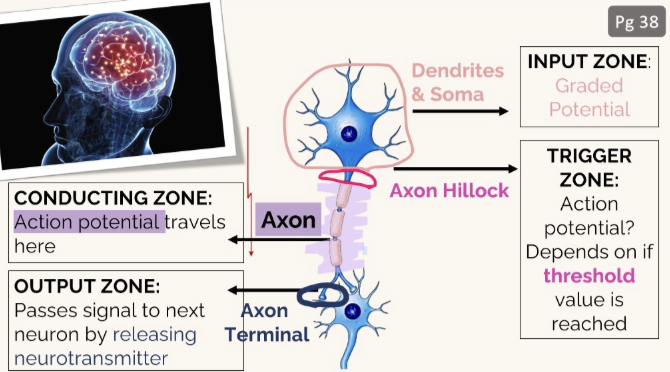
What type of electrical response occurs in the input zone?
A graded potential.
Trigger Zone
The axon hillock, where an action potential begins if threshold is reached.
remember its all or none - there can be no small action potentials.
if threshold is not reached - action potential wont happen
Conducting zone of a neuron
The axon, where the action potential travels down.
output zone of a neuron
The axon terminal.
passes signal to the next neuron by releasing neurotransmitter
What is a graded potential?
A local change in membrane potential that occurs in the dendrites or soma when a stimulus opens gated ion channels.
(input zone)
What types of ion channels can create graded potentials?
Mechanically gated and chemically gated channels. not voltage gated channels -they are NOT responsible for graded potentials.
depolarization
membrane potential becomes more positive / less negative than resting membrane potential.
Usually caused by Na⁺ entering the cell (or Ca²⁺ entering).
Hyperpolarization
The membrane potential becomes more negative than resting membrane potential.
Usually caused by K⁺ leaving the cell or Cl⁻ entering the cell.
Can a graded potential be either depolarizing or hyperpolarizing?
Yes. It depends on which ion channels open and which ions move.
threshold
The minimum membrane potential that must be reached at the trigger zone to initiate an action potential.
What is the threshold for triggering an action potential in neuron
About −55 mV.
repolarization
The membrane potential moves back toward its resting negative value.
What are the steps of an action potential?
Resting membrane potential: neuron starts around −70 mV.
Graded potentials depolarize the axon hillock toward threshold.
Threshold is reached at about −55 mV → action potential begins.
Voltage-gated Na⁺ channels open.
Na⁺ rushes into the cell → rapid depolarization.
Membrane potential rises to about +30 mV.
Na⁺ channels inactivate/close and voltage-gated K⁺ channels open.
K⁺ leaves the cell → repolarization back toward negative.
K⁺ channels close slowly, so extra K⁺ leaves → hyperpolarization below −70 mV.
K⁺ channels close and the neuron returns to its resting membrane potential (~−70 mV); leak channels and the Na⁺/K⁺ pump maintain the

Rest → Threshold → Na⁺ IN → Depolarize → K⁺ OUT → Repolarize → Hyperpolarize → Rest
Bonus: what moves the axon hillock toward threshold?
depolarizing graded potentials