PC EX3 practice
 Call Kai
 Learn
 Practice Test
 Spaced Repetition
 Match
 Flashcards
 Knowt Play
1/61

There's no tags or description
Looks like no tags are added yet.
62 Terms
A 72-year-old male with metastatic prostate cancer is starting systemic chemotherapy. He has a history of GI bleeding 3 months ago. His CrCl is 35 mL/min. Which is the most appropriate thromboprophylactic strategy?
A. Rivaroxaban 10 mg daily
B. Apixaban 2.5 mg BID
C. Fondaparinux 7.5 mg SC daily
D. LMWH
Answer: D. LMWH
Rationale:
-LMWH (e.g., enoxaparin) is first-line for VTE treatment in cancer patients.
-Apixaban is a possible option but not preferred after GI bleed.
-Fondaparinux is contraindicated in CrCl < 30 mL/min, and this patient is borderline at 35.
-Rivaroxaban is associated with a higher GI bleeding risk.→ LMWH is effective and safer in this case.
Which of the following is preferred in a patient with valvular Afib for stroke prevention and VTE management?
A. Apixaban
B. Dabigatran
C. Rivaroxaban
D. Warfarin
Answer: D. Warfarin
Rationale:
DOACs are not indicated in valvular Afib, particularly in patients with mechanical heart valves or moderate-to-severe mitral stenosis.
Only warfarin has evidence in this population.
Which of the following statements is TRUE regarding DOAC use in patients with renal impairment?
A. Rivaroxaban should be avoided if CrCl < 60 mL/min
B. Apixaban must be avoided in all patients with CrCl < 30 mL/min
C. Dabigatran is 80% renally cleared and should be avoided in CrCl < 30 mL/min
D. Edoxaban is safe in patients with CrCl > 95 mL/min
Answer: C. Dabigatran is 80% renally cleared and should be avoided in CrCl < 30 mL/min
Rationale:
Dabigatran is mostly cleared by the kidneys, so renal function is critical.
Apixaban is the safest in renal impairment due to low renal clearance (25%).
Edoxaban should be avoided if CrCl > 95 mL/min due to risk of decreased efficacy.
A patient is on warfarin for VTE and presents with an INR of 6.5 but no bleeding. What is the best next step according to ASH guidelines?
A. Give IV vitamin K and resume warfarin when INR is <3
B. Hold warfarin and give PO vitamin K
C. Hold warfarin only
D. Administer 4-factor PCC
Answer: C. Hold warfarin only
Rationale:
ASH recommends holding warfarin when INR is 4.5–10 with no bleeding.
Vitamin K is only given if bleeding is present or INR is >10.
PCC is reserved for life-threatening bleeding.
Which of the following anticoagulants is contraindicated in pregnancy but safe during breastfeeding?
A. Apixaban
B. Rivaroxaban
C. Warfarin
D. Dabigatran
Answer: C. Warfarin
Rationale:
Warfarin is teratogenic, especially in the 1st trimester—avoid in pregnancy.
However, it does not pass into breast milk significantly, so it is safe during breastfeeding.
DOACs are not well studied in pregnancy or lactation.
A patient weighs 47 kg and has newly diagnosed DVT. What is the appropriate Fondaparinux dose?
A. 10 mg SC daily
B. 7.5 mg SC daily
C. 5 mg SC daily
D. Contraindicated due to low weight
Answer: C. 5 mg SC daily
Rationale:
Fondaparinux dosing is based on weight:
<50 kg = 5 mg
50–100 kg = 7.5 mg
100 kg = 10 mg
Only contraindicated if CrCl < 30 mL/min, not based on weight alone.
What is the initial treatment duration recommended for a proximal DVT provoked by surgery?
A. 6 months
B. 1 month
C. 3 months
D. Indefinitely
Answer: C. 3 months
Rationale:
For provoked VTE events, such as after surgery, 3 months of anticoagulation is sufficient.
Longer durations are reserved for unprovoked VTE or patients at high risk for recurrence.
Which DOAC is least renally cleared and therefore safest in moderate renal impairment?
A. Dabigatran
B. Rivaroxaban
C. Edoxaban
D. Apixaban
Answer: D. Apixaban
Rationale:
Apixaban is only 25% renally cleared, making it safer in renal impairment.
Dabigatran = 80%, Edoxaban = 50%, and Rivaroxaban = 33% renal clearance.
Apixaban is the DOAC of choice when CrCl is borderline or <30.
Which DOAC is most appropriate in a patient with moderate renal impairment and a history of GI bleeding?
A. Dabigatran
B. Apixaban
C. Rivaroxaban
D. Edoxaban
Answer: B. Apixaban
Rationale:
Apixaban has the lowest renal clearance (25%) and a lower GI bleed risk than other DOACs.
Dabigatran and Edoxaban are both highly renally cleared and linked to GI bleeding.
Rivaroxaban is also associated with higher GI bleeding risk.
Which anticoagulant should be avoided in patients with CrCl > 95 mL/min due to reduced efficacy?
A. Dabigatran
B. Apixaban
C. Edoxaban
D. Rivaroxaban
Answer: C. Edoxaban
Rationale:
Edoxaban should be avoided if CrCl > 95 mL/min, as its efficacy may be reduced (drug is cleared too fast).
This is a unique renal dosing warning not shared by the other DOACs.
Which patient scenario would most likely warrant the use of warfarin over DOACs?
A. A patient with CrCl 60 mL/min and atrial fibrillation
B. A patient with a BMI of 28 and unprovoked DVT
C. A patient with valvular atrial fibrillation due to mitral stenosis
D. A patient with VTE and a history of HIT
Answer: C. A patient with valvular atrial fibrillation due to mitral stenosis
Rationale:
DOACs are not recommended for valvular Afib, particularly due to mechanical valves or mitral stenosis.
Warfarin is the anticoagulant of choice in these patients.
HIT history would exclude heparins but not necessarily DOACs or warfarin.
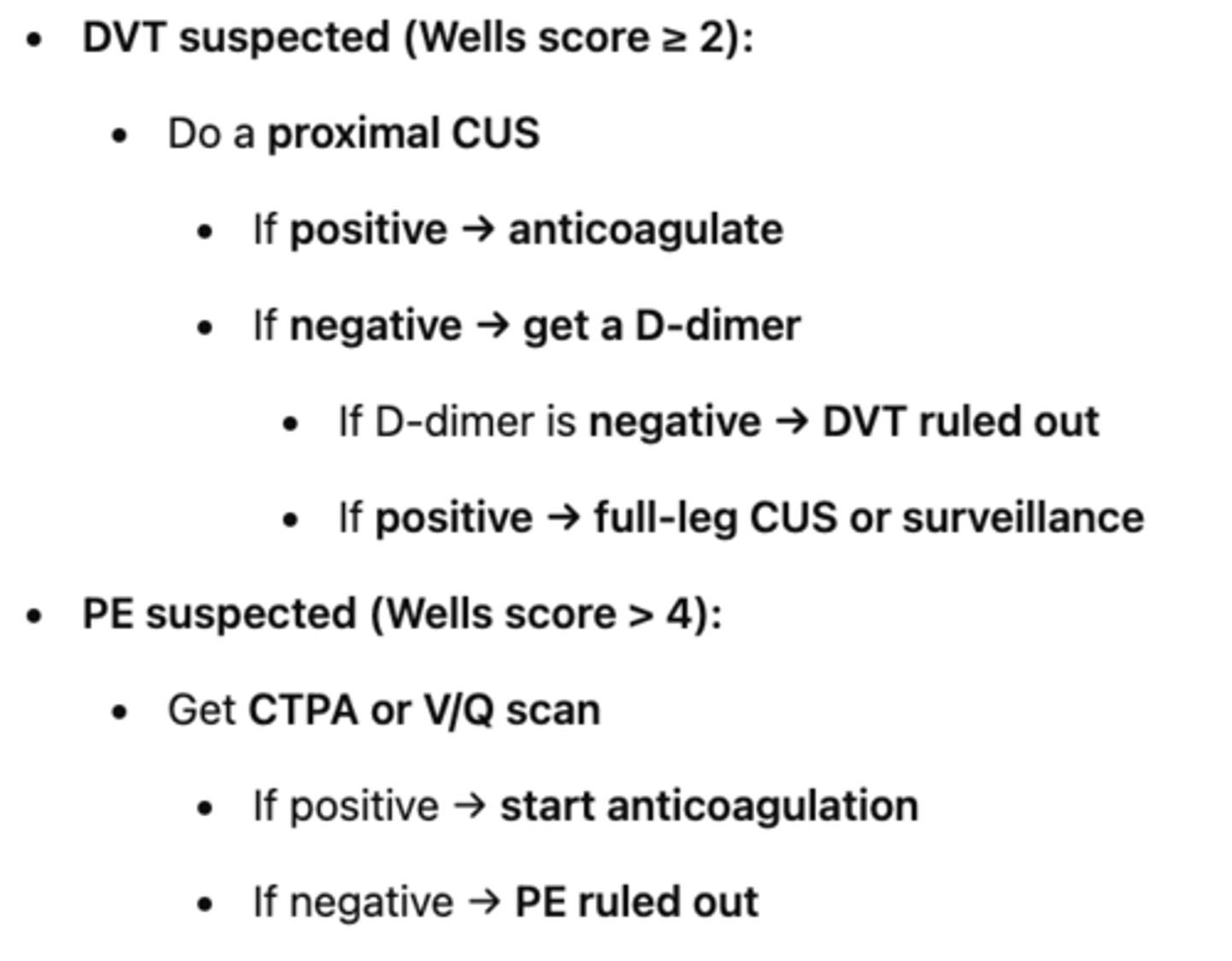
Wells Score-Based Diagnostic Pathway
What if VTE is unprovoked?
Unprovoked VTE + high bleeding risk → 3 months of anticoagulation
Unprovoked VTE + low/mod bleeding risk → extended anticoagulation with no stop date
When to use mechanical prophylaxis over anticoagulation?
If a patient is high VTE risk but also high bleeding risk (e.g., active ulcer, recent bleed, plt < 50,000)
Use mechanical prophylaxis like compression stockings or IPC devices
Special Populations: Pregnancy
Use LMWH
Avoid DOACs (not well studied)
Consider fondaparinux only if LMWH not tolerated or with HIT
Special Populations: Breastfeeding
Warfarin is safe
DOACs are not recommended
Special Populations: Obesity
Use Rivaroxaban or Apixaban with caution
Avoid Dabigatran and Edoxaban
DOACs Drug Interactions
If a patient is taking a P-gp or strong CYP3A4 inducer/inhibitor (like phenytoin, carbamazepine, rifampin, or ketoconazole), DOACs may not be safe.
➡️ Use warfarin or LMWH instead.
Surgery & Anticoagulant Timing
Stop DOACs at least 2 days before invasive procedures
Warfarin: may need up to 5 days for full reversal
For urgent reversal of warfarin with bleeding → use IV vitamin K + 4-factor PCC
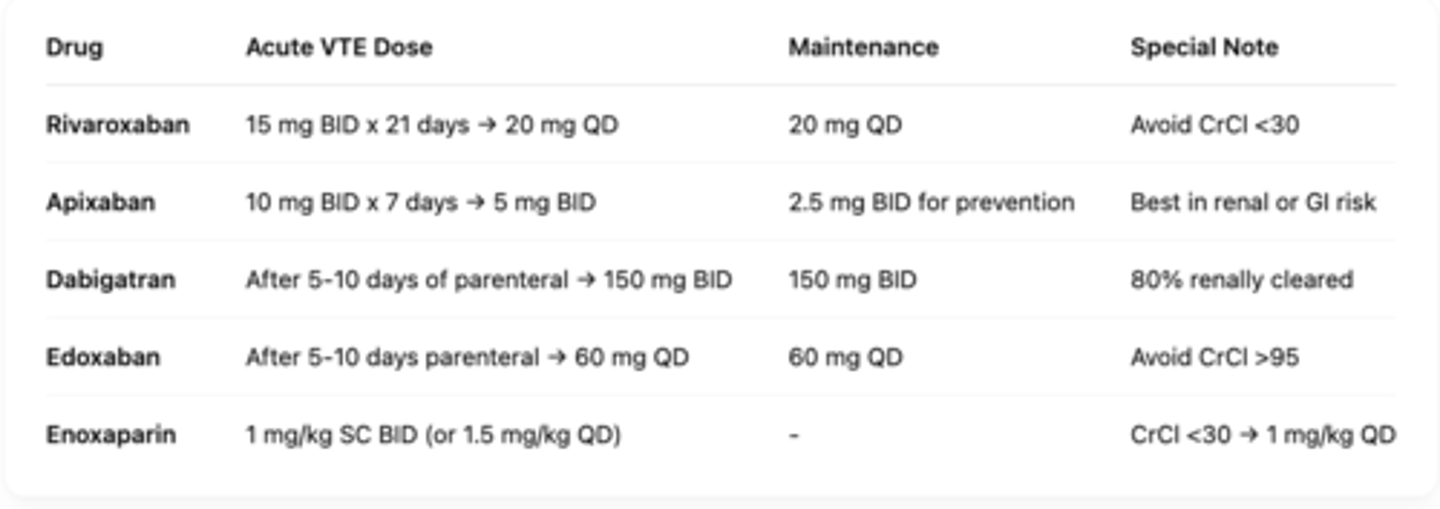
VTE Doses (Quick Recall Set)
A 54-year-old man presents to the ED with leg swelling and tenderness. His Wells score for DVT is 3. What is the most appropriate next step?
A. Start anticoagulation immediately
B. Order a D-dimer
C. Order a proximal compression ultrasound
D. Order a V/Q scan
Answer: C. Order a proximal compression ultrasound
Rationale:
Wells score ≥2 = high probability of DVT
First step is proximal CUS
If CUS is negative → get a D-dimer
V/Q scans are for PE, not DVT→ Know this Wells + imaging algorithm cold!
A 38-year-old woman is diagnosed with a first-time unprovoked DVT. She has low bleeding risk. What is the best duration for anticoagulation?
A. 3 months
B. 6 months
C. 12 months
D. Indefinite duration (no scheduled stop date)
Answer: D. Indefinite duration (no scheduled stop date)
Rationale:
For unprovoked VTE and low bleeding risk, guidelines recommend extended anticoagulation
Stop after 3 months only if there’s a high risk of bleeding
A 78-year-old man is admitted for pneumonia and has a recent history of GI bleed. Platelet count is 40,000. Which is the best VTE prevention strategy?
A. Apixaban
B. Fondaparinux
C. Mechanical compression devices
D. Low-dose warfarin
Answer: C. Mechanical compression devices
Rationale:
In high bleeding risk patients (e.g. recent GI bleed, plt <50k), avoid pharmacologic prophylaxis
Use mechanical prophylaxis (IPC or compression stockings)
Which anticoagulant is preferred in pregnancy for VTE treatment?
A. Warfarin
B. Dabigatran
C. LMWH
D. Rivaroxaban
Answer: C. LMWH
Rationale:
LMWH is first-line in pregnancy
Warfarin is teratogenic, especially in 1st trimester
DOACs (Dabigatran, Rivaroxaban) are not studied in pregnancy
A patient is on rifampin and is diagnosed with PE. Which is the most appropriate anticoagulant?
A. Apixaban
B. Edoxaban
C. Rivaroxaban
D. Warfarin
Answer: D. Warfarin
Rationale:
Rifampin is a strong CYP3A4 and P-gp inducer, which reduces DOAC effectiveness
Use warfarin or LMWH instead
A patient on Apixaban is scheduled for elective surgery. When should the medication be stopped?
A. 1 day before
B. 2 days before
C. 5 days before
D. Continue without stopping
Answer: B. 2 days before
Rationale:
DOACs should be held at least 2 days before procedures
Warfarin requires 5 days for INR reversal
A 65-year-old male is initiated on unfractionated heparin for VTE treatment. His weight is 80 kg. What is the correct initial dosing strategy?
A. 60 units/kg IV bolus, then 12 units/kg/h
B. 5000 units SC Q8H
C. 80 units/kg IV bolus, then 18 units/kg/h infusion
D. 1 mg/kg SC BID
C. 80 units/kg IV bolus, then 18 units/kg/h infusion
Rationale:
This is the treatment dose for VTE using TBW.
The 60/12 dose is for ACS/STEMI.
SC doses are for prophylaxis, not treatment.
1 mg/kg SC is for LMWH, not UFH.
A hospitalized patient on heparin infusion develops skin lesions at injection sites and a platelet count drop of 55% from baseline. What condition is most likely?
A. Type 1 HIT
B. Type 2 HIT
C. DIC
D. TTP
Answer: B. Type 2 HIT
Rationale:
Type 2 HIT is immune-mediated, usually occurs 4–10 days after heparin, and involves thrombotic complications, not bleeding.
Type 1 HIT occurs within the first 2 days and is non-immune.
What is the correct enoxaparin dose for VTE prophylaxis in a patient with normal renal function?
A. 1 mg/kg SC BID
B. 30 mg SC BID or 40 mg SC daily
C. 1.5 mg/kg SC BID
D. 30 mg SC daily
Answer: B. 30 mg SC BID or 40 mg SC daily
Rationale:
These are the standard prophylaxis doses.
The other choices are treatment doses.
If CrCl < 30 mL/min → use 30 mg SC daily
Which anticoagulants are considered safe in patients with active or past HIT?
A. Enoxaparin and Dabigatran
B. Warfarin and Argatroban
C. Argatroban and Bivalirudin
D. Fondaparinux and Warfarin
Answer: C. Argatroban and Bivalirudin
Rationale:
Direct thrombin inhibitors (DTIs) like Argatroban and Bivalirudin are safe in HIT.
LMWH and UFH are contraindicated in HIT.
Warfarin is not started until platelets have recovered.
Which DOAC must be avoided in patients with CrCl < 15 mL/min?
A. Apixaban
B. Dabigatran
C. Warfarin
D. Rivaroxaban
Answer: B. Dabigatran
Rationale:
Dabigatran is 80% renally cleared and contraindicated in CrCl < 15 mL/min.
Rivaroxaban is also avoided below CrCl 15, but Dabigatran is more dependent on renal clearance.
Apixaban can be used with dose adjustment.
Warfarin inhibits which clotting factors?
A. II, V, VII, X
B. II, VII, IX, X
C. I, III, V, X
D. VII, VIII, IX, XIII
Answer: B. II, VII, IX, X
Rationale:
Warfarin is a Vitamin K antagonist and inhibits production of factors II, VII, IX, X, and proteins C and S.
Anti-Xa monitoring is most appropriate in which scenario?
A. All patients on LMWH
B. Patient on DOACs undergoing surgery
C. Pregnant patient on enoxaparin
D. Patient receiving warfarin with INR >3
Answer: C. Pregnant patient on enoxaparin
Rationale:
Anti-Xa is reserved for select populations (e.g. pregnancy, renal dysfunction, obesity) to ensure therapeutic LMWH levels.
DOACs don't require routine monitoring. Warfarin is monitored using INR.
What is the black box warning for LMWH (e.g., Enoxaparin)?
A. Anemia
B. Thrombocytopenia
C. Risk of hematoma with neuraxial anesthesia
D. Osteoporosis
Answer: C. Risk of hematoma with neuraxial anesthesia
Rationale:
LMWH and DOACs carry a BBW for spinal/epidural hematoma when used with neuraxial procedures (e.g. spinal anesthesia, epidurals).
A 60-year-old man reports chest tightness when mowing the lawn that is relieved within 5 minutes by rest. Which type of angina does this best represent?
A. Unstable angina
B. Prinzmetal’s angina
C. Stable angina
D. Silent ischemia
Answer: C. Stable angina
Rationale:
Stable angina is predictable, relieved by rest or nitroglycerin, and associated with exertion.
Unstable angina is not relieved by rest and is a medical emergency.
Prinzmetal’s occurs at rest, typically from vasospasm.
Which of the following are risk factors for Ischemic Heart Disease? (Select all that apply)
A. Smoking
B. Diabetes
C. GERD
D. Obesity
E. Dyslipidemia
Answers: A, B, D, E
Rationale:
Classic IHD risk factors include: HTN, DM, smoking, obesity, dyslipidemia, age, sedentary lifestyle.
GERD is not a cardiac risk factor.
A 58-year-old patient with newly diagnosed Stable Ischemic Heart Disease (SIHD) is starting antianginal therapy. What is the most appropriate first-line treatment?
A. Amlodipine
B. Nitroglycerin patch
C. Ranolazine
D. Metoprolol
Answer: D. Metoprolol
Rationale:
Beta-blockers are first-line for SIHD.
Amlodipine and Ranolazine are alternatives or add-ons.
Long-acting nitrates are not preferred initially.
Which of the following is most commonly used for pharmacologic stress testing in patients who cannot exercise?
A. Nitroglycerin
B. Dobutamine
C. Regadenoson
D. Atenolol
Answer: C. Regadenoson
Rationale:
Regadenoson (Lexiscan) is the most common agent.
Dobutamine is used when vasodilators are contraindicated.
Nitroglycerin and beta-blockers are not used for stress testing.
Which of the following findings is unique to STEMI among the ACS types?
A. Negative cardiac enzymes
B. Complete artery blockage
C. Normal ECG
D. Absence of chest pain
B. Complete artery blockage
Rationale:
STEMI = complete occlusion, positive cardiac enzymes, ST elevation.
NSTEMI = partial blockage.
Unstable angina has negative enzymes.
A patient received a drug-eluting stent (DES) following a coronary angioplasty. How long should he remain on dual antiplatelet therapy (DAPT)?
A. 1 month
B. 3 months
C. 6 months
D. 12 months
Answer: C. 6 months
Rationale:
DES = DAPT for at least 6 months (Aspirin + Clopidogrel).
BMS = 1 month, CABG = 12 months.
Which of the following medications should be avoided with Ranolazine (Ranexa)? (Select all that apply)
A. Phenytoin
B. Rifampin
C. Amiodarone
D. St. John’s Wort
E. Tegretol (carbamazepine)
Answers: A, B, D, E
Rationale:
Ranolazine is a CYP3A4 substrate.
Avoid strong inducers (rifampin, carbamazepine, phenytoin, St. John’s Wort).
Use with caution with moderate inhibitors (e.g., diltiazem, verapamil).
A patient is using Nitroglycerin transdermal patches (Nitro-Dur) daily. How long should the patch be removed each day to prevent tolerance?
A. 2–4 hours
B. 6 hours
C. 10–12 hours
D. 24 hours
Answer: C. 10–12 hours
Rationale:
To prevent nitrate tolerance, patients must have a daily nitrate-free interval:
Patch = 10–12 hours off
Ointment = 6+ hours between doses
Isosorbide = 14-hour nitrate-free period
Which of the following is an absolute contraindication for nitrate use?
A. Atrial fibrillation
B. PDE-5 inhibitor use
C. Tachycardia
D. Hypertension
Answer: B. PDE-5 inhibitor use
Rationale:
Nitrates + PDE-5 inhibitors (like sildenafil, tadalafil) can cause severe hypotension or death.
Also avoid in severe anemia, Riociguat, increased ICP.
What dose of aspirin is given immediately to a patient presenting with STEMI in the emergency department?
A. 81 mg PO
B. 324 mg PO (4 x 81 mg chewable)
C. 325 mg enteric-coated
D. 500 mg IV
Answer: B. 324 mg PO (4 x 81 mg chewable)
Rationale:
Chewable aspirin is used in STEMI for fast onset.
Avoid enteric-coated or extended-release in ACS situations.
MJ’s lipid panel reads:
TC = 202 mg/dL
HDL = 36 mg/dL
TG = 280 mg/dL
What is his LDL using the Friedewald formula?
A. 110 mg/dL
B. 120 mg/dL
C. 135 mg/dL
D. Cannot calculate due to high TG
Answer: A. 110 mg/dL
Rationale:LDL = TC - HDL - (TG/5) = 202 - 36 - (280/5) = 202 - 36 - 56 = 110 mg/dL
Only avoid using this formula if TG > 400 mg/dL
Which of the following conditions is considered a primary cause of dyslipidemia?
A. Alcohol use disorder
B. Hypothyroidism
C. Familial hypercholesterolemia
D. Type 2 diabetes
Answer: C. Familial hypercholesterolemia
Rationale:
Primary = genetic, such as HeFH and HoFH
Others are secondary/acquired (diet, disease, lifestyle)
A patient is taking simvastatin 40 mg daily but needs to switch to atorvastatin. What is the equivalent dose?
A. 10 mg
B. 20 mg
C. 40 mg
D. 80 mg
Answer: B. 20 mg
Rationale:Statin equivalence = Pharmacists Rock At Saving Lives and Preventing Fats
Simvastatin 20 mg = Atorvastatin 10 mg
Simvastatin 40 mg = Atorvastatin 20 mg
Which lab is most appropriate to monitor for statin-induced liver injury?
A. CPK
B. HDL
C. ALT
D. TSH
Answer: C. ALT
Rationale:
Monitor LFTs (especially ALT/AST) at baseline and if symptoms appear.
CPK is used for myopathy/rhabdo, not hepatotoxicity.
Which patient is most at risk for statin-induced rhabdomyolysis?
A. 35-year-old on pravastatin 20 mg
B. 50-year-old on simvastatin 40 mg + gemfibrozil
C. 60-year-old on atorvastatin 10 mg
D. 45-year-old on rosuvastatin 5 mg
Answer: B. Simvastatin + Gemfibrozil
Rationale:
Gemfibrozil + Simvastatin = high rhabdomyolysis risk
Avoid simvastatin 80 mg and avoid combo with gemfibrozil
Which of the following is considered a high-intensity statin regimen?
A. Rosuvastatin 10 mg
B. Atorvastatin 40 mg
C. Pravastatin 40 mg
D. Simvastatin 20 mg
Answer: B. Atorvastatin 40 mg
Rationale:High-intensity = ↓LDL ≥ 50%
Atorva 40–80 mg, Rosuva 20–40 mg
Which drug lowers LDL by inhibiting intestinal cholesterol absorption?
A. Niacin
B. Ezetimibe
C. PCSK9 inhibitors
D. Fish oil
Answer: B. Ezetimibe
Rationale:
Ezetimibe = Zetia, blocks cholesterol absorption
PCSK9 inhibitors increase LDL receptor activity
Fish oils mostly lower TGs
Which of the following is a contraindication to using Colesevelam (Welchol)?
A. T2DM
B. Hypothyroidism
C. TG = 600 mg/dL
D. Pregnancy
Answer: C. TG = 600 mg/dL
Rationale:
BASs raise TGs; avoid when TG ≥ 300–500 mg/dL
Colesevelam is approved in pregnancy and T2DM
Which of the following should be routinely monitored in a patient on Niacin (Niaspan)? (Select all that apply)
A. Uric acid
B. Liver enzymes
C. Triglycerides
D. Thyroid levels
E. Blood glucose
Answers: A, B, C, E
Rationale:
Niacin can raise uric acid, blood glucose, and cause hepatotoxicity
Monitor LFTs, lipid panel, uric acid, and glucose
Which counseling point is true for Evolocumab (Repatha)?
A. Must be stored at room temperature for at least 60 days
B. May cause gallstones and increased uric acid
C. Store in original carton and discard after 30 days at room temp
D. Can be taken orally or by injection
Answer: C. Store in original carton and discard after 30 days at room temp
Rationale:
PCSK9 mAbs are injectables
Store in fridge, room temp OK for 30 days
Not associated with gallstones or gout
A 55-year-old African American male with newly diagnosed Stage 2 HTN and no compelling indications presents with a BP of 152/94. Which of the following would be most appropriate initial therapy?
A. Lisinopril
B. Metoprolol
C. Amlodipine + Chlorthalidone
D. Clonidine
Answer: C. Amlodipine + Chlorthalidone
Rationale:
Stage 2 HTN (SBP ≥ 140 and/or DBP ≥ 90) → start 2 first-line agents if ≥20/10 above target.
In Black patients, thiazide diuretics and CCBs are preferred.
ACE inhibitors are less effective as monotherapy in this population.
LT started a new medication for BP and reports breast enlargement. Which drug is most likely responsible?
A. Labetalol
B. Spironolactone
C. Losartan
D. Amlodipine
Answer: B. Spironolactone
Rationale:
Spironolactone is a non-selective aldosterone antagonist → blocks androgen receptors → gynecomastia, impotence.
Which antihypertensive class is most likely to increase potassium levels?
A. Thiazide diuretics
B. Loop diuretics
C. ACE inhibitors
D. Alpha-1 blockers
Answer: C. ACE inhibitors
Rationale:
ACE inhibitors (and ARBs, K-sparing diuretics) can cause hyperkalemia.
Thiazides and loops cause hypokalemia.
A 68-year-old female presents to the ED with a BP of 210/130 and signs of confusion and vomiting. What is the initial BP reduction goal in the first hour?
A. Lower to <160/100
B. Lower by no more than 25%
C. Lower to <140/90
D. Lower systolic to <120
Answer: B. Lower by no more than 25%
Rationale:
In hypertensive emergency, lower SBP by ≤25% in first hour, then toward 160/100 over 2–6 hours.
Rapid drop risks organ ischemia.
Which is an appropriate antihypertensive for a pregnant woman with chronic hypertension?
A. Lisinopril
B. Methyldopa
C. Aliskiren
D. Losartan
✅ Answer: B. Methyldopa
Rationale:
Preferred in pregnancy: Methyldopa, Nifedipine, Labetalol
ACEi, ARBs, Aliskiren = teratogenic
Which medication is most likely to cause elevated BP?
A. Levothyroxine
B. Omeprazole
C. Naproxen
D. Metformin
✅ Answer: C. Naproxen
Rationale:
NSAIDs can raise BP by fluid retention and reduced prostaglandin synthesis
Important cause of secondary HTN
Which antihypertensive does not require dose adjustment in renal impairment?
A. Lisinopril
B. Chlorthalidone
C. Metoprolol
D. Atorvastatin
✅ Answer: D. Atorvastatin
Rationale:
Atorvastatin is not renally cleared
Lisinopril and Chlorthalidone are renally excreted and require caution.
Which antihypertensive agents are preferred in patients with HFrEF? (Select all that apply)
A. Metoprolol succinate
B. Amlodipine
C. Lisinopril
D. Spironolactone
E. Diltiazem
✅ Answers: A, C, D
Rationale:
HFrEF regimen = ACEi/ARB, BB (bisoprolol, metoprolol succinate, carvedilol), MRA (Spironolactone)
Non-DHP CCBs like Diltiazem are contraindicated
Amlodipine is neutral but not preferred