10/1 - Angular Limb Deformities, Flexor Limb Deformities, and Hyperextension
 Call Kai
 Learn
Learn Practice Test
 Spaced Repetition
 Match
Match Flashcards
 Knowt Play
1/20

There's no tags or description
Looks like no tags are added yet.
Name | Mastery | Learn | Test | Matching | Spaced | Call with Kai | Chat |
|---|
No analytics yet
Send a link to your students to track their progress
21 Terms
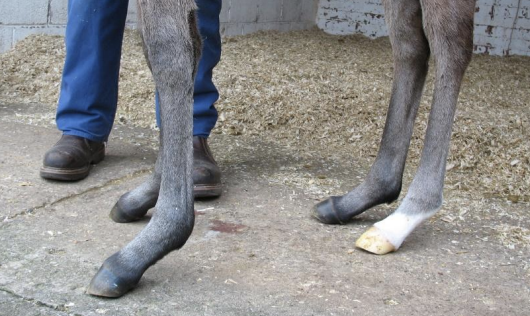
Valgus
Which ALD is lateral deviation distally?
Varus
Which ALD is medial deviation distally?
Cuboidal
Hypoplasia of what bones (category) is more common in premature/dysmature foals due to the high risk of crushing to these bones?
Laxity
Periarticular what condition is an ALD of young foals, giving them a windswept appearance?

Osseous
If manual correction of an ALD is not possible, then it originates in what type of tissues?
Radiography
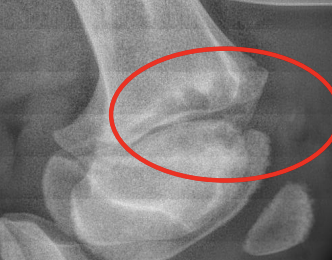
What diagnostic imaging technique is used in ALD to evaluate degree of cuboidal bone ossification, shape of skeletal components, point of intersection, and angle of deviation (less than 5 mild, 5-10 moderate, over 10 severe)?
Yes
Do mild bilateral carpal valgus (2-5 degree) and toe-out conformation occur very often and spontaneously resolve in foals?
Good
What prognosis does normal ossification with periarticular laxity have? Rest, exercise, and monitoring are important. Incomplete ossification also has this prognosis if there is protection of the bones and cartilage early one plus rest and helping the foal to stand.
No
Is external coaptation generally recommended in foals?
HCPTE
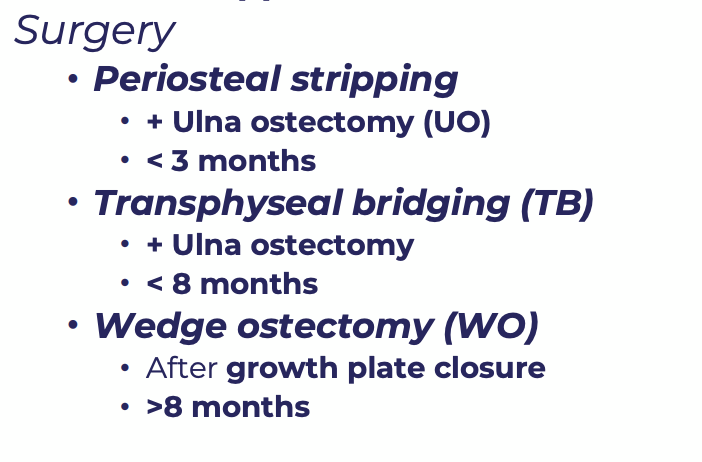
What surgery (abbreviated) is done to correct ALD in mild/early acquired or persistent cases by doing an inverted T incision above the physis, speeding growth, and avoiding overcorrection?

ALD
This chart refers to possible surgical treatments for what conditions (abbreviated)?

Valgus
Is valgus or varus more common in crias? This decreases the sale value.

Conservative
What type of treatment for cria ALD is done if under 3 months and involves splints and vitamin D supplementation?
Cria
These are the main surgical treatment techniques for ALD repair in which animals (specific)?
Flexural
What type of limb deformities refer to inability to fully extend the limbs, involving DIPJ, MCPJ, and carpus? They are more common in calves and can cause dystocia and preventing standing, ambulation, and suckling. Spontaneous improvement, splinting, bandaging, and farriery can be attempted. Management for foals can include IV oxytetracycline. If there is severe fibrosis, then euthanize.

Acquired
What type of flexural deformities occur due to disproportionate growth and longer bones, and diagnosis is with palpation and manipulation of the limb, or radiography? DIPJ can be type I or II. Management is with farriery, toe extension, heel wedge, early weaning, exercise, pain relief, and surgery.

DIP
Surgery on which joint is done if the toe is over vertical or doesn’t improve in 4-8 weeks? It includes ALDDFT desmotomy and farriery.
MCP
Surgery on which joint is done by transecting the ALSDFT and ALDDFT and corrective farriery?
Hyperextension
What limb deformity is also called flaccid tendons, and has unknown cause? It is more common in premature and dysmature foals with other conditions and fetlock/pastern drop. Most cases are due to muscular weakness and resolve rapidly. Bandaging may worsen laxity. Heel extensions are used in non-responsive cases. Prognosis is generally good.
Lateral
Luxation of the patella in what direction is most common in miniature breeds due to underdeveloped groove/ridge/patella? It can be uni or bilateral and there may be inability to stand. Surgery includes imbrication of the retinaculum and trochleoplasty. Prognosis is guarded and breeding is counterindicated.
Synovial
Sepsis/physitis of what structures usually happens secondary to failure of passive transfer or hematogenous spread? It involves one or multiple limbs and can present with pyrexia, dullness, stiffness, swelling, and heat. Management includes blood culture, joint flush, managing other conditions, and fair/good prognosis if only in this location, but poor/guarded if involving multiple joints.