Lecture 15: Pain Management of the Dental Patient
 Call Kai
 Learn
Learn Practice Test
 Spaced Repetition
 Match
Match Flashcards
 Knowt Play
1/45

There's no tags or description
Looks like no tags are added yet.
Name | Mastery | Learn | Test | Matching | Spaced | Call with Kai | Chat |
|---|
No analytics yet
Send a link to your students to track their progress
46 Terms
- acute pain ID and management --> move rapidly to period of healing and return to function
What is the goal of pain management for dental patients?
- projection
- transmission (maxillary N or mandibular N)
- transduction
What parts of the pain pathway do we target with local blocks?

- activate proportional to stimuli in the normal state
- pain generates an intense stimulus and then triggers as proportional response in CNS
How do pain receptors work normally?
- increased sensitivity (lowers threshold)
- budding of new receptive terminals
- receptive field expansion
- recruitment of previously quiescent nociceptors (silent nociceptor)
How do pain receptors change with repeated stimuli?
- repeated and amplified stimulus leading to axonal, spinal cord, brain stem, thalamic and cortical changes
How does chronic pain develop?
- how quickly/effectively initial pain is treated
- degree of nerve injury/CNS injury
- secondary healing problems from initial injury (infection)
- degree of anxiety/depression/fear
Chronic/maladaptive pain is hard to treat. What should you be aware of when treating it?
- minimize magnitude and duration of signal generated
- modulate neuroplasticity away from reactive/maladaptive and toward healing/adaptive
How do analgesic interventions help with managing chronic/maladaptive pain?
- nervous system has a lot of reserve capacity, but heals badly
What is the concept of neuroplacisity?
- implement gentle handling
- appropriate positioning
- decrease stress
What should be the first step of treating pain?
- opioids (best for acute pain)
What is the first line of treating pain?
- centrally and peripherally to decrease the magnitude of the acute pain signal
How do opioids work to treat pain?
- extremely effective analgesics and anti-inflammatory
- few contradictions for short term use
- work well with opioids = allows for opioid dose reduction
What are NSAIDs good for in regards to treatment of pain?
- once the P is stabilized = not in Ps that are cold, hypotensive, or with poor perfusion (renal/GI tox)
When should NSAIDs be given for pain?
- regional anesthesia
- reduce amount of inhalant due to multimodal approach
- continuing post-op analgesia without winding P up (pic)
What benefits do oral nerve blocks provide during dental procedures?

- A
- infraorbital N
Which needle indicates the rostral maxillary nerve block? What nerve does it block?
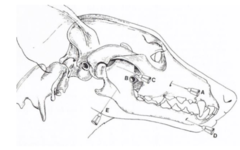
- D
- mental N
Which needle indicates the rostral mandibular nerve block? What nerve does it block?

- B/C (a few locations to give)
- caudal maxillary N
Which needle indicates the caudal maxillary nerve block? What nerve does it block?

- E
- inferior alveolar N
Which needle indicates the caudal mandibular nerve block? What nerve does it block?

- bone, teeth, intraoral soft tissue from the 3rd MX PM rostral to midline
What structures does the rostral maxillary nerve block impact?

- bone, teeth, intraoral soft tissue from the last molar rostral to midline
- ipsilateral soft/hard palatal mucosa and bone
What structures does the caudal maxillary nerve block impact?

- bone, teeth, intraoral soft tissue from the 2nd- 3rd MN PM rostral to midline
What structures does the rostral mandibular nerve block impact?

- bone, teeth, intraoral soft tissue from the 3rd molar rostral to midline
What structures does the caudal mandibular nerve block impact?

- 0.5% Bupivacaine/Ropivacaine
What is the drug of choice for oral nerve blocks?

- 5-15 mins onset
- 4-6 hour duration
Bupivacaine/Ropivacaine has what type of onset and duration?
- 2mg/kg
What is the max total dose of Bupivacaine/Ropivacaine for dogs and cats?
- Don't combine with lidocaine = shortens block duration
- No need to add buprenorphine = does not improve analgesic effect
What does not need to be added to Bupivacaine/Ropivacaine oral nerve blocks? Why?
- each site is based on size and weight of animal
- use clinical judgement
- do not exceed total calculated dose for all sites combined
How do you determine a dose (volume) for oral nerve blocks?

- 0.2 - 0.3 ml per site (0.25 ml)
What is the general dose of Bupivacaine/Ropivacaine given to small dogs cats for oral blocks?
- 0.3 - 0.6 ml per site (0.5ml)
What is the general dose of Bupivacaine/Ropivacaine given to a medium dog (15-25 kg) for oral blocks?
- 0.8 - 1.2 ml per site (1ml)
What is the general dose of Bupivacaine/Ropivacaine given to a large dog (26 - 40 kg) for oral blocks?
- 1.4 - 1.6 ml per site (1.5 ml)
What is the general dose of Bupivacaine/Ropivacaine given to a giant dog (40+ kg) for oral blocks?
- 1 ml or 3 ml syringes
- Bupivacaine/Ropivacaine
- needles 25g x 5/8 or 22 x 1/2
What equipment is need to perform oral nerve blocks?
- changes to ECG
- intralipid emulsion therapy
What can signify a local anesthetic toxicity? How would you treat?
- aspirate
What should you do prior to giving a nerve block?
- infraorbital foramen
What is the skeletal landmark for the rostral maxillary nerve block?
- middle mental foramen
What is the skeletal landmark for the rostral mandibular nerve block?
- infraorbital foramen
- rostral maxillary nerve block
What is this structure? What block goes here?

- find/palpate the infraorbital foramen just dorsal to the distal root of the 3rd Max PM
- advance needle just rostral to infraorbital foramen opening parallel + adjacent to the maxillary bone in a rostral-caudal direction
- needle should rest just inside the canal
How do you perform a rostral maxillary nerve block?
- brachycephalic breeds
- short infraorbital canal allows agent placed rostrally to travel caudally
Which breeds to not require a caudal maxillary nerve block? Why?
- insert needle in a ventral to dorsal direction into the soft palate mucosa where it meets the bone just caudal to the 2nd mandibular molar
- advance needle no more than 3-5 mm ensuring the tip rests directly under the nerve
How do you perform a caudal maxillary nerve block?
- small dogs and cats = hard to do due to limited ability to access nerve
Who do we not often perform the rostral mandibular nerve block in? why?
- retract the mandibular labial frenulum ventrally
- advance the needle slightly (~15 degrees) ventral and caudal to enter the foramen
How do you perform a rostral mandibular nerve block?
- palpate the mandibular foramen
- direct the needle through the skin toward the lingual aspect of the mandibular body.
- palpation the needle tip to ensure contact with the bone
- tip should rest just ventral to where the inferior alveolar nerve
How do you perform a caudal mandibular nerve block, using an extraoral approach?
- opioids
- ketamine/memantine (NMDA antagonist)
- gabapentin (oral)
Other than oral nerve blocks what other meds can be given to a dental anesthetic patient to help with pain?
- attenuates excitatory neurotransmitters in brain and SC
- helps prevent and Tx CNS sensitization
- prevents and reverse opioid tolerance/hyperalgesia
How does ketamine/memantine (NMDA antagonist) help with pain?
- not an analgesic --> an ANTI--HYPERALGESIC
How does gabapentin help with main?
