Psychology Chapter 6: Classical Conditioning and Learning
 Call Kai
 Learn
 Practice Test
 Spaced Repetition
 Match
 Flashcards
 Knowt Play
1/26

There's no tags or description
Looks like no tags are added yet.
27 Terms
What is learning?
The acquisition, from experience, of new knowledge, skills, or responses that results in a relatively permanent change in the state of the learner.
What is habituation?
A general process in which repeated or prolonged exposure to a stimulus results in a gradual reduction in responding.
What is sensitization?
A simple form of learning that occurs when presentation of a stimulus leads to an increased response to a later stimulus.
What is classical conditioning?
A type of learning that occurs when a neutral stimulus produces a response after being paired with a stimulus that naturally produces a response.

Who discovered classical conditioning?
Ivan Pavlov.
What is an unconditioned stimulus (US)?
A stimulus that elicits an unconditioned response (UR) without previous conditioning.
What is an unconditioned response (UR)?
An unlearned reaction to an unconditioned stimulus (US) without previous conditioning.
What is a conditioned stimulus (CS)?
A previously neutral stimulus that becomes conditioned through repeated pairings with an unconditioned stimulus (US).
What is a conditioned response (CR)?
A learned reaction to a conditioned stimulus (CS) that occurs because of repeated pairings with an unconditioned stimulus (US).
What is the neutral stimulus (NS)?
A stimulus that, before conditioning, does not bring about the response of interest.
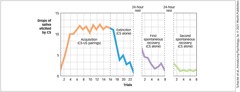
What is the acquisition phase in classical conditioning?
The initial learning phase when the CS and US are presented together.
What does generalization mean in classical conditioning?
The CR is observed even though the CS is slightly different from the CS used during acquisition.
What is discrimination in classical conditioning?
The capacity to distinguish between similar but distinct stimuli.
What is extinction in classical conditioning?
The gradual elimination of a learned response that occurs when the CS is repeatedly presented without the US.
What is spontaneous recovery?
The reappearance of a previously extinguished conditioned response (CR).
What is higher-order conditioning?
A new conditioned stimulus (CS) is created by pairing it with a previously conditioned stimulus (CS).
In the example of a pregnant woman and morning sickness, what is the unconditioned stimulus (US)?
Morning sickness (the biological cause of nausea).
In the same example, what is the conditioned response (CR)?
Feeling sick/nauseated when driving by the fast food restaurant.
In the example of the man and his grandmother's cookies, what is the unconditioned response (UR)?
Feeling happy and comforted.
In the same example, what is the conditioned stimulus (CS)?
The smell of chocolate chip cookies (after grandma's visits).
What is the role of repeated pairings in classical conditioning?
They help establish the association between the neutral stimulus and the unconditioned stimulus.
What happens during the extinction phase?
The conditioned response declines and eventually is eliminated when the conditioned stimulus is presented without the unconditioned stimulus.
What is the significance of the Little Albert experiment?
It demonstrated classical conditioning of emotional responses in a child.

What is second-order conditioning?
A type of learning whereby a CS is paired with a stimulus that became associated with the US in an earlier procedure.
What is the effect of generalization on discrimination?
The more an organism shows generalization, the less they show discrimination, and vice versa.
What is an example of spontaneous recovery?
Experiencing anxiety again while watching a movie that reminds you of a previous stressful event.
What is the relationship between the conditioned stimulus and the conditioned response?
The conditioned stimulus elicits the conditioned response due to its association with the unconditioned stimulus.