e7 practice assignment
 Call Kai
 Learn
 Practice Test
 Spaced Repetition
 Match
 Flashcards
 Knowt Play
1/26

There's no tags or description
Looks like no tags are added yet.
27 Terms

From question → “Select all the code snippets that correspond to correct Python syntax and which will run without raising an error.”
Is this option correct Python syntax or no?
Yes. It runs through the for loop 6 times, with 0 + 0 + 0 + 1 + 1 + 1.
Print is also nicely closing everything.

From question → “Select all the code snippets that correspond to correct Python syntax and which will run without raising an error.”
Is this option correct Python syntax or no?
Yes, it runs through all three numbers and since the end number is zero, the “ZeroDivisionError” catches it.

From question → “Select all the code snippets that correspond to correct Python syntax and which will run without raising an error.”
Is this option correct Python syntax or no?
No. The range of the list would be (1,4) and since the three numbers have indexes “0, 1, 2".
When i = 3, trying to access AQI[3] throws an IndexError: list index out of range because valid indices for this list are only 0, 1, 2. Note that the except block only catches ZeroDivisionError, not IndexError

From question → “Select all the code snippets that correspond to correct Python syntax and which will run without raising an error.”
Is this option correct Python syntax or no?
Yes. It runs through the command again, giving 0 + 0 + 0 + 1 + 1 + 1 = 3.
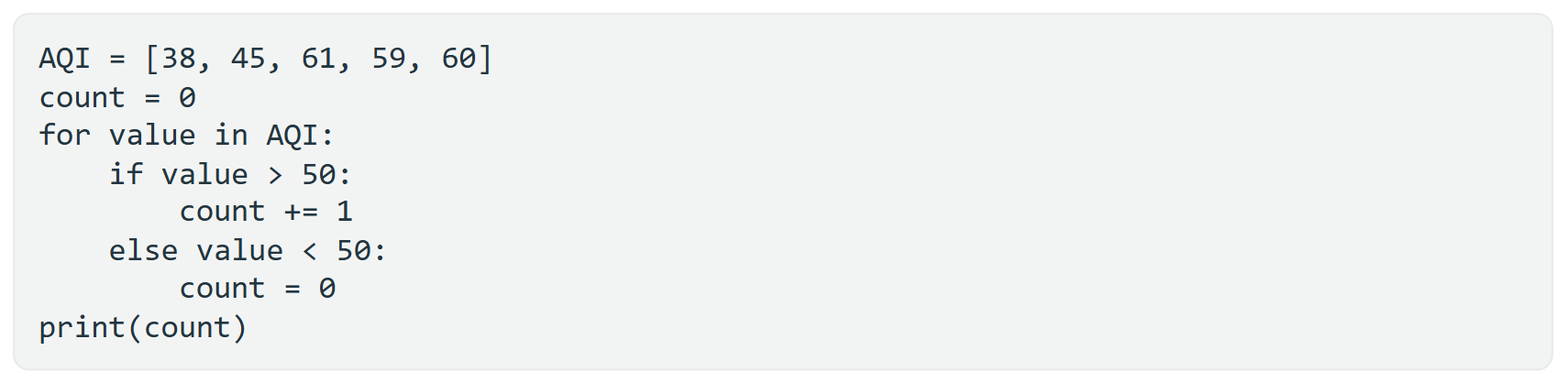
From question → “Select all the code snippets that correspond to correct Python syntax and which will run without raising an error.”
Is this option correct Python syntax or no?
No. You cannot put a condition after else! In Python, it must be elif value < 50:, or just else:. Writing else value < 50: throws an immediate SyntaxError.

From question → “Select all the code snippets that correspond to correct Python syntax and which will run without raising an error.”
Is this option correct Python syntax or no?
Yes. Else has a colon after it!

From question → “Select all the code snippets that correspond to correct Python syntax and which will run without raising an error.”
Is this option correct Python syntax or no?
Python does not have a log() function. Even if you imported math.log or numpy.log, Python standard lists do not support element-wise math directly like log([38, 45, ...]) (that's a MATLAB feature or a NumPy array feature). Running this gives a NameError (or TypeError)
What does a ; mean in MATLAB?
In MATLAB, a semicolon has two main uses:
Suppress Output: When placed at the end of a line or statement, it runs the code and saves the variable, but hides the result from appearing in the Command Window.
Row Separator / Command Separator:
Inside brackets for arrays or matrices, it separates rows.
What does i mean in Python?
In Python, i does not have a special built-in meaning or reserved status; it is simply a standard variable name.
Does MATLAB have +=?
No.
% Instead of x += 5,
x = x + 5;
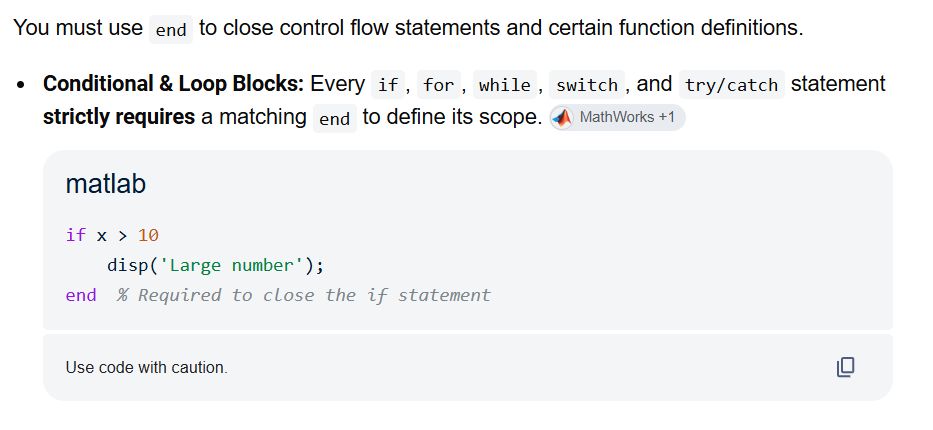
When do you use “end” in MATLAB?
Can you multiply lists in Python?

Python:
ans = 5 % 2
1
Python:
ans = [0, 1, 0, 1] * 2
[0, 1, 0, 1, 0, 1, 0, 1]
Just repeats it!
Python:
ans = [0, 1, 0, 1] / 2
Error
Python:
ans = [0, 1] + [1, 0]
[ 0, 1, 1, 0 ]
Just concatenates (glues) together!
Python:
ans = [i+1 for i in range(5)]
[ 1, 2, 3, 4, 5 ]
Range includes everything BUT the last number, which is 6.
So (0,1,2,3,4) + 1 gives that
Python:
ans = 1 + '2'
Error
MATLAB:
ans = 5 % 2
Error OR 5
MATLAB:
ans = [0, 1, 0, 1] * 2
[0, 2, 0, 2]
MATLAB:
ans = [0, 1, 0, 1] / 2
[0, 0.5, 0, 0.5]
MATLAB:
ans = [0, 1] + [1, 0]
[1, 1]
MATLAB:
ans = [2, 3] .^ [1, 2]
[2, 9]
The .^ operator means element-wise exponentiation (power), NOT multiplication!
MATLAB:
ans = [2, 3] > [1, 2]
[1, 1]
Is 2 > 1? Yes (
1/ true).Is 3 > 2? Yes (
1/ true).
MATLAB:
ans = 10:-2:2
[10, 8, 6, 4, 2]
The syntax start:step:end starts at 10, steps down by -2 each time, and stops at 2.
MATLAB:
ans = [138, 153, 147, 160]
ans(ans < 150) = 0
Logical Indexing
[0, 153, 0, 160]
It finds all values less than 150 (138 and 147) and replaces them with 0.
The highest value for an individual digit that can be used in the base-6 number system is
