BC Unit 5
 Call Kai
 Learn
 Practice Test
 Spaced Repetition
 Match
 Flashcards
 Knowt Play
1/13

There's no tags or description
Looks like no tags are added yet.
14 Terms
Rolle’s Theorem
Consider y=f(x) from a<=x<=b
Must be continuous
Must be differential
If f(a)=f(b)=0 → Exists at least 1 value C such that a<c<b, where f’(c)=0
Mean Value Theorem
Consider y=f(x) from a<=x<=b
Must be continuous
Must Be Differentiable
Then, there must exist at least c value where
f’(c)=( f(b)-f(a) )/( b-a )
MVT Corolaries
f’(x) = g’(x) → f(x)=g(x)+c
f’(x)=0 → f(x)=0
If y=f(x) is Continuous & Diffable, (from a<=x<=b) & f(a) & f(b) have different signs, f’ is never between a & b)
will always rise or always fall
First Derivative Test
Solve for x when f’(x)=0
points given are maxs/mins
Use number line test
Second Derivative Test
Find maxs/mins using f’(x)=0
Plug values into f’’(x)
if f’’(x)>0, it is a minimum
if f’’(x)<0, it is a maximum
Characteristics of Logistic Curve
Grow slowly at first, then experience a period of rapid growth, and eventually slow down
Appropriate Procedure for Word Problem
Define variables/draw picture
Write appropriate equations
Take the derivative (if needed) & solve.
Check work & give units
Area of equilateral triangle
√3/4 s2
Regular Hexagon Area

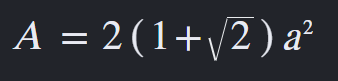
Regular Octagon Formula
Linearization Equation
Based on 2nd Definition of Derivatives
L(x)=f’(a)(x-a)+f(a)
more or less slope intercept form with derivatives
Newtons Method
Numerical Technique for approximating a zero of a function
steps:
Write equation in form of f(x)=0
Define first approximation as x0, where x=0, or x0 is given
Use Recursive formula: xn-f(xn)/f’(xn)
how to simplify equations with “d”
replace d with dx, then take derivative of everything inside/multiplied to d