Genetics, Genomics, Evolution
 Call Kai
 Learn
Learn Practice Test
 Spaced Repetition
 Match
Match Flashcards
 Knowt Play
1/193

There's no tags or description
Looks like no tags are added yet.
Name | Mastery | Learn | Test | Matching | Spaced | Call with Kai | Chat |
|---|
No analytics yet
Send a link to your students to track their progress
194 Terms
Where do most errors in genetic information arise from?
DNA replication
How do dNTPs come together to form a chain?

What are 4 effects of the negative charge of the phosphate backbone of DNA?
1) Interactions with water make DNA stable in the cell
2) Interactions with protons attracts positively charged amino acids (His, Lysine, Arg)
3) Chromosome structure results from electrostatic repulsion
4) Allows us to do gel electrophoresis
What 3 amino acids are attracted to the phosphate backbone of DNA?
Histidine (H), Lysine (K), Arginine (R)
What carbon do nitrogenous bases attach to?
1’ carbon

Purines vs Pyrimidines
Purines = Bigger, 2-ring shape - Guanine, Adenine
Pyrimidines = Smaller, 1 hexagon - Cytosine, Thymine

What is the effect of pairing purines and pyrimidines in the DNA double-helix?
One is always smaller, and the other is always bigger, creating a consistent distance between the 2 strands
What is the strongest base pair?
G-C (3 H-bonds)
Why are weaker base pair interactions sometimes useful?
It takes less energy to break the bonds and perform certain biological processes on them
What direction to you read DNA strands?
5’ to 3’
What is the 5’ carbon on DNA?
The carbon directly outside the ring, on the phosphate backbone

Where is the 3’ Carbon on DNA?
The carbon connected to the hydroxyl group (bonded to phosphate in previous sugar in DNA polymer)

How does base pair content affect how quickly DNA denatures?
Higher percentage of Gs and Cs means it needs a higher temperature to denature/melt
Why is DNA more stable than RNA? 3 reasons
1) Double stranded (base pairing, stacking, protected coil)
2) Has no oxygen/hydroxyl on 2’ carbon, making it less reactive
3) Uses Thymine instead of Uracil. The extra methyl group makes it more stable
What comes first, transcription or translation?
Transcription
What is cDNA, and why does it exist?
A DNA complementary to mRNA created in-vitro with reverse transcriptase for tests like PCR, gene cloning, to study the mRNA/protein expression in a cell. Does not include introns or regulatory sequences.
Allows us to ask how MUCH of a gene is being transcribed under particular conditions, not just whether someone has a gene.
The tests are made for more stable DNA, so we make complementary DNA from the RNA for practicality.
What are two evolutionary advantages of DNA having thymine rather than uracil?
1) Thymine is more limited in its base pairing than uracil because of its methyl group
2) Uracil (without the methyl group) is recognized as damaged cytosine by DNA repair systems
Transcriptional Profile
The set of transcripts produced by a cell under particular circumstances.
Find out using cDNA to do RNA-seq and microarrays, for example
Sense Strand
Coding strand
Which DNA strand does mRNA have the same sequence as?
Coding/Sense Strand
Which DNA strand does mRNA have the complementary sequence as?
Template/Antisense strand
Antisense strand
Template strand
Which organism has a greater proportion of its genome transcribed: Human or Bacteria?
Bacteria - more than 90%, as they don’t have introns
What characteristics are true of all amino acids?
Polar
Contain nitrogen
The three-letter _1_ on _2_ is recognized by _3_ during _4_
1) Codon
2) mRNA
3) tRNA
4) Translation
Sort the following RNA molecules in descending order of size:
long noncoding RNA
mRNA
microRNA
microRNA (shortest)
long noncoding RNA
mRNA (longest)
At what stage does regulation of gene expression NOT occur?
Replication
At what stages does the regulation of gene expression occur?
Transcription, Translation, Splicing
Introns
Noncoding sections in a gene that are removed from mRNA during splicing, before translation
Exons
The coding parts of a gene that stay in the final mRNA to be translated into proteins
What techniques determine the transcription profile of a cell?
Microarray analysis, RNA-seq
What happens during electrophoresis?
DNA moves towards the positive pole because of the negative charge on phosphate
Hybridization
A single stranded probe (DNA or RNA fragment used as a starting material) is used to search complex mixtures of nucleic acid molecules for that specific fragment, using complementary base pairing.
The process to pair the complementary sequence of the probe with its target is hybridization.
microRNA
Initially made as a transcript of about 120 nucleotides, but processed to a functional molecule of only 22 nucleotides.
Reduces expression of their target genes
Types of functional RNA
mRNA, tRNA, rRNA (ribosomal), microRNA, long non-coding RNA
Long ncRNA (3 functions)
Longer than 200 bases, to 1000. Has diverse functions that are not totally understood, including regulating chromatin structure, DNA replication, transcription initiation, and general cell function regulation.
What are most geneticists talking about when they speak of gene regulation?
Regulation of Transcription/initiation of transcription
ORF
Open reading frame - the length of DNA or RNA that has no stop signals in it, usually coding for an amino acid sequence
TSS
Transcriptional Start Site/Core Promoter

Core Promoter/TSS
Where basic transcription machinery assembles.
Regulatory region needed for transcription to occur - defines if a gene can be transcribed
Can include the TATA box

CRM
cis-Regulatory Module. AKA a regulatory region for specificity of transcription, generally upstream of the coding region/core promoter.
Regulates where, when a gene is transcribed, and how strongly it is expressed.
Contains sequence-specific binding sites for transcription factors
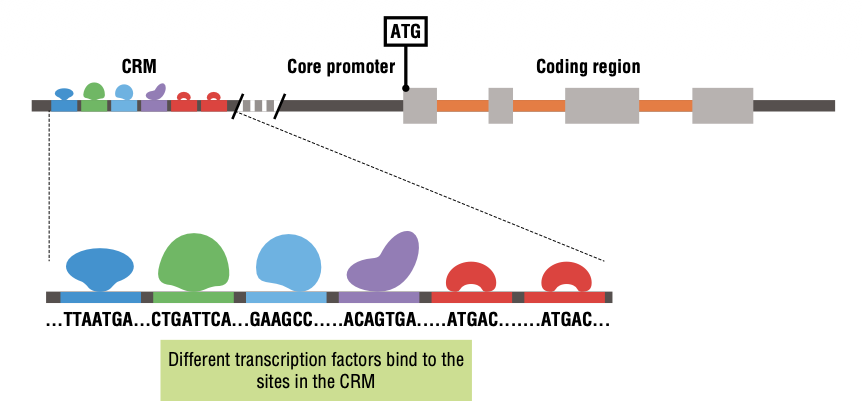
Transcription factor
A protein that binds to DNA and regulates transcription of other genes or itself. 5-10% of genes in a genome are transcription factors
Micro-arrays
Used to find transcription profile/expression profile
Single-stranded sequences complementary to a sequence unique to the desired gene are fixed onto a chip. Hybridizes with nucleic acids isolated from the organism for studying the gene and transcription
RNA-seq
Direct sequencing of cDNA to get the expression profile
Nucleobase
Base itself (ATCG)
Nucleoside
Nucleobase + Sugar
Nucleotide
Nucleoside + Phosphate
How do environmental factors play a role in phenotype?
The state of a cell affects gene expression/expression profile
N-Terminus
Amine backbone, 5’ end of mRNA
C-Terminus
COOH, 3’ end of mRNA
Is genetic information static?
NO - it is dynamic, gene regulation changes over time/environments. Individuals can be different even if they have the same genetic code
Housekeeping genes
Like GAPDH: Required for basic needs of cell in response to stress. Helps change and maintain metabolism, so expression is universally pretty similar across tissues
What did the sea turtles experiment tell us?
RNA-seq was used to look at genes involved in sex development at different temperatures. Gene expression changed in response to temperature at certain stages in development.
Shows that there is some sort of gene regulation, and it is dynamic.
Where does protein translation start?
AUG (start codon)
In what direction is DNA made?
5’ to 3’
In other words, each new nucleotide is added to the 3’ end, and becomes the new 3’ end.
Stop Codons
UAA, UAG, and UGA
In what direction is DNA read?
3’ to 5’
In what direction is mRNA read?
5’ to 3’
How many reading frames do nucleic acids have?
3
What features are in the regulatory region of a gene?
CRM, promoter, enhancers/silencers
What features are in the coding region of a gene?
Start/stop codons, Un-translated regions (UTRs), introns, exons
What eukaryotic RNA polymerase transcribes:
tRNA
siRNA
rRNA
mRNA
RNAPIII
RNAPIV
RNAPI
RNAPII
What type of RNA does each RNA polymerase transcribe:
RNAPI
RNAPII
RNAPIII
RNAPIV
rRNA
mRNA
tRNA
siRNA
What happens during the elongation transcription stage?
RNA polymerase pauses
What happens during the initiation in eukaryotes transcription stage?
TBP binds to DNA
What happens during the initiation in bacteria transcription stage?
Sigma recruits RNA polymerase
What happens during the termination transcription stage?
Hairpin structures block RNA polymerase
What are five components of the pre initiation complex?
General transcription factors
RNA polymerase II
TFIID
TBP (sort of separate)
Mediator complex
What is the function of the TATA box?
TFIID binds to TATA as part of transcription initiation
What is one effect of a long 5’ UTR?
More translational regulation
What is one factor in transcriptional regulation in bacteria? How is it different from in eukaryotes?
Different sigma subunits can bind to different promoters.
In Eukaryotes, TFIID binds to promoters of all protein-coding genes.
What are two factors involved in controlling transcription specificity in eukaryotes?
Master regulators
Effectors
What is the most common binding sequence for a particular transcription factor?
Consensus sequence
Transcription factors cluster together at the [A], which integrates inputs from multiple transcription factors. Binding sites that are involved in activating gene expression are [B]. Binding sites are [C] and transcription factors are [D]. Components of a gene are [E] and can be exchanged.
A. CRM
B. Enhancers
C. In cis
D. In trans
E. Modular
What is a reporter gene?
A gene that encodes a protein that can easily be followed to investigate promoter activity
What is one example of a master regulator?
Hox genes - control for transcription of a large number of genes, defining the head-tail development of the body.
What are three components of transcription factors
DNA binding domain
Activation domain
SOMETIMES Zinc finger motif
What is it called when the binding of one transcription factor increases the likelihood of the binding of another transcription factor?
Cooperative binding
Methylation of histone protein is associated with…
Chromatin that is open to transcription
What do histone modifications do?
They affect how tightly DNA is wound around the protein, which affects accessibility of genes to transcription factors
What is the role of the Mediator complex?
Essential for transcription: Facilitates interactions between transcription factors and RNAPII for initiation at promoter:
Part of the Mediator complex interacts with RNAP II and the general transcription factors required for transcriptional initiation at the promoter.
Another part of the Mediator complex interacts with transcription factors bound to their sequences at distant CRMs.
In rho-[A] termination, a [B] binds to a [C] rich region of the transcript and unwinds the RNA from the DNA. In rho-[D] termination, a [E] rich region of the transcript makes a [F], which blocks polymerase from carrying out further transcription.
A. Dependent
B. Protein
C. Cytosine
D. Independent
E. GC
F. Hairpin
What are four modifications that can occur from precursor mRNA to mature RNA?
3’ polyadenylation (increases stability in euks, helps with degradation in bacteria)
5’ guanine cap (increases stability in euks for transport out of nucleus)
Removal of Introns
Splicing of exons
Spliceosome
Protein complex that removes introns and splices exons. Recognizes splice site using base complementarity.
mRNA
Carries information for amino acid sequence
tRNA
Interprets nucleic acid information into amino acid information
rRNA
Structural and catalytic RNA involved in protein synthesis
Xist
Non-coding RNA - transcription may be the triggering event/master regulator for inactivation
snRNA
Small Nuclear RNA: forms core of spliceosome for splicing of exons
microRNA
Negative regulation (like siRNA)
long ncRNA
Lots of functions we don’t know, generally regulates cellular processes
RNA interference is a laboratory technique that exploits the [A] molecular machinery. In RNA interference, a [B] molecule is introduced into the cell. This is cleaved by [C] and processed into [D]. This can then become incorporated into the [E] complex and used as a guide to target the destruction of complementary [F].
A. miRNA
B. dsRNA
C. Dicer
D. siRNA
E. RISC
F. mRNA
Dicer
Enzyme that cuts long double-stranded RNA into short fragments, which are then loaded into RISC
RISC
RNA-Induced Silencing Complex that incorporates siRNA to silence specific genes
ALX1
Candidate gene associated with changes in shape of Galapagos finches’ beaks - regulates other transcription factors
Master regulator for craniofacial development
What enzyme transcribes a gene?
RNA polymerase II
TATA box
DNA promoter sequence in 25% of genes that helps signal where transcription should begin.
Located in core promoter.
TBP
TATA Binding Protein: subunit of transcription factor TFIID that binds to TATA sequence in genes that have a TATA box
TBP subunit binds first, and recruits the rest of RNAPII (and other general TFs) assembled into a pre-initiation complex.
What can happen when genes have more than one core promoter?
Alternative Promoter Usage: Using a different promoter can change the transcription start site and thus produce different RNA transcripts from the same gene.
ATG
Start codon for TRANSLATION